Check Your Knowledge!
Complete the quiz questions below using your chapter 7 notes.
Confucius says, “Education breeds confidence. Confidence breeds hope. Hope breeds peace.”
To be given after classwork.
Check Your Knowledge!
Complete the quiz questions below using your chapter 7 notes.
Confucius says, “Education breeds confidence. Confidence breeds hope. Hope breeds peace.”
What was China's first civilization and what was invented during that period?
Connect each period of Chinese History to one of it's major achievements.
| Draggable item | arrow_right_alt | Corresponding Item |
|---|---|---|
Qin Dynasty | arrow_right_alt | The first recorded dynasty of China. It mostly controlled just Northern China along the Huang He (Yellow River). The first Chinese writing system came into being during this time. Aristocratic rule was established in China by this dynasty. |
Han Dynasty | arrow_right_alt | Built forts and walls to defend against other kingdoms. Lasted for 1,000 years and was mostly stable. When it collapsed China entered the Warring States Period. |
Shang Dynasty | arrow_right_alt | No one dynasty had control over China. Many famous legends and stories in China are set in this time. |
Zhou Dynasty | arrow_right_alt | United China after the Warring States Period. Started construction of the Great Wall of China but did not finish it. It's one emperor was considered successful but brutal. He had the Terracotta Warriors built to protect his tomb. |
The Warring States Period | arrow_right_alt | Invented numerous technologies and systems enhancing the life of the average person in their empire. Began trading with the Western World along the silk road spreading goods and ideas. The majority of modern Chinese trace their culture and ethnicity to this time period. |
Why are Confucianism and Taoism considered philosophies rather than religions?
Separate the characteristics and beliefs below into Confucianism or Taoism.
Taught that duty to one's relationships was the most important thing above all else.
Practitioners followed Filial Piety.
Focused on maintaining balance in all things.
Taught that happiness comes from living a balanced life in harmony with nature.
Possibly founded by Lao-Tzu
Practitioners followed the principles of the Yin and the Yang.
Focused on bringing peace and stability to China.
Founded by Confucius
Confucianism
Taoism
In ancient Egypt the Pharaohs were gods. In Mesopotamia kings ruled by divine right.
What legitimized China's rulers?
Select below the qualities of a good ruler in Ancient China.
What is a monsoon?
What is the most popular religion in China that doesn't originate from China?
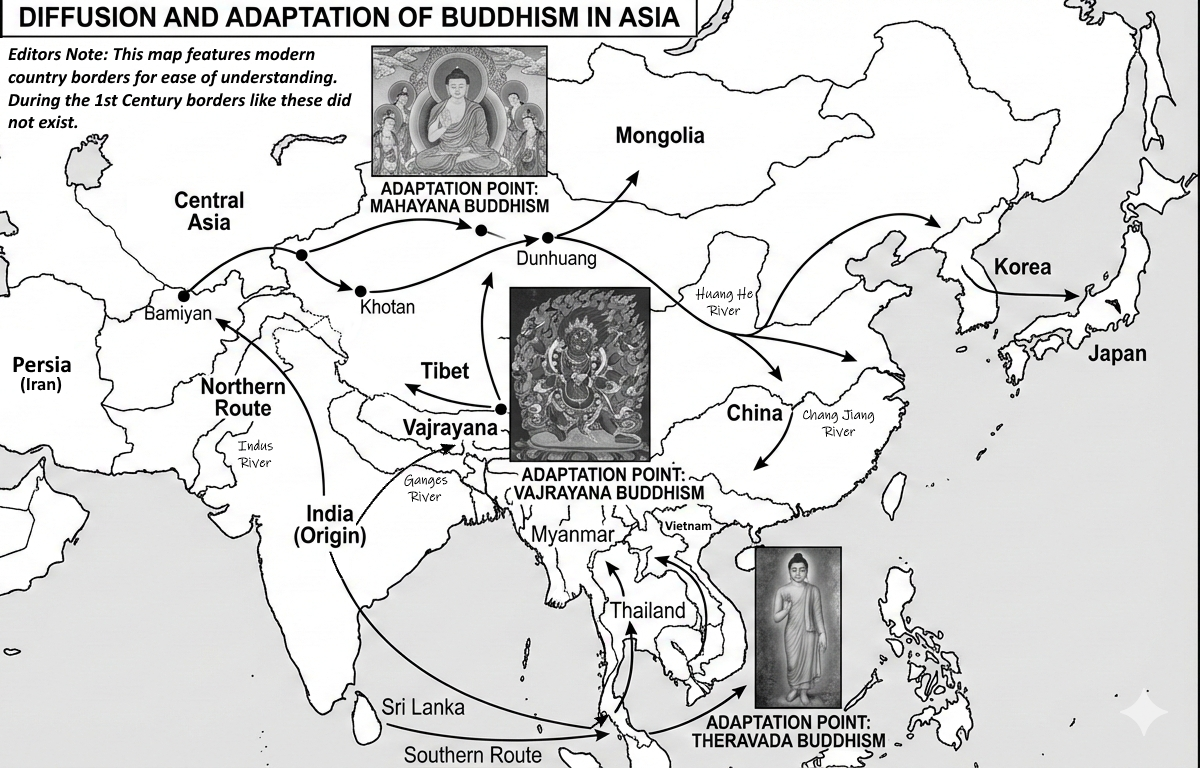
Accurately fill in the sentence frames to the right, using words from the map above.
Example: Buddhism started in India.
Buddhism started in . To get to , Buddhism traveled along the Northern Route through a city called Bamiyan. Mahayana Buddhism reached by traveling through the desert cities of Khotan and Dunhuang. After Buddhism reached China, it continued to spread east to the countries of and. Theravada Buddhism spread into Southeast Asian countries like and . A type of Buddhism called Vajrayana spread into the high mountains of .
Like so many ancient civilizations, the Chinese civilization formed alongside rivers.
Connect what you've learned so far about China and other ancient civilizations, such as Mesopotamia, Egypt, and India, to explain why ancient civilizations seem to form alongside rivers.
Answer in at least four sentences and in your own words.