Log in
Sign up for FREE
arrow_back
Library
Membrane Transport Passive Transport Practice
By Kate Turner
star
star
star
star
star
Share
share
Last updated over 1 year ago
24 questions
Add this activity
1
1
1
1
1
1
1
1
1
1
1
1
1
1
1
1
1
1
1
1
1
1
1
1
Question 1
1.
Which of the following are functions of the cell membrane?
Controls what goes in and out of the cell
Helps to maintain the cell's shape
Produces energy for the cell
Protects the cell
Contains the cell
Question 2
2.
What molecule is the majority of the cell membrane made up of?
Question 3
3.
Which of the following are also found in the cell membrane (in addition to the answer to the previous question).
Ribosomes
Nucleic acids
Proteins
Carbohydrates
Question 4
4.
Which of the following are ways to describe a cell membrane (or alternative names for the cell membrane) ...
Semipermeable
Phospholipid bilayer
Cell wall
Fluid mosaic
Plasma membrane
Question 5
5.
In a cup of salt water the salt would be referred to as the ...
Solute
Solvent
Neither
Question 6
6.
In a cup of salt water the water would be referred to as the ...
Solute
Solvent
Neither
Question 7
7.
Which type of membrane transport do not use energy to occur?
Active transport
Passive transport
Osmosis
Facilitated diffusion
Simple diffusion
Question 8
8.
Which of the following can move through a cell membrane without a protein channel?
A small and non-polar molecule
A large and non-polar molecule
A small and polar molecule
A large and polar molecule
Question 9
9.
Which of the following is true if a solute has reached dynamic equilibrium between the two sides of a membrane?
The solute has stopped moving
The solute is moving across the membrane at about an equal rate
The concentration of the solute is about equal on both sides of the membrane
The membrane no longer allows the solute to move in order to maintain equilibrium
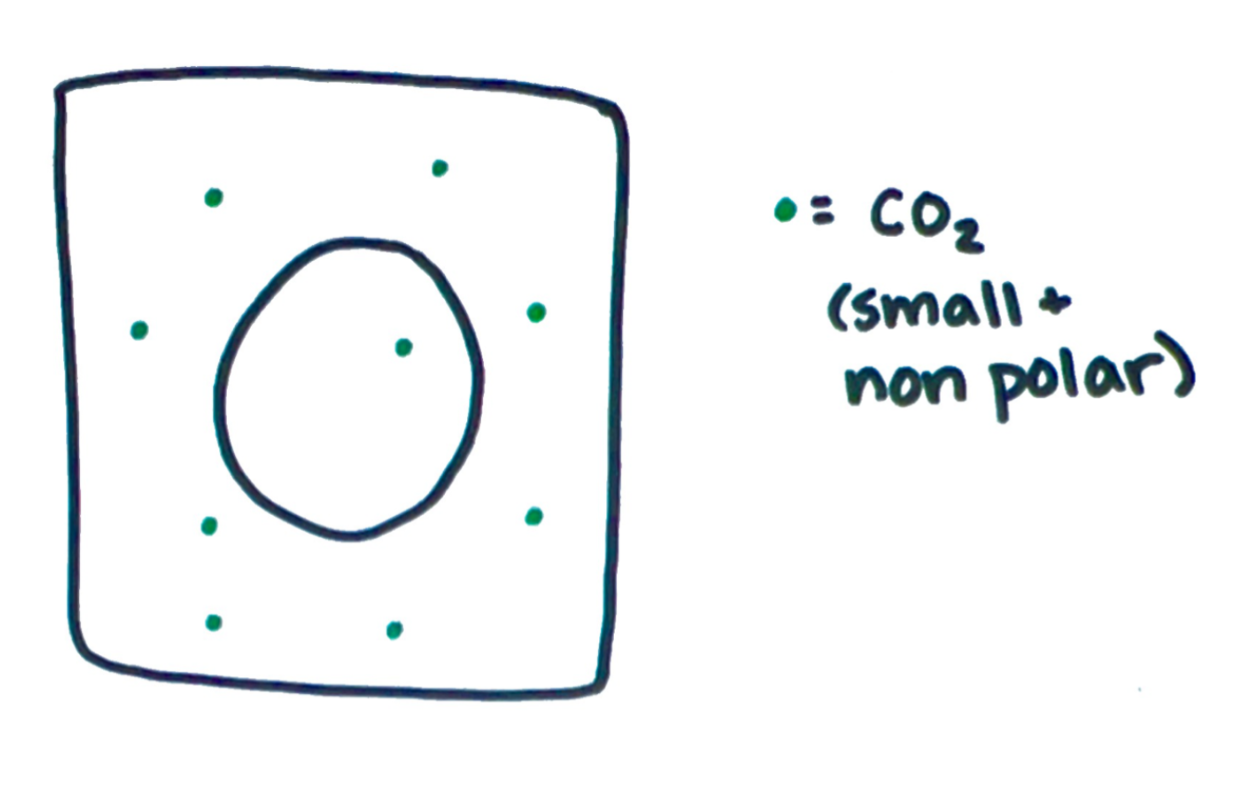
Use the next image to answer the questions that follow. Note: if there is not a protein channel drawn do not assume it is there.
zoom_in
Question 10
10.
To start, the inside of the cell is ____ for CO2.
Hypertonic
Hypotonic
Isotonic
Question 11
11.
Can the CO2 move on its own (without a protein channel)?
Yes
No
Question 12
12.
Where will the CO2 move?
All of the CO2 will move inside the cell
The CO2 will move inside the cell until it reaches dynamic equilibrium
All of the CO2 will move outside of the cell
The CO2 will move outside the cell until it reaches dynamic equilibrium
The CO2 won’t move so water will move
Question 13
13.
What type of membrane transport occurred?
Simple diffusion
Facilitated diffusion
Osmosis
"Regular" active transport
Endocytosis
Exocytosis
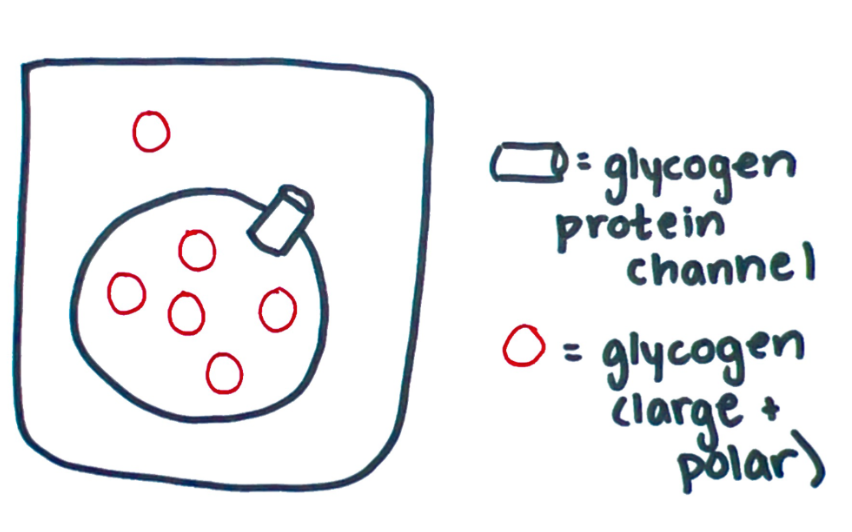
Use the next image to answer the questions that follow. Note: if there is not a protein channel drawn do not assume it is there.
zoom_in
Question 14
14.
To start, the inside of the cell is ____ for glycogen.
Hypertonic
Hypotonic
Isotonic
Question 15
15.
Can the glycogen move on its own (without a protein channel)?
Yes
No
Question 16
16.
Is there a protein channel for glycogen?
Yes
No
Question 17
17.
Where will the glycogen move?
All of the glycogen will move inside the cell
The glycogen will move inside the cell until it reaches dynamic equilibrium
All of the glycogen will move outside of the cell
The glycogen will move outside the cell until it reaches dynamic equilibrium
The glycogen won’t move so water will move
Question 18
18.
What type of membrane transport occurred?
Simple diffusion
Facilitated diffusion
Osmosis
"Regular" active transport
Endocytosis
Exocytosis
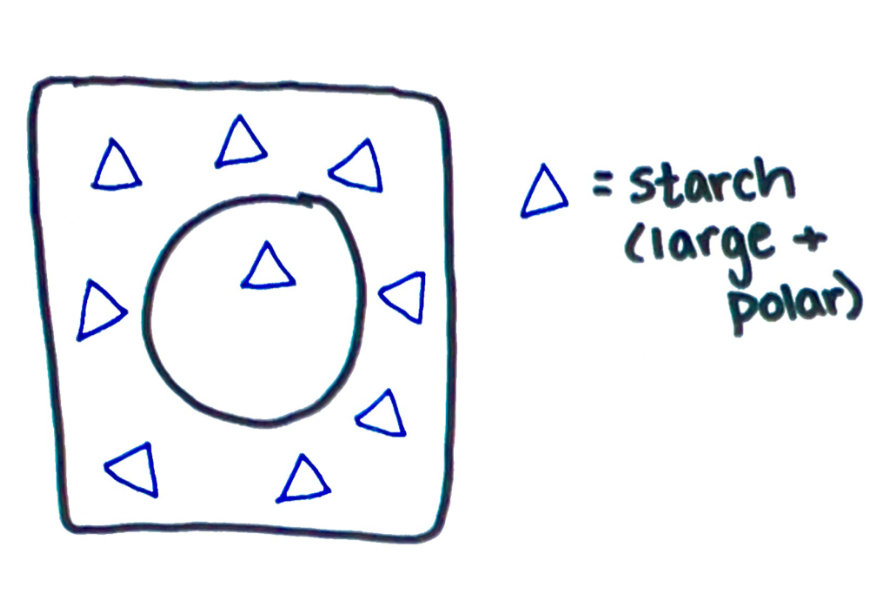
Use the next image to answer the questions that follow. Note: if there is not a protein channel drawn do not assume it is there.
zoom_in
Question 19
19.
To start, the inside of the cell is ____________ for starch.
Hypertonic
Hypotonic
Isotonic
Question 20
20.
Can the starch move on its own (without a protein channel?
Yes
No
Question 21
21.
Is there a protein channel for starch?
Yes
No
Question 22
22.
Where will the starch move?
All of the starch will move inside the cell
The starch will move inside the cell until it reaches dynamic equilibrium
All of the starch will move outside of the cell
The starch will move outside the cell until it reaches dynamic equilibrium
The starch won’t move so water will move
Question 23
23.
If water moves, will the cell shrink or grow?
Shrink
Grow
Question 24
24.
What type of membrane transport occurred?
Simple diffusion
Facilitated diffusion
Osmosis
"Regular" active transport
Endocytosis
Exocytosis