Synopsis: Leonardo da Vinci was born in 1452 in Italy. He lived during the time of the Italian
Renaissance. Science and art flourished then. Da Vinci was the definition of a "Renaissance man." To put it another way, he was a man of many talents. Da Vinci studied the laws of science and nature. These affected his work as a painter, sculptor, architect, inventor and engineer. His ideas have influenced countless artists.
Humble Beginnings
Leonardo da Vinci was born on April 15, 1452, in present-day Italy. He grew up in the small town of Vinci.annotation end That is where his name, "da Vinci," comes from.
He received little schooling. Around the age of 14, da Vinci began an apprenticeship
with the artist Andrea del Verrocchio in Florence. He learned many different skills, from metalworking to sculpture. At the age of 20, da Vinci started his own workshop.
"Renaissance Man" Emerges In Milan
After leaving Verrocchio's studio, da Vinci received his first paid art job in 1478. Three years later monks in Florence hired him to paint "Adoration of the Magi." He would never finish either job.
In 1482, Florentine ruler Lorenzo de' Medici commissioned da Vinci to make a silver lyre. It is a musical instrument like a harp. It was a gift for Ludovico Sforza, the ruler of Milan. After that, da Vinci asked Sforza for a job. He sent Sforza a letter touting his skills as an engineer. In it, he sketched war machines such as an armored tank propelled by a crankshaft and an enormous crossbow. The letter worked. Sforza brought da Vinci to Milan.
Da Vinci thought science and art were linked together. He began to examine dead human and animal bodies during the 1480s. He did this to more accurately sculpt and paint people. His drawings of organs and muscles are some of the first on record.
Da Vinci studied many subjects. He filled dozens of notebooks with illustrations and observations. Some of his sketches seemed to predict the future. He made drawings of machines resembling bicycles and helicopters. He even drew a flying machine that looked like a bat.
"The Last Supper" And Other Works
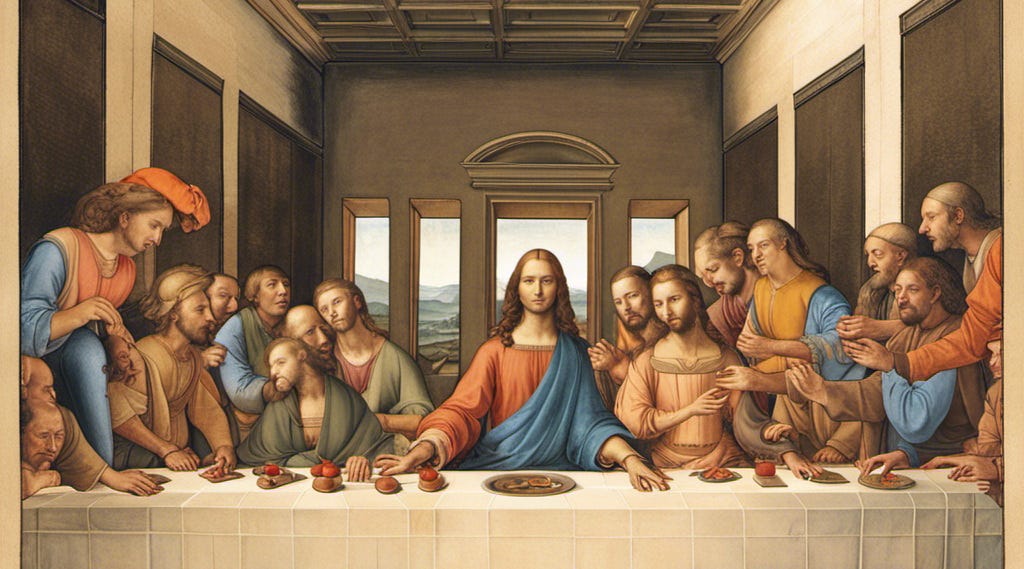
Da Vinci was paid to work on many projects during his time in Milan. Around 1495, Sforza commissioned da Vinci to paint "The Last Supper" in Santa Maria delle Grazie, a church in Milan. It took about three years to complete.
Sforza also hired da Vinci to sculpt a 16-foot-tall bronze statue of his father. With the help of students in his workshop, da Vinci worked on the statue for more than a dozen years, even sculpting a life-size clay model of it. In 1499, French forces overran Milan and destroyed the model. After that, da Vinci left the city.
Return To Florence And "Mona Lisa"
Eventually, da Vinci returned to Florence. In 1503, da Vinci started work on another large painting, "Battle of Anghiari." It was to be twice as large as "The Last Supper." He never finished it.
At the same time, he started working on his most well-known painting, the "Mona Lisa." For da Vinci, the "Mona Lisa" was never finished. He wanted it to be perfect.
Final Years
Leonardo returned to Milan in 1506. He worked for the same French rulers who had overtaken the city seven years earlier. Francesco Melzi, one of the students who joined his studio, would become da Vinci's closest companion.
Da Vinci left the city and moved to Rome in 1513. Giuliano de' Medici, Lorenzo de' Medici's son, gave da Vinci a monthly allowance and a home inside the Vatican. But he also gave da Vinci little work. Da Vinci devoted himself to math and science.
In 1515, France's King Francis I offered da Vinci the title "Premier Painter and Engineer and Architect to the King." Along with Melzi, he departed for France. There he continued his scientific studies. He died at the age of 67 on May 2, 1519.
Although da Vinci is known for his artistic talent, few paintings are attributed to him. Thousands of pages from his journals, however, have surfaced.