U0- The Nature of Chemistry

Last updated over 1 year ago
27 questions
Note from the author:
FYI: U0- The Nature of Chemistry = Chapter 1 Matter and Change in Book
Learning Objectives:
- To get to know Missy and Ragnar
- To understand the nature of Chemistry as a Science

Introducing Missy!


Hello grade 10 and welcome to Chemistry!
I am Missy. I will be your guide to the basics of Chemistry that you must know throughout this course!
I am excited to meet you all! Mr. Ahmad has told me so much about you.
You will ALL be responsible for my content.
Any time you see me, it means my work and information and tasks are ALL mandatory!

Introducing Ragnar!


Greetings, fellow students. I'm Ragnar. I bid you a warm welcome to your first Chemistry class.
While all of you will be dealing with Missy, not everyone will deal with me.
Mr. Ahmad will specify who deals with my questions, tasks, and information in addition to Missy's.

Chemistry is a Body of Knowledge

Before we begin with Chemistry, we need to understand what chemistry is.
Chemistry, very generally, is a body of knowledge.

But there are different types of "knowledges".


Chemistry is a Body of Knowledge


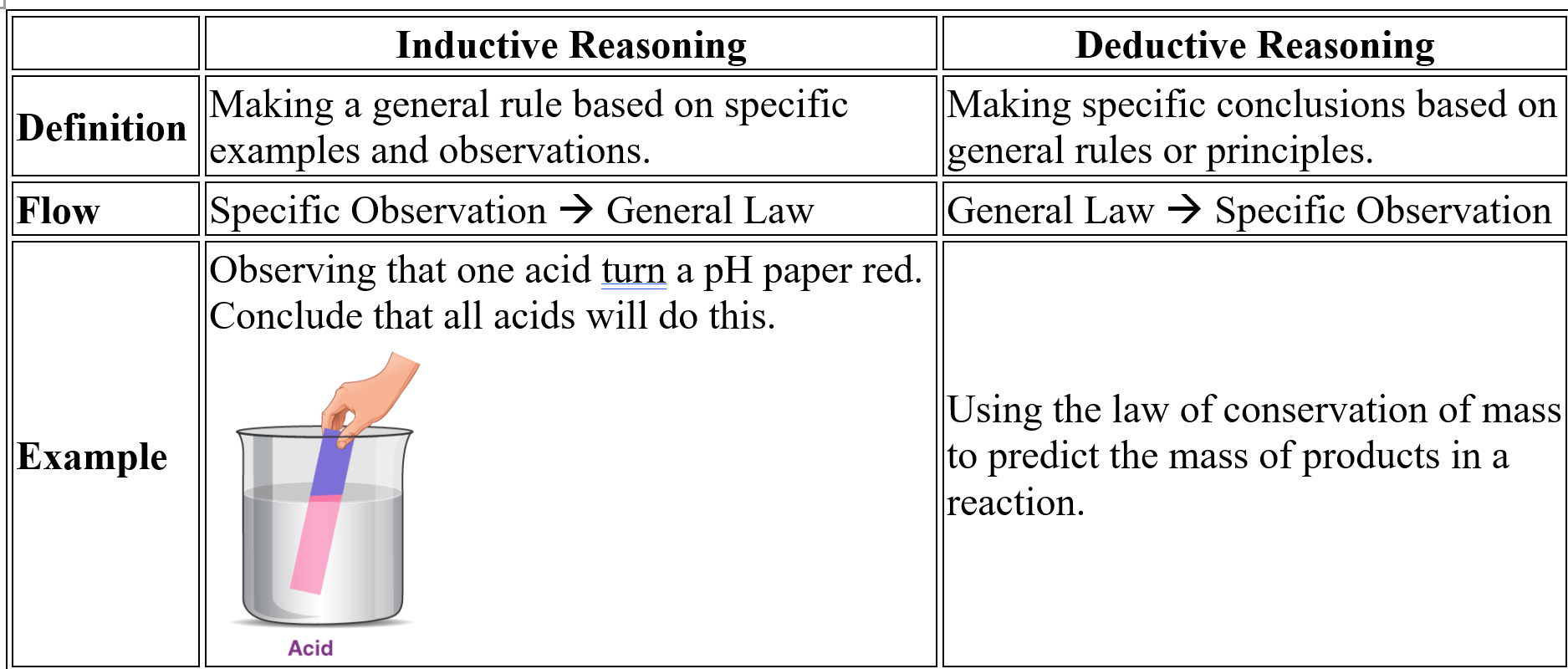
Math, for example, is grounded in deductive reasoning.
(Rule: The sum of all angles in ANY triangle is 180⁰.
Conclusion: the sum of all angles in THIS triangle is 180⁰).

Chemistry, on the other hand, is grounded in inductive reasoning.
(Observation: heating THIS sample of water to 100⁰C makes it boil.
Concluded Rule: so water boils at 100⁰C).

Chemistry is a Body of Knowledge

We know math by thinking about numbers and shapes and their relationships:
- for example: A Triangle = a closed 3-sided shape whose angles sum up to 180⁰
Ragnar: With math, the "Triangle definition" CANNOT be wrong.
It is impossible to REJECT that a triangle is a closed 3-sided shape.

We know Chemistry by observing things in the outside world and making generalizations:
- for example: it will rain tomorrow because rainclouds are forming today.

Ragnar: With chemistry, the statement that it will rain tomorrow CAN be wrong!
It is possible to prove that it won't rain tomorrow!
1

Explain the main difference between inductive and deductive reasoning in your own words.

1

Which of the following best describes inductive reasoning?

1

Which reasoning method is used when you start with a known theory and apply it to a specific case?

1

If a student observes that a metal reacts with an acid to produce hydrogen gas and concludes that all metals will react with acids to produce hydrogen gas, which type of reasoning are they using?

1

Give an example of how inductive reasoning might be used in a science experiment.

1

Describe a scenario in mathematics where deductive reasoning is essential.

1

Which of the following is an example of deductive reasoning in chemistry?

1

Which of the following is an example of a chemical observation?

1

Which of the following best describes chemistry?

1

How does chemistry differ from mathematics in terms of how we acquire knowledge?

Chemistry is an Empirical System

We saw before that Chemistry is a different type of knowledge than Math.

We can say that math is "Rational"
Math is "Rational" because it depends a lot on our logic and rationality.
Math statements is true INDEPENDANTLY of our observations of the world!
"A triangle has a sum of 180⁰" is true because our rationality demands it!
"A triangle has a sum of 180⁰" is true independently of anything we observe about the world!


Chemistry, however, is Empirical (fancy word!).
"Empirical": depends on our observation of the outside world.
Chemistry facts are true INDEPENDANTLY of what our rationality demands!
(you might think that the sea is blue, but the truth is it only reflects the sky!)
Chemistry facts are true BECAUSE of what we observe about the outside world.

1

Which of the following best describes why math is considered a "rational" system?

1

Which of the following scenarios best illustrates the empirical nature of chemistry?

1

Which of the following is an example of using empirical methods in chemistry?

1

Which of the following best explains why chemistry is considered an "empirical" system?

1

What does it mean for a fact in chemistry to be "empirical"?

1

Compare and contrast the nature of knowledge in mathematics and chemistry.


Chemistry is a Science

We now know that Chemistry is Empirical, but it is a special type of "empirical",

Chemistry is a Science.
It follows the rigorous "Scientific Method" (remember that?).

Other fields like Business/Management, in contrast, are Empirical, but they are not a science!
Business relies on observations, but it might not follow the same rigor of the Scientific Method. So business is not a Science!
1

Which of the following best describes why business is NOT a science

1

Which of the following best describes why business is empirical

1

Which of the following best describes why chemistry is considered a science?

1

What is a "Rational" body of knowledge? give an example.

1

What is an "Empirical" body of knowledge? give an example.

1

We know that Business/Management are "empirical", but they are not Sciences.
Explain.


What is Chemistry?

Chemistry is a field of science that studies of the properties of matter, including their interaction, energy, quantity, composition.

What does Chemistry ask?

Chemistry asks any question related to the properties of matter.
For example:
- What makes up material?
- What happens to a metal when it is heated?
- How do some substances absorb heat better than other substances?
1

Missy Question: Define Chemistry.

1

Missy Question: Write 2 questions about what a chemist would try to answer about a material called "Chemical X".

The Branches of Chemistry

1) Organic Chemistry: The study of substances that have Carbon-Hydrogen bonds
2) Inorganic Chemistry: The study of all other non-organic substances
3) Physical Chemistry: the study of physical laws in chemical reactions
4) Analytical Chemistry: the study of the quantification of matter
5) Biochemistry: the study of all chemicals included in living things
6) Theoretical Chemistry: the study of predicting the properties of new substances.
1

Missy Question: Match the following branches of science with their corresponding field of study

Draggable itemCorresponding Item
Organic Chemistry
The study of substances that have Carbon-Hydrogen bonds
Theoretical Chemistry
The study of all other non-organic substances
Biochemistry
the study of physical laws in chemical reactions
Inorganic Chemistry
the study of the quantification of matter
Analytical Chemistry
the study of all chemicals included in living things
Physical Chemistry
the study of predicting the properties of new substances.
1

Ragnar Question:
List 4 branches of Chemistry and define each briefly.

Why is Chemistry Important?


Chemists have made it possible to have:
- medications for healing illnesses
- purified metals for constructing machines,
- fertilizers for improving crop quality
- cleansers for improving sanitary conditions
- inks for writing
1

Missy Question:
List 3 chemical innovations that improve your everyday life. Answer in a full sentence.