1
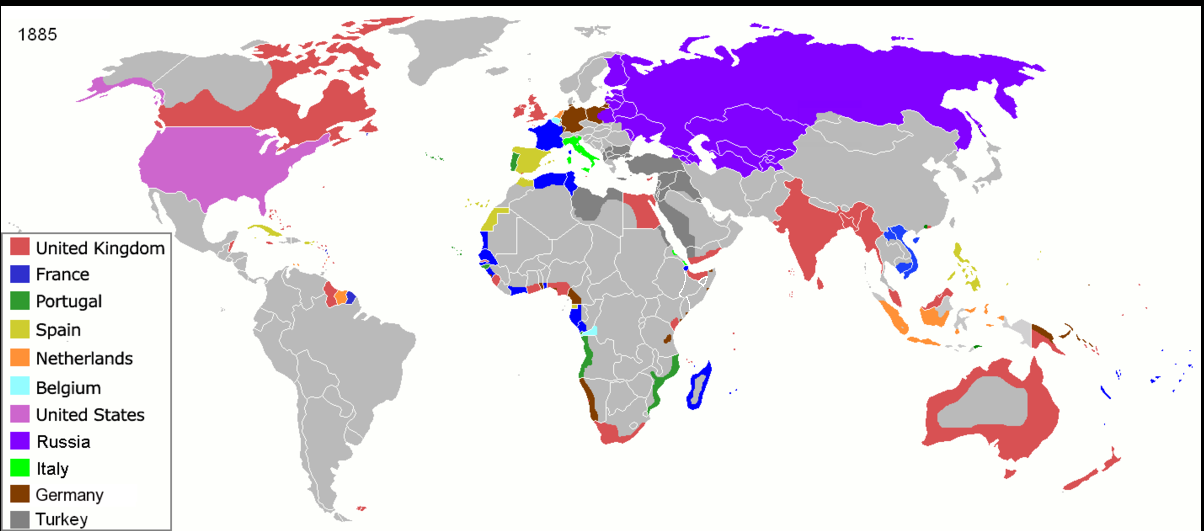
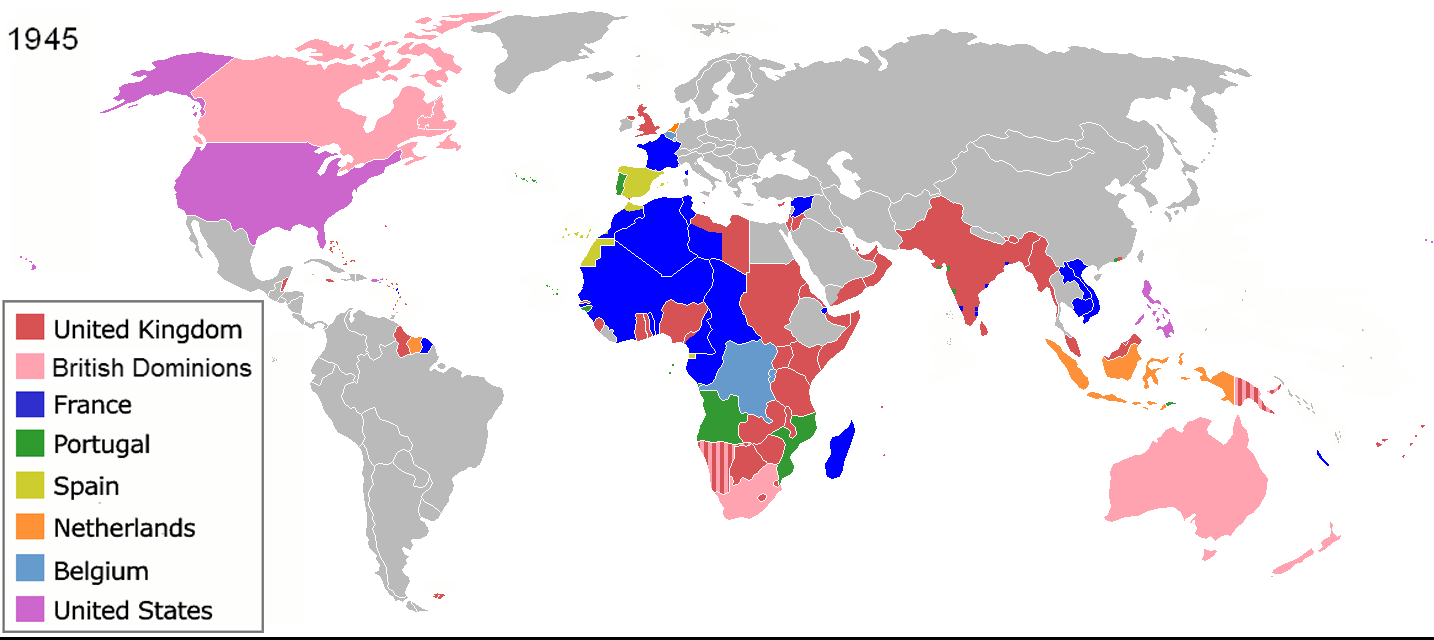
According to the maps of colonialism, from 1885 to 1945, colonialism mostly spread to:
According to the maps of colonialism, from 1885 to 1945, colonialism mostly spread to:
1
According to the maps of colonialism, from 1885 to 1945, colonialism mostly spread to:
The political landscape of our world has undergone significant transformations since the late 1800s. At that time, many nations were still ruled by empires, such as the British Empire, which had colonies around the globe. However, the turn of the 20th Century and particularly, world events like World Wars I and II dramatically altered these borders. These wars led to an era of decolonization beginning in the mid-1900s, where numerous countries gained independence. Changes to political borders continued into the late twentieth century and beyond with the breakdown of the Soviet Union in 1991 into multiple independent nations. Today's geopolitical order, with 195 recognized sovereign states, bears little resemblance to the political map of just a century ago. Notably, changes to political borders are still occurring today, influenced by economic conditions, conflict, and cultural shifts. Analyzing these changes allows us to understand the complexities and interplay of historical and contemporary geopolitical phenomena.
What significant events in the early 20th century dramatically altered political borders?
How does conflict contribute to soil degradation?
What environmental impact can result from producing war ammunition?
Which regions are prone to conflict due to soil degradation and why?
How can climate-induced water scarcity contribute to a geopolitical conflict?
Why might deforestation cause disagreements?
Match the supranational organization with the global issue it primarily tackles.
| Draggable item | arrow_right_alt | Corresponding Item |
|---|---|---|
European Union (EU) | arrow_right_alt | Worldwide health-related issues |
World Health Organization (WHO) | arrow_right_alt | Promote unity and development in Africa |
African Union (AU) | arrow_right_alt | Promote peace and stability in Europe |
Match the geographical area with its supranational organization.
| Draggable item | arrow_right_alt | Corresponding Item |
|---|---|---|
Eastern Europe | arrow_right_alt | African Union (AU) |
Sub-Saharan Africa | arrow_right_alt | World Health Organization (WHO) |
Global | arrow_right_alt | European Union (EU) |
Since the fall of communism, Eastern European nations have made remarkable strides in upholding human rights, particularly in areas such as freedom of speech, fair trial, and prohibition of torture. The transition to democracy has brought about significant improvements, indicating a positive trend towards respecting the UDHR.
Despite some success stories like South Africa, many nations in Sub-Saharan Africa continue to grapple with issues such as poverty, civil conflicts, and political oppression. These challenges hinder the effective implementation of the UDHR, leading to violations of human rights and widespread suffering among populations.
The extent to which nations implement the provisions of the UDHR depends largely on factors such as political stability, economic development, and societal attitudes towards human rights. Countries with stable governments, robust economies, and a culture of respect for human rights tend to fare better in upholding the principles of the UDHR.
What's the author's perspective on human rights implementation?
Match the key term with the appropriate definition.
| Draggable item | arrow_right_alt | Corresponding Item |
|---|---|---|
Nation-state | arrow_right_alt | The study of the effects of geography on politics and international relations |
Geopolitics | arrow_right_alt | A nation that stretches across borders and states |
Multi-state nation | arrow_right_alt | A sovereign state whose citizens are united by language and culture |
The "Universal Declaration of Human Rights" (UDHR) was adopted in 1948 by the United Nations with its primary goal being to establish fundamental human rights that should be universally protected. These include freedom of thought, religion, and expression; rights to work, health, and education; and freedom from torture and degrading treatment. However, the success of actualizing these provisions varies across societies. In Eastern Europe, there have been efforts to uphold these rights, though some areas still struggle particularly with freedom of expression and equal access to resources. For Sub-Saharan African societies, the challenge is even greater. Many nations still grapple with issues of poverty, health, inequalities, and education. Consequently, widespread implementation of the UDHR's provisions remains a work in progress. It is clear that while the UDHR provides standard guidelines, achieving these goals requires national efforts tailored to the unique realities and challenges of each society.
What is the primary purpose of the passage?
Match the geopolitical concept with its description.
| Draggable item | arrow_right_alt | Corresponding Item |
|---|---|---|
Borders | arrow_right_alt | An area of land under jurisdiction of a state |
Territory | arrow_right_alt | The authority of a state to govern itself |
Sovereignty | arrow_right_alt | The geographical boundaries of a state |
Match the term with its geopolitical impact.
| Draggable item | arrow_right_alt | Corresponding Item |
|---|---|---|
Globalization | arrow_right_alt | Policies and wars over natural resources |
Resource Scarcity | arrow_right_alt | Domination over indigenous population, resources and territory |
Colonialism | arrow_right_alt | Interdependence and interaction among states and nations |
What is a common long-term cause of border disputes?
What element can typically escalate civil war conflicts?
Match the following revolutions with their key advancements
| Draggable item | arrow_right_alt | Corresponding Item |
|---|---|---|
Second Agricultural Revolution | arrow_right_alt | Domestication of plants and animals |
First Agricultural Revolution | arrow_right_alt | Genetic modification and mechanization of agriculture |
Third Agricultural Revolution | arrow_right_alt | Introduction of new technologies and improvement of farming techniques |
Match the agricultural revolution with its impact on human civilization
| Draggable item | arrow_right_alt | Corresponding Item |
|---|---|---|
First Agricultural Revolution | arrow_right_alt | Increased food production, Industrial Revolution |
Second Agricultural Revolution | arrow_right_alt | Population boom, environmental concerns |
Third Agricultural Revolution | arrow_right_alt | Start of settled life, towns & cities |
The Green Revolution, which began in the 1930s-1940s in developed countries like the United States and spread outwards, brought about both positive and negative impacts globally. It increased agricultural productivity, reducing global hunger and poverty. However, it also caused environmental harm including soil degradation and water depletion, and increased income disparities among farmers. Similarly, the Gene Revolution offers solutions to various challenges like pest resilience and climate change, though it raises concerns about genetically modified organisms' impact on health and biodiversity. Both movements were driven by a need for food security and faced inroads and resistances in their dissemination due to health and environmental concerns, technology, policy, and social responses. Understanding these revolutions informs future agricultural advancements and their potential consequences.
What is the primary purpose of the passage?
According to the maps of colonialism, from 1885 to 1945, which countries lost colonial power?
What event in 1991 resulted in the creation of multiple independent nations?
What is the main argument presented in the passage?
What is the main argument presented in the passage?