Chapter 6 - Ancient India Essay

Last updated over 1 year ago
1 question
Below you will see three source documents.
Using these three documents write an essay to prove or disprove a claim.
In Science a claim can be tested and is called a hypothesis.
A hypothesis is an idea about the world that has not yet been tested.
Pick one of the following hypothesis to argue for or against with evidence.
Hypothesis 1 - Steppe; The original Indo-Europeans started somewhere in the Eastern European steppe lands and then migrated from there.
Hypothesis 2 - Farming; The original Indo-Europeans started somewhere in the South Caucasus. Some migrated. Their ideas and language spread wherever their style of farming spread.
Hypothesis 3 - Hybrid; The original Indo-Europeans started in the South Caucasus. Some migrated into Anatolia, Armenia, Albania, and Greece. Much later some migrated to the steppes where they spread out into Europe, Central Asia, and India.
Source 1
Secondary Source
Title: Language Family Tree
Author: The 3Seas Initiative
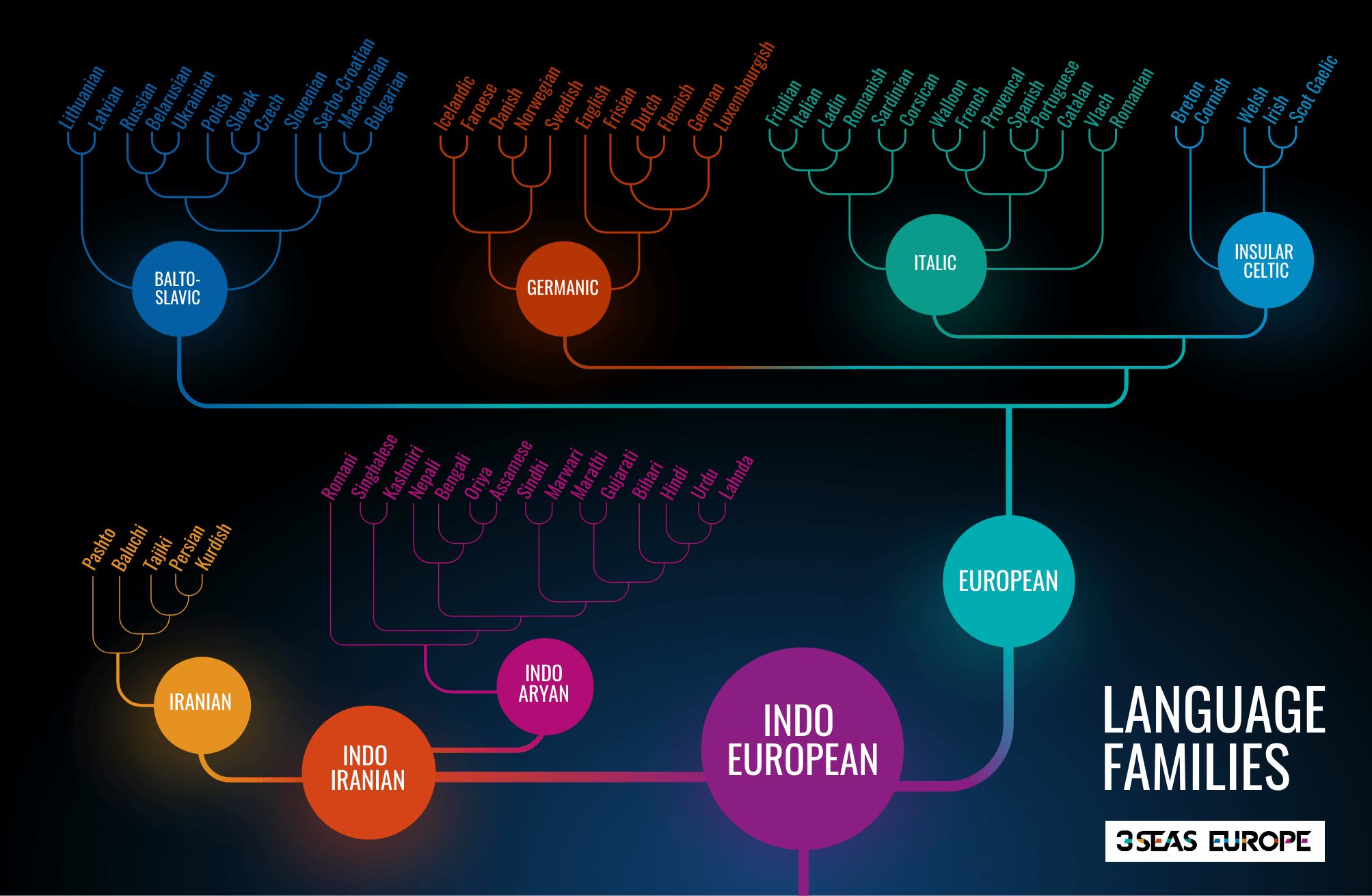
When the first tribes of people reached Europe, they migrated from the East. However, their journey did not simply end. You can just see that – groups of humans wandering the lands in search of better living conditions. Some groups adapted to a particular area, while others moved on. They needed to communicate effectively, and so languages started forming. They were similar between the tribes that lived nearby each-others and were growing apart from the ones who moved further away.
The Indo-European family of languages is prevalent in Europe. Some languages which belonged to this group are now extinct. Eight branches of the Indo-European language family are still alive and spoken today. The family gathers languages that all descend from one common language – Proto-Indo-European. Just let it sink in – dozens of languages can be traced to one common ancestor.
The topic is complicated and has been the center of many expert debates as we travel far back in time to find this common ancestor, namely sometime in the Neolithic or Early Bronze Age periods. What is similar between the languages of this family is that their vowel system is based on five main vowels (a, e, I, o, u), which were present in the parent language, Proto-Indo-European. Languages are constantly evolving, even today!
Adapted from: https://3seaseurope.com/central-european-languages-roots/
Source 3
Secondary Source
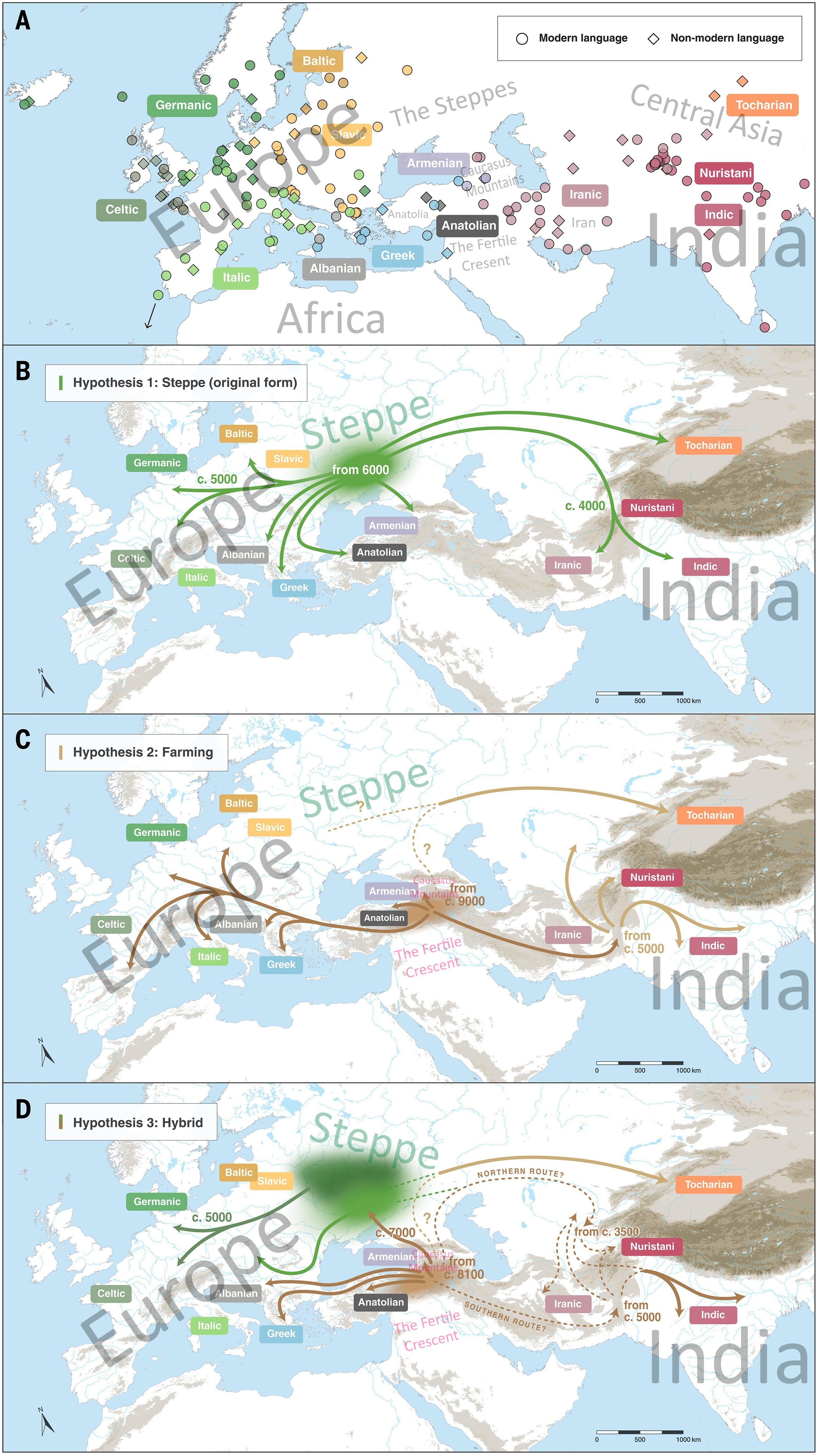
Title: Indo-European languages through space and time.
(A) 109 modern Indo-European languages (round dots) and 52 nonmodern languages (diamonds). Colors distinguish the 12 main clades of Indo-European.
(B to D) Maps showing different hypotheses for the first stages of Indo-European migration and language expansion. The hypothesis of an origin in the Steppe (B) contrasts with the hypothesis of an earlier spread with farming in the South Caucasus (C). The map in (D) shows a hybrid of parts of both hypotheses. Date estimates for when the languages separated from each other are given on the map. Language labels on the hypothesis maps show modern language group locations, not exact migrations paths.
Adapted from: https://www.thearchaeologist.org/blog/new-analysis-suggests-an-emergence-of-indo-european-languages-around-8000-years-ago
Source 3
Strong Secondary Source
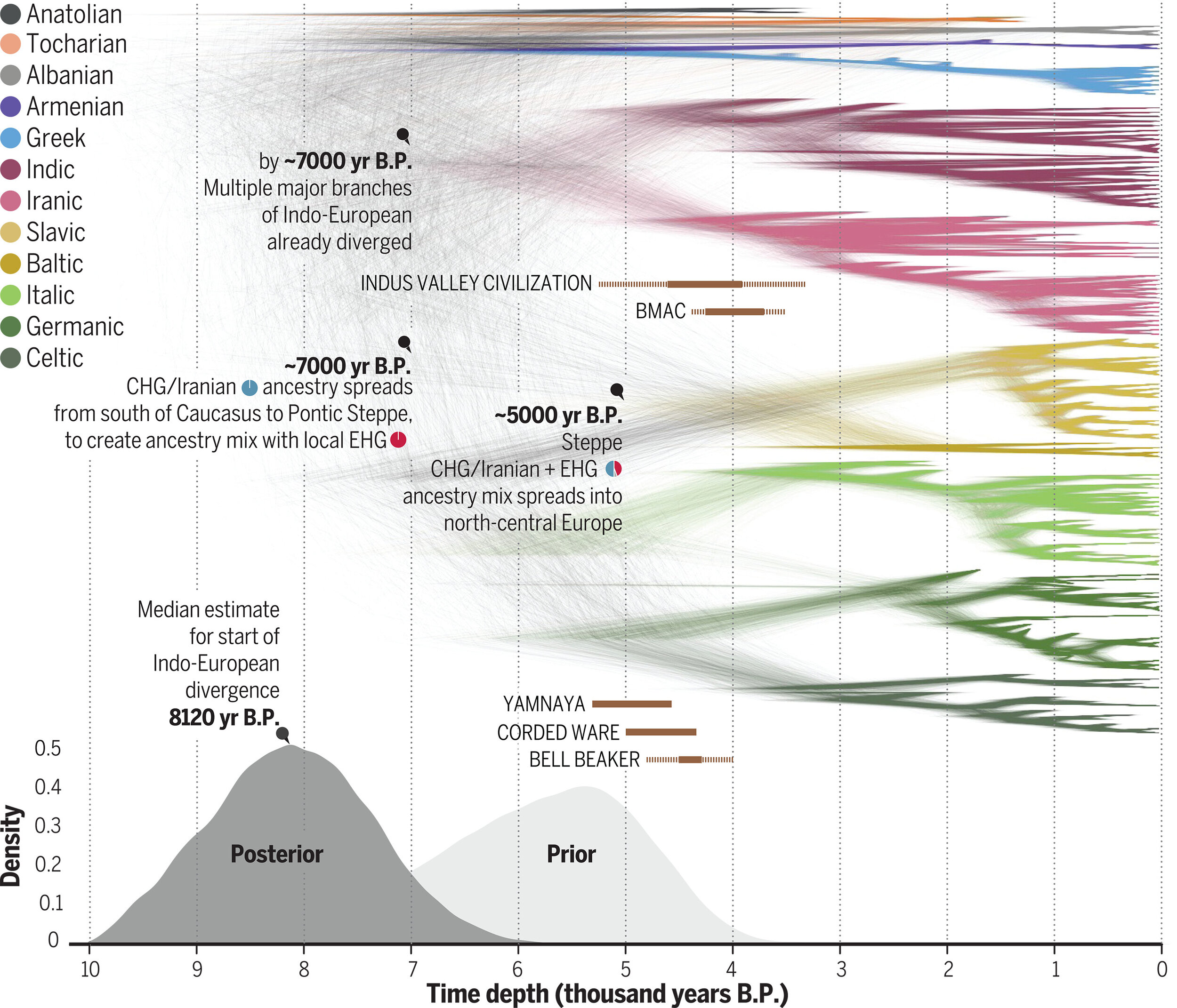
Title: Indo-European Time Graph
From a research article by 32 Original Authors, Heggarty et al.
Languages of the Indo-European family are spoken by almost half of the world’s population, but their origins and patterns of spread are disputed. A team of social scientists created a database of 109 modern and 52 historical Indo-European languages, which they analyzed with computer models. Their results suggest that Indo-European languages started around 8000 years ago. This is an older date than previously thought. It fits with an initial origin south of the Caucasus followed by a branch northward into the Steppe region. These findings lead to a “hybrid hypothesis” that fits language data and ancient DNA evidence together. The eastern Fertile Crescent (South Caucasus) would be where the Indo-European language started. Later the steppe would become a secondary homeland.
Adapted from: https://doi.org/10.1126/science.abg0818
Required
4

Write an essay to prove or disprove a claim using source documents.
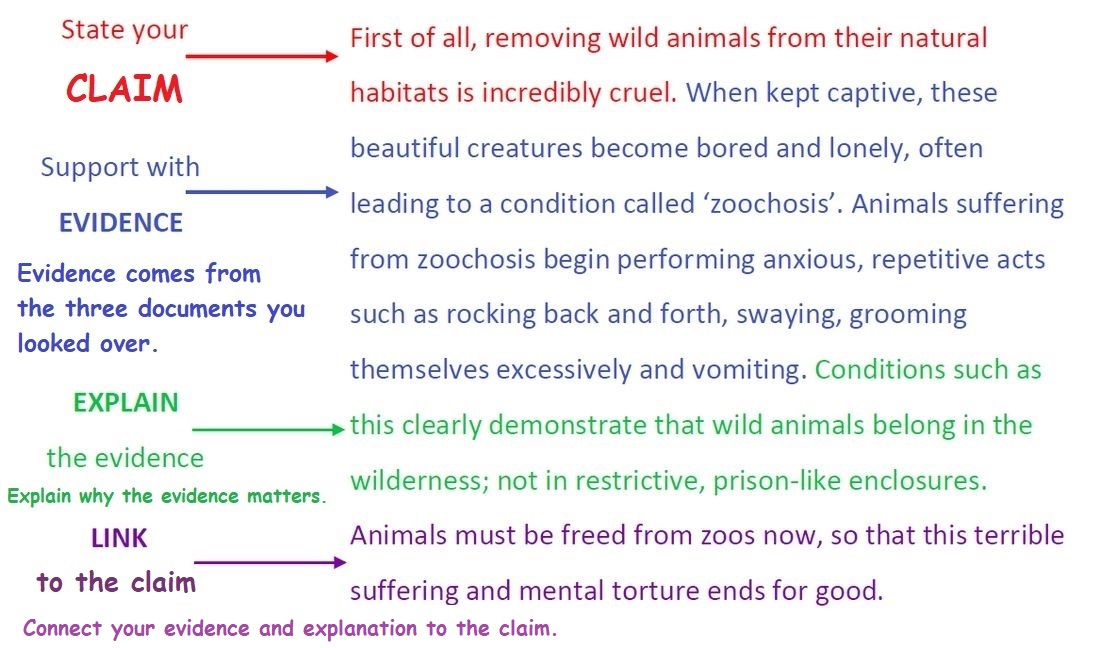
Make sure your essay states a claim, uses evidence, explains evidence, and links the evidence/explanation to the claim.
Rubric (How you will be graded for this essay.)
4 - I wrote an essay with a claim, used evidence, explained evidence, and linked evidence to the claim.
3 - I wrote an essay with a claim, used evidence, and explained evidence.
2 - I wrote an essay with a claim and used evidence.
1 - I wrote an essay with a claim.
0 - I did not write an essay.