Log in
Sign up for FREE
arrow_back
Library
Humidity, Relative Humidity, Dew, Frost CFU (6/19/2024)
By Erica Harrison-Fuoco
star
star
star
star
star
Share
share
Last updated over 1 year ago
10 questions
Add this activity
1
1
1
1
1
1
1
1
1
1
Question 1
1.
What will happen if the relative humidity is 100%, and the temperature begins falling?
The air will be sticky and uncomfortable.
Dew will form.
The temperature will rise.
The atmospheric pressure will fall.
Question 2
2.
Which cylinder represents the highest relative humidity?

1
2
3
4
5
Question 3
3.
Air with a relative humidity of 100% is said to be ______________________.
hot
muggy
saturated
unsaturated
Question 4
4.
The ability of the air to hold water depends on its _________________________.
air pressure
thermometer
water vapor
temperature
Question 5
5.
When the dew point and the temperature are equal, what is the relative humidity?
0%
25%
50%
100%
Question 6
6.
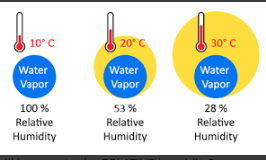
Use the model to answer the next question.
If the air temperature cools, but the TOTAL amount of water vapor in the air stays the same, what will happen to the RELATIVE humidity?
Relative humidity will decrease.
Relative humidity will increase.
Relative humidity will stay the same.
Question 7
7.
IF the air temperature
stays the same
, but the TOTAL amount of water vapor in the air
increases
what will happen to the RELATIVE humidity?
Relative humidity will decrease.
Relative humidity will increase.
Relative humidity will stay the same.
Question 8
8.
When can dew form?
when cold air comes into contact with a warm surface
when warm air comes into contact with a cold surface
when warm air comes into contact with a warm surface
when cold air comes into contact with a cold surface
Question 9
9.
How does dew form on a surface?
Rain drops land on a surface that is colder than the air.
Water vapor condenses into water droplets on a surface that is cooler than the air.
Water vapor condenses into water droplets on a surface that is warmer than the air.
Rain drops land on a surface that is warmer than the air.
Question 10
10.
How does frost form on a surface?
The air is cold enough to snow and the snow lands on a cold surface.
Rain droplets freeze on a cold surface.
Water vapor changes into a solid ice crystal on a surface that is below freezing.
Water vapor condenses then freezes into an ice crystal on a surface that is below freezing.