Log in
Sign up for FREE
arrow_back
Library

CFU 6.ESS2.1 Ocean Currents (6/19/2024)

star
star
star
star
star
Last updated almost 2 years ago
10 questions
1
1
1
1
1
1
1
1
1
1
Question 1
1.

Question 2
2.

Question 3
3.

Question 4
4.

Question 5
5.

Question 6
6.

Question 7
7.

Question 8
8.

Question 9
9.

Question 10
10.

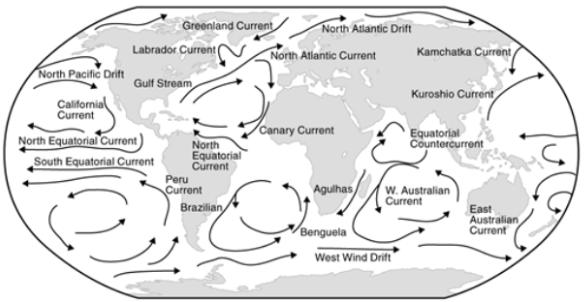
Cindi's teacher gives her a map of the world.  On her map, Cindi draws lines with arrows to show some of the major surface currents in the oceans.  Her map looks similar to the map below.  What conclusion about Earth's surface currents could someone draw by looking at Cindi's map?
Surface currents in the Eastern Hemisphere flow in a counterclockwise direction.
Surface currents in the Western Hemisphere flow in a counterclockwise direction.
Surface currents in the Southern Hemisphere flow in a counterclockwise direction.
Surface currents in the Northern Hemisphere flow in a counterclockwise direction.
How does convection cause ocean currents?
During the process of convection, energy is transferred to the atmosphere, forming winds. These winds power density currents.
During the process of convection, the heating of surface water by the sun results in upwelling.
During the process of convection, more minerals and gases dissolve in warm water. This increases the density of the warm water causing the warm water to sink.
During the process of convection, energy in warm water is transferred to its surroundings. The water cools, becomes denser, and sinks.
Which three factors most directly affect surface currents in the oceans?
upwelling, convection, and the sun's energy
global winds, the Coriolis effect, and continental deflection
deep currents, convection currents, and surface winds
dissolved solids, dissolved gases, and the sun's energy
Which properties of polar ocean water likely drive the movement of ocean currents around the globe?
salinity only
temperature and salinity only
temperature and density only
temperature, salinity, and density
What is TRUE about warm water currents in both the Northern and Southern hemispheres?

Warm water currents flow from north to south.
Warm water currents flow from west to east.
Warm water currents flow from the poles to the equator.
Warm water currents flow from the equator to the poles.
Tanya is writing questions to use in a quiz show game that reinforces concepts about the movement of water in the ocean. To which of the following questions would the correct answer be deep current?
What type of current forms far below the ocean's surface because of differences in density?
What type of current forms when cold, nutrient-rich water rises to the ocean's surface?
What type of current transfers heat when warm water is moved into areas of cooler water?
What type of current is influenced by the Coriolis effect, continental deflection, and surface winds?
Some ocean currents are caused by differences in the density of water from the poles to the equator around the globe. What two factors cause differences in ocean water density?
differences in water temperature and wind
differences in water temperature and phases of the moon
differences in the amount of dissolved salts and gravity
differences in water temperature and amount of dissolved salts
What role does heat energy from the Sun play in influencing ocean currents?
The higher rate of evaporation at the equator causes water from the poles to move toward the equator.
The polar ice caps melt due to the heat of the Sun, causing warm currents to move toward the equator.
The colder temperatures at the poles causes water to freeze and expand, pushing cold currents toward the equator.
The warm water at the equator moves toward the poles and the cooler water from the poles moves toward the equator.
Which statement BEST describes why warm ocean currents are usually surface currents?
Warm water is less dense than cold water.
Ocean tides bring warm water to the surface.
Warm water contains more salt than cold water.
Ocean water loses heat to the air at the surface.
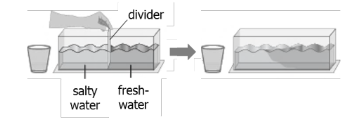
A teacher creates a model of ocean currents. The teacher pours salt water with blue dye on one side of a container and freshwater with green dye on the other side. Next, the teacher carefully removes the divider, and the students observe what occurs, as shown.

What event do the students observe immediately after the divider is removed that models ocean currents?
evaporation of freshwater and salt water
complete mixing of freshwater and salt water
conduction between freshwater and salt water
convection between freshwater and salt water