CFU for 6.LS4.1, 6.LS4.2, and 6.ESS3.3 (6/19/2024)
star
star
star
star
star
Last updated over 1 year ago
10 questions
6.LS4.1 Explain how changes in biodiversity would impact ecosystem stability and natural resources.
1 point
1
Question 1
1.
The image shows food webs from two different forests.
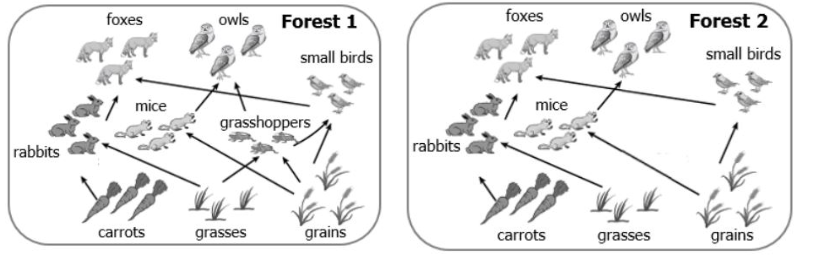
A disease breaks out in the forests, causing the extinction of all the mice. Which forest will be better able to recover from this change, and why?
1 point
1
Question 2
2.
In a pond, the primary producer is a green alga, Spirogyra. The primary consumer is the crustacean, Daphnia. The secondary consumer is a small fish, the bluegill. The tertiary consumer is a larger fish, the smallmouth bass. What changes can be expected in the pond if the Daphnia are killed with pesticides?
1 point
1
Question 3
3.
A chemical pesticide was applied to an area of this ecosystem by a landowner to control the mouse population. There was a decrease in the mouse population due to the presence of this pesticide. Which one of the following would most likely occur first due to this change in the ecosystem.
1 point
1
Question 4
4.
The Atlantic Northern cod is a fish widely eaten by humans. Fishermen use boats with large nets to increase the amounts they can catch. These large nets also catch unwanted fish, like capelin, which are prey for the Atlantic Northern cod.
How will removing capelin from the ocean affect the population of Atlantic Northern cod?
6.LS4.2 Design a possible solution for maintaining biodiversity of ecosystems while still providing necessary human resources without disrupting environmental equilibrium.
1 point
1
Question 5
5.
A region of a state includes a large forested area. The forest is a habitat for many different types of wildlife. The state officials would like to use the region for recreational opportunities, but individuals living in the state want to protect the biodiversity of the wildlife living there.
Problem:
Assess which plan will best meet both goals.
1 point
1
Question 6
6.
A region includes a coastal wetland area. The wetland is a habitat for many types of wildlife. Members of the community surrounding the wetland design a plan that has two goals. The first goal is to provide recreation opportunities for humans in the wetland. The second goal is to protect the biodiversity of wildlife living there.
Which plan will best meet both goals?
1 point
1
Question 7
7.
Traditional farming practices can increase soil erosion. Eroded soils can affect nearby lakes by causing eutrophication. Eutrophication decreases the water quality of a lake by reducing the amount of oxygen in the water.
Which statement describes the best solution for a farmer to increase the biodiversity of a nearby lake?
6.ESS3.3 Assess the impacts of human activities on the biosphere including conservation, habitat management, species endangerment, and extinction.
1 point
1
Question 8
8.
Which of the following human activities negatively affects a natural resource?
1 point
1
Question 9
9.
Great blue herons are a wading bird indigenous (native) to the United States. These large birds have adapted to live in both fresh and salt water wetlands in both warm and cooler regions but are vulnerable to habitat loss. Since the 1950s, wetland habitats have been destroyed at alarming rates to provide space for human housing, shopping, and entertainment. These large predatory birds eat a wide variety of animals such as fish, crustaceans, small mammals, and amphibians.
Problem:
Based on the information above, which of the following human activities most impacts great blue heron populations?
1 point
1
Question 10
10.
The piping plover is a bird that builds its nest on sand dunes along the Atlantic Ocean. Which of these actions most likely damages the nests of the piping plover?