Copy of Microbiology BM8 Viruses (Chapter 5) (6/25/2024)
star
star
star
star
star
Last updated 24 days ago
18 questions
NGSS LS1-2 CCC: Structure/Function PE: Developing and Using Models DCI: LS1.A
Please read carefully before choosing your answer.
3
3
3
3
3
3
3
3
3
3
3
3
3
Free Response
6
8
Claim, Evidence, and Reasoning
15
Question 1
1.
Host range is limited by
Question 2
2.
The event that occurs in bacteriophage multiplication that does not occur in animal virus replication is
Question 3
3.
Helical and icosahedral are terms used to describe the shapes of a virus
Question 4
4.
Host cells of viruses include
Question 5
5.
NCLEX Prep - Test Bank Question: Please read the clinical scenario, and then answer the questions that follow to become familiar with the traditional NCLEX question format.
Mrs. Hammond is a 79-year-old woman who has been a resident on your floor for the past 5 years. She has been complaining of pain, burning, and tingling on her left side. Today, you observe fluid-filled blisters wrapping around the left side of her torso in a single line. The physician diagnoses her with shingles and places her on contact precautions.
Mr. Hammond inquires how his wife contracted this viral infection, since she has not meet anyone who has shingles. You recall from microbiology that varicella zoster virus can remain in a chronic latent state in a host by
Question 6
6.
Viruses have all the following except
Question 7
7.
The envelope of enveloped viruses is
Question 8
8.
Persistent viruses that can reactivate periodically are
Question 9
9.
When a virus is able to hide in a host cell and cause a reaction years later, it is called a ____________________ infection?
Question 10
10.
Sometimes a virus like HPV causes changes in the host cell and the host cell will multiple uncontrollably. This type of viral infection can cause ______________________.
Question 11
11.
Which of the following is true about the structure of viruses?
Question 12
12.
What is the purpose of the protein coat (capsid) in a virus?
Question 13
13.
What is the main genetic material found in viruses?
True or False: Viruses are considered living organisms.
1
Question 14
14.
False
2
Question 15
15.
Explain your choice.
Question 16
16.
CCC: Structure and Function
Viruses continue to surprise those who study them. Viruses, often dismissed as mere agents of disease, continually astonish researchers with their complexity and adaptability.
a. How would you use the knowledge you have gained to explain why viruses are still surprising given their simplicity in structure?
b. How could this simplicity give them an advantage in their ability to cause diseases?
c. How could this simplicity be a disadvantage for causing diseases?
Question 17
17.
PE: Modeling and Using Models
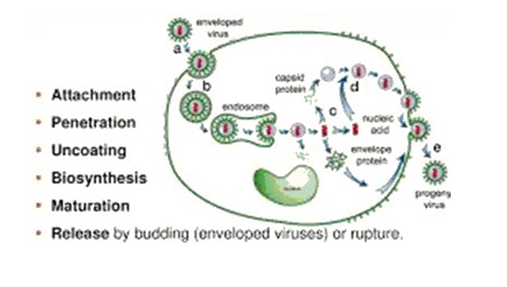
1. a. Using the model of virus multiplication, how could you make use of viral multiplication
to prevent viral infections?
b. Which stage or stages would you target?
c. Why did you choose this stage(s) to target?
d. How would this disrupt the viral infection?
2. Create a new model showing how viral multiplication would look with your target preventative.
For full credit: identify the type of viral multiplication, discuss the step that has the best chance, and why you made your choice.
Question 18
18.
CER/Data Question: Claim, Evidence, and Reasoning.
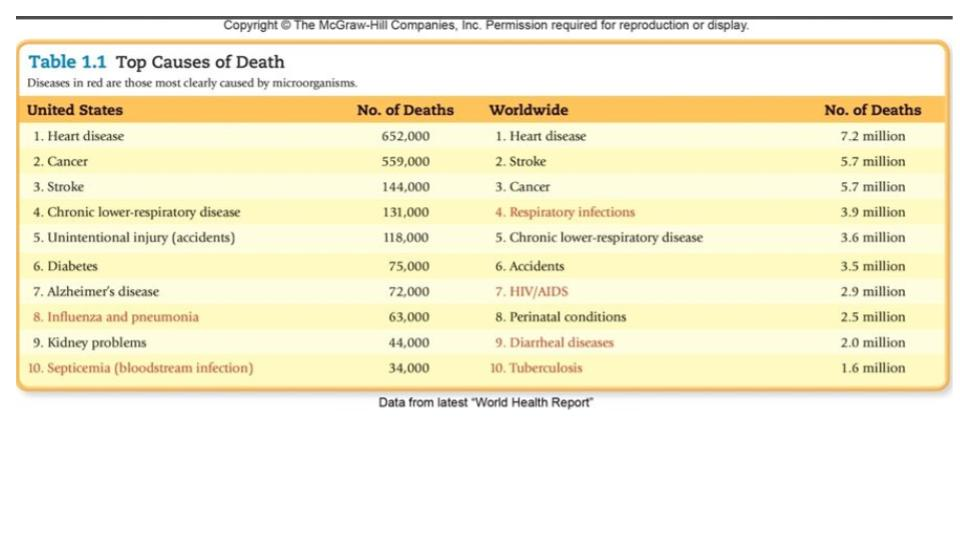
Viruses are microscopic agents that can significantly disrupt cellular functions or changing the cell entirely. When a virus infects a cell, it hijacks the cell's machinery to replicate itself, often causing cellular damage or death in the process. This disruption can alter metabolic pathways, contributing to insulin resistance. Viruses can also induce mutations in the host's DNA or provoke chronic inflammation, creating an environment conducive to tumor development. Thus, understanding the mechanisms by which viruses affect cells is crucial for unraveling their roles in complex diseases.
This chart from chapter one identified diseases most clearly caused by microorganisms/viruses.
Question:
Are viruses responsible for more deaths than currently attributed (beyond red-labeled diseases)?
a. Make a claim by answering the above question.
b. Use evidence from the given information and image to support your claim.
c. Give the scientific reasons/rationale/theory that allow you to use your evidence in support of your claim.
See the rubric to ensure you get the greatest amount of points for your answer.