A Quick Guide to Snow and Snowflakes
Are there days when you wish for snow? If you live in a warm, dry place like one of the Arizona deserts, snow almost never falls. Florida, on the other hand, has plenty of moisture, but the temperatures are often not low enough for snow to form. Snow requires two things: moisture and low temperatures. Snow crystals cannot form without both of these.
What is snow?
Snow is precipitation in the form of ice crystals. Ice crystals form in a cloud when the temperature in the cloud is below freezing. Freezing occurs at 32 degrees Fahrenheit. Water droplets form when water changes from a vapor to a liquid. The tiny water droplets then freeze into ice crystals. When the Sun heats the water in lakes or streams, the water evaporates—or turns into vapor. This vapor rises into the atmosphere, condenses, and forms clouds. If the atmosphere is warm, rain falls from the clouds. If the atmosphere is cold (below freezing), snow falls.
What are snow crystals?
Scientists use the terms “snow crystal” and “snowflake” to describe two different things. A snow crystal is a single crystal of ice, but a snowflake is a cluster of snow crystals that falls to Earth. Snow crystals are very different from sleet.
Sleet occurs when drops of rain freeze as they fall to Earth. Snow crystals, on the other hand, are formed in a cloud before they fall to Earth.
Dr. Kenneth Libbrecht, a physics professor at the California Institute of Technology, studies snow crystals. He puts them under high-powered microscopes and photographs them. He says that the most basic form of a snow crystal is a hexagonal prism (figure 1). Some are long and thin. Others are short and thick. The size varies, but the shape remains the same. Small snow crystals usually take the simple form of a hexagonal prism.

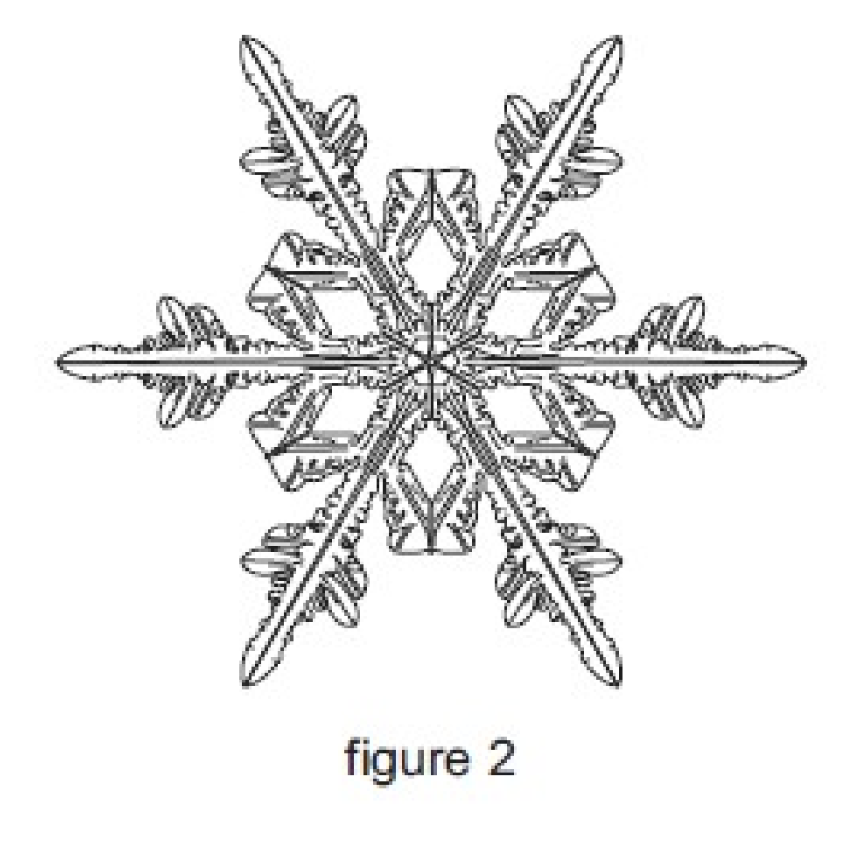
As snow crystals grow, branches sprout from the corners to make more complicated shapes. There are six corners, so most snow crystals have six arms. The arms tend to grow at about the same rate, so they are all about the same length. Of course, not all snow crystals have a perfect shape. It is difficult to see some snow crystals with the human eye. This is a drawing of one that was photographed through a high-powered microscope (figure 2).
What are snowflakes?
Snowflakes occur when snow crystals join together. Most snowflakes are about a half an inch wide. Much larger snowflakes can form when the ground temperature is near freezing and light winds are blowing. Big snowflakes may be almost two inches wide. It is difficult to measure snowflakes, however, since they tend to melt!
Why is snow white?
Snow crystals have no color at all. When they fall as snowflakes, they appear white. Most natural materials, such as grass, dirt, or rocks, absorb some sunlight, which gives them their colors. Snow does not absorb sunlight. It reflects almost all light, so it looks white.
Sometimes deep snow will appear blue. As the light travels through many layers of snow, some of it is absorbed. Red light is absorbed more easily than blue light, so the light bouncing back tends to look blue.
Why is snow crunchy?
Snow affects how sound waves travel. When the snow is fresh and fluffy, it absorbs sound waves. Pets write about how quiet the world sounds after a snowstorm. They are making a scientific observation. New snow has a sound-dampening effect.
But as the snow is packed down, the snow crystals compress together. This creates a crunchy or creaking sound. Experts at the National Snow and Ice Data Center say that “the colder the snow, the louder the crunch.” As the snow begins to melt, it makes no noise at all.
Why study snow?
Scientists like Dr. Libbrecht study snowflakes to understand exactly how they form and assemble themselves into particular shapes. This is called self-assembly. Snowflakes use a simple form of self-assembly. The cells in our body, for example, form and divide on their own. Biological self-assembly, the kind that occurs in the human body, is much more complex than snowflake self-assembly. However, scientists often gain insight into more complex mechanisms by understanding simple ones. “There is a great deal of interesting physics, chemistry, and materials science wrapped up in snowflake growth, and studying the lowly snowflake may indeed teach us something useful,” Dr. Libbrecht says. He adds, “History has shown over and over that the fundamental knowledge gained by doing basic science (without worrying about what it’s good for) often leads to useful engineering applications.” Dr. Libbrecht does not know what those applications might be, but he thinks that scientists should try to understand how nature works because all knowledge is useful.
When people learn that he studies snowflakes, many ask, "Is every snowflake unique?"
"Yes!" he says, and then he explains. "It’s like shuffling a deck and getting the exact same shuffle for 52 cards. You could shuffle every second for the entire life of the universe, and you wouldn't come close to getting two of the same."
Each and every snowflake is amazing in its own way.