1
Which type of wave is represented?
Which type of wave is represented?
1
1
Which type of wave is represented?

A longitudinal wave moves to the right through a uniform medium, Points A, B, C, D, and E represent the positions of particles of the medium.
The wavelength of this wave is equal to the distance between points ________
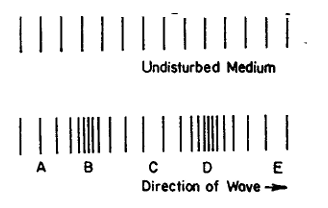
The diagrams shown represent an undisturbed medium and a medium through which a disturbance is moving. Which is represented by area B?
If the displacement of particles in a medium is parallel to the direction of travel of the wave, the wave is classified as
A periodic transverse wave has an amplitude of 0.20 meter and a wavelength of 3.0 meters. On the grid provided below, draw at least one cycle of this periodic wave
The diagram below represents a transverse wave, A, traveling through a uniform medium. On the diagram, draw a wave traveling through the same medium as wave A with twice the amplitude and twice the frequency of wave A.
What is the velocity of a wave whose wavelength is 8.0 meters and frequency is 10 cycles per second?
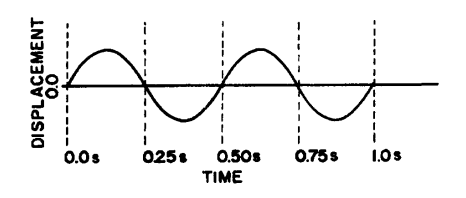
The graph represents the displacement of a point in a medium as a function of time as a wave passes through the medium. What is the frequency of the wave?
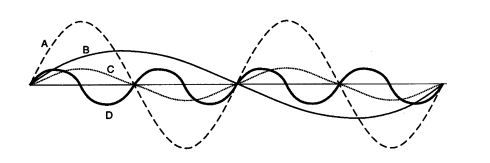
Which wave has the longest period?
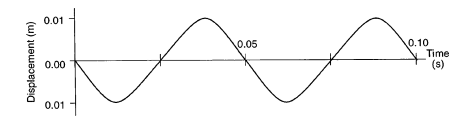
The accompanying graph shows displacement versus time for a particle of a uniform medium as a wave passes through the medium. What is the frequency of the wave?
What is the wavelength of a 30-hertz periodic wave moving at 60 meters per second?
Which diagram best illustrates wave refraction?
When a ray of white light is refracted, the component color that has the greatest change in direction is
Which of the following is caused by the interference of sound waves?
Sound can not be transmitted through a
Put the electromagnetic waves in order from longest to shortest wavelength
ultraviolet
x ray
infrared
microwave
gamma ray
visible
radio
Radio waves and gamma rays traveling in space have the same
Radio waves diffract around buildings more than light waves do because, compared to light waves, radio waves
The ratio of the energy of a quantum of electromagnetic radiation to its frequency is
The wavelength of photon A is greater than that of photon B. Compared to the energy of photon A, the energy of photon B is
Which phenomenon is most easily explained by the particle theory of light?
Gamma radiation consists of a stream of high energy
Experiments performed with light indicate that light exhibits
The energy of a photon is inversely proportional to its
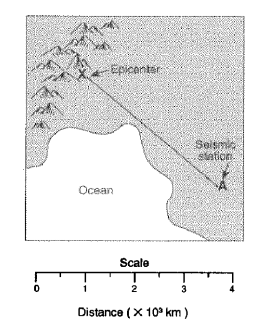
Base your answer(s) to the following question(s) on the map to the left. The map shows point X, which is the location of an earthquake epicenter, and point A, which is the location of a seismic station. Which statement best describes the arrival of the initial S-wave at the seismic station?
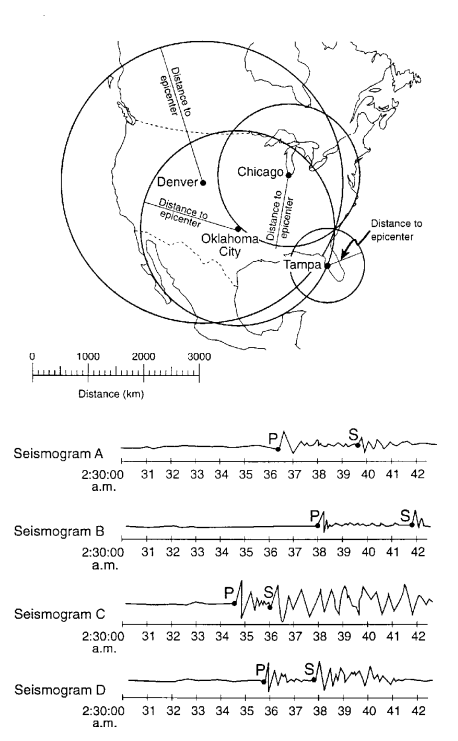
The map shows seismic stations in Chicago, Denver, Oklahoma City, and Tampa that recorded data from an earthquake. Seismograms A, B, C, and D show, in Greenwich time, the arrival times of the earthquake waves at the four stations.
What is the minimum number of seismic stations needed to locate most earthquake epicenters?
Base your answer to the following question on the diagram below, which shows models of two types of earthquake waves.
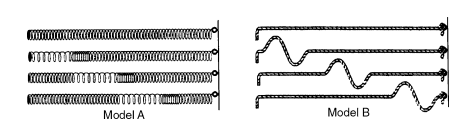
Model A best represents the motion of earthquake waves called
The difference in seismic station arrival times of the two waves represented by the models helps scientists determine the
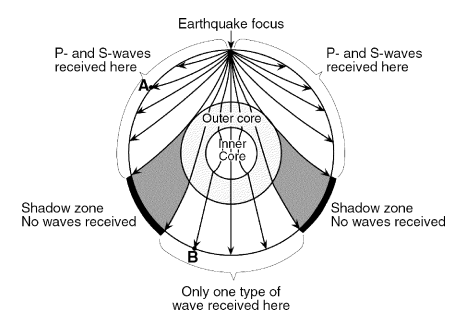
Which statement best explains why only one type of seismic wave was recorded at location B?
Which statement correctly compares seismic P-waves with seismic S-waves?
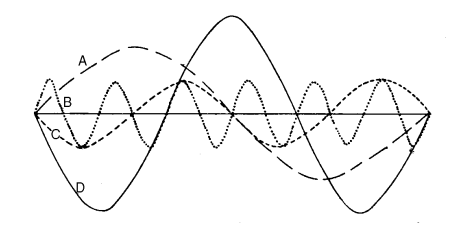
Which wave has the highest frequency?
Which wave has the longest wavelength?
Which two waves have the same wavelength?
Which wave has the highest frequency?
No P-waves or S-waves are received in the shadow zone because