Asemmisa {{asɛmmisaAhyɛnsode}}
27.
What word in chemistry means containing one type of particle only? (1 Point)
What word in chemistry means containing more than one type of particle jumbled together? (1 Point)
What word in chemistry means containing one type of atom only? (1 Point)
What word in chemistry means containing two or more different elements chemically joined together in a fixed ratio? (1 Point)
Pure substances have a sharp melting point.
Pure substances melt over a range of temperatures.
Which statement is correct? (1 Point)
Which method would be used to get sodium chloride from salt water?
Which method would be used to separate sand from water? (1 Point)
Which method would be used to separate ethanol from water?
Which method would be used to separate ammonia from nitrogen and hydrogen?
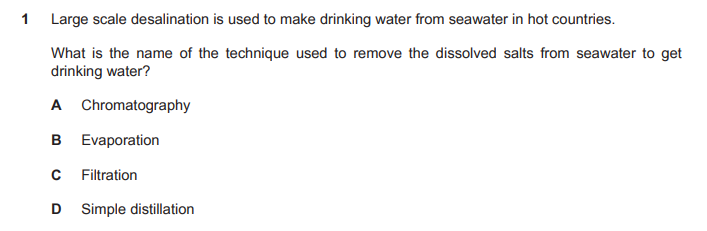
Which method would be used to separate pure water from sea water?
Which method would be used to separate food colourings? (1 Point)
Which method would be used to separate dyes? (1 Point)
The stationary phase is the (actually the water adsorbed onto the surface of the paper).
The mobile phase is the .
As the solubility of the substance increases, the distance travelled by the substance ____________.
As the solubility of the substance increases, the Rf value of the substance ____________.
How can an impure substance be identified on a chromatogram?
How can a pure substance be identified on a chromatogram?
An unknown sample can be identified because: The for the unknown sample are at the same height as the for the sample on the
Which is the correct equation for Rf?
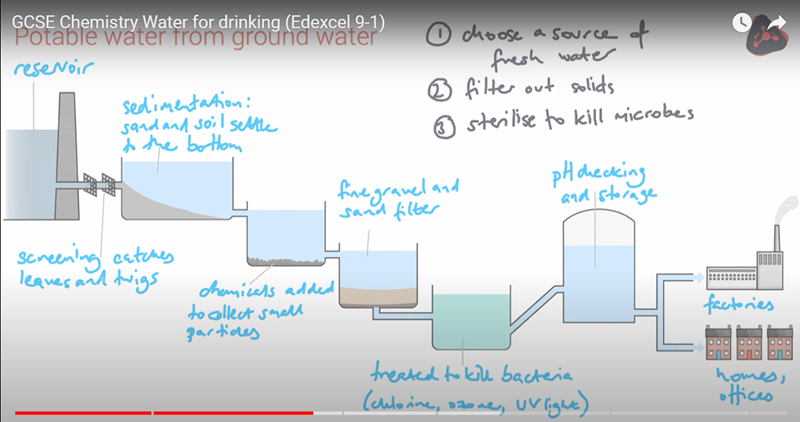
To make water drinkable is to make water:
Solids settle to the bottom of the water during:
Sea water can be purified using _________________________ (1 Point)
Solids settle to the bottom of the water during _____________________ (1 Point)
Solid impurities are removed using _____________________________
You need to copy out these steps into your book.
Chemical such as aluminium sulfate are added to cause flocculation (clumping together) of fine grained suspended particles (4)
Firstly water is collected in a reservoir (1)
Smaller insoluble impurities sediment out of the water (3)
Large insoluble impurities are removed by screens (2)
Finally pH is tested and water is neutralised if needed. (7)
Remaining insoluble material is removed by filtration using gravel and sand (5)
Bacterial and or viruses are killed using - chlorine / UV light /ozone (6)
Match up the technique and the example.
| Draggable item | arrow_right_alt | Corresponding Item |
|---|---|---|
evaporation/crystallisation | arrow_right_alt | Separate the food colourings in a sweet |
fractional distillation | arrow_right_alt | Obtain salt from a solution of salty water |
filtration | arrow_right_alt | Separate various fractions of crude oil |
simple distillation | arrow_right_alt | Obtain sand from a mixture of sand and water |
chromatography | arrow_right_alt | Obtain water from salt water |
Suggest one process a different country, which has very little rainfall, a long coastline, and plentiful energy supplies, could use to obtain most of its potable water.
Simple of