S1W1 Astronomy FC Ancient greek astronomy, seasons
star
star
star
star
star
Last updated 3 months ago
16 questions
1 point
1
Question 1
1.
Welcome to Astronomy! We will be hitting the ground running on the first day of school. Please read the syllabus that is pinned at the top of the google classroom. Do you have any questions?
1 point
1
Question 2
2.
Watch the following video.
Do you have any questions?
1 point
1
Question 3
3.
Read chapter 1.1 of your textbook. Do you have any questions?
1 point
1
Question 4
4.
The name for planets comes from the term "wanderer" explain how the motion of planets was different from the motion of stars.
1 point
1
Question 5
5.
Match the vocab to the definitions
Draggable item
arrow_right_alt
Corresponding Item
parallax
arrow_right_alt
slow rotation of the axis of a planet around another axis
precession
arrow_right_alt
how the position of an object changes with respect to its background when seen from different positions
geocentrism
arrow_right_alt
the idea that the earth is the center of the solar system
epicycle
arrow_right_alt
how planets seem to move backwards in their orbits
retrograde motion
arrow_right_alt
a small circular orbit whose center moves around a larger circular orbit
1 point
1
Question 6
6.
You observe a star as soon as the sun sets and observe the same star an hour later. What difference do you see?
1 point
1
Question 7
7.
Geocentrism didn't accurately predict when planets would be in retrograde motion. Which theory was introduced to explain retrograde motion?
1 point
1
Question 8
8.
why did the greeks reject the concept of heliocentrism
1 point
1
Question 9
9.
If the shape of the earth's orbit was unaltered, but the tilt of the rotation axis was changed until it had no tilt with respect to the orbit, how would seasons be affected?
1 point
1
Question 10
10.
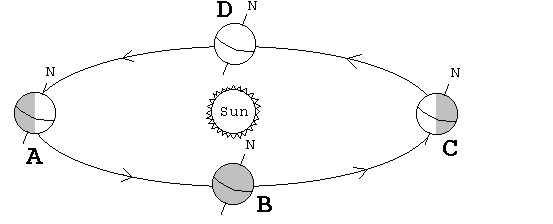
given this diagram, note where the solstices and equinoxes fall for the northern hemisphere.
A
B
C
D
Fall equinox
spring equinox
summer solstice
winter solstice
1 point
1
Question 11
11.
How would they be different for the southern hemisphere?
A
B
C
D
Fall equinox
spring equinox
summer solstice
winter solstice
1 point
1
Question 12
12.
Which of the following describes the path of the sun
1 point
1
Question 13
13.
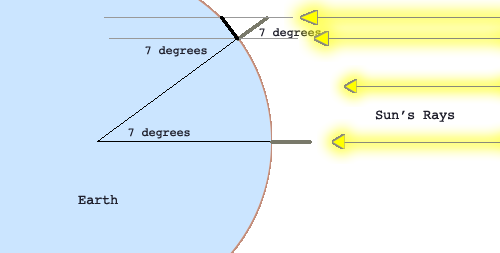
You are Erotosthenes measuring the diameter of the earth. You realize that you underestimated the angle of the poll. Would this mean that the circumference of the earth your calculated would be:
1 point
1
Question 14
14.
Honors: Which of the following is the equation Eratosthenes used to find the circumference of the earth?
1 point
1
Question 15
15.
For on level: What proof would you offer a flat-earther to prove that the earth is round?
For Honors: Draw yourself a sketch of the earth and persuade yourself that your latitude is the angle of the north celestial pole above the horizon. Try to explain here, but be ready to prove your point in class.
1 point
1
Question 16
16.
Below is a list of expected understanding from the reading and the
what causes the seasons
the difference between heliocentrism and geocentrism
What is parallax and why it convinced the greeks that geocentrism is true rather than heliocentrism
why the north star hasn't always been Polaris
how the greeks determined the shape and size of the earth