Astronomy week 3
star
star
star
star
star
Last updated 11 months ago
15 Nsɛmmisa
1
1
1
1
N.Q.1
2
DCI.PS2.B.6-8.2
3
1
1
1
1
1
1
1
1
1
Which of the following statements are implied by Kepler's laws?
Consider a comet, with a far more eccentric orbit than a planet like earth. Can you explain in terms of Kepler's law why the comet must move much slower when it is at the outer edge of the solar system than when it is close to the earth?
Consider a comet, with a far more eccentric orbit than a planet like earth. Can you explain in terms of Newton's law of universal gravitation why the comet must move much slower when it is at the outer edge of the solar system than when it is close to the earth?
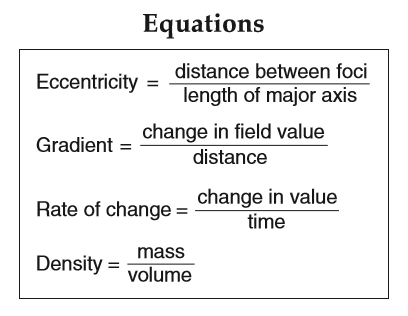
Which one of the following is used as the unit for eccentricity?
Which of the following eccentricity values is the closest to being a circle?
milankovich's cycles are based on which of the following variables, check all that apply.
ice forms more readily on land than on water
ice is more likely to form on ice than on land
explain the effect Saturn and Jupiter have on Earth's orbit that affects the Milankovich cycles?
From watching that video, what insights do you glean about global warming?
The moon pulls on the close side of the earth, why does that create a bulge that becomes high tide on the far side of the earth?
tidal locking is
You are falling feet first into a black hole, and you start to be spaghettified. What is spaghettification, and what is happening to you?
You and a brother are in a moving car. You pass a friend standing still on the street. From your frame of reference, you are your brother are stationary, and your friend is moving. From your friend's frame of reference, you are both moving along the street. Your brother lunges across the seat to steal your candy. Draw a quick sketch that compares the motion from your frame of reference compared to your friend's frame of reference.
This guy says that while everything else the first guy said is true, the actual force involved is tiny. Can you summarize how he explains how those tiny forces can cause large tides?