Log in
Sign up for FREE
arrow_back
Library
Astronomy, light and spectroscopy
By Gwyneth Lenfest
star
star
star
star
star
Share
share
Last updated 5 months ago
16 questions
Add this activity
1
1
1
1
1
1
1
1
1
1
1
1
1
1
1
1
Question 1
1.
Waves carry _____________ from one place to the other.
frequency
medium
materials
energy
Question 2
2.
The number of wavelengths that pass a point each per second is:
baseline
period
frequency
amplitude
Question 3
3.
Increasing the amplitude of the light changed:
to the blues & purples
bright to dim
dim to bright
to the reds & oranges
Question 4
4.
Which of the following is not a mechanical wave?
sound wave
electromagnetic wave
ocean wave
slinky wave
Question 5
5.
Electromagnetic waves are
The emission of electrons from a metal when light shines on the metal
Radio waves with the shortest wavelengths and the highest frequencies
Electromagnetic waves with the longest wavelengths and lowest frequencies
A form of energy that can move through the vacuum of space.
Question 6
6.
The ______________________ is how tall the wave is.
crest
trough
amplitude
wavelength
Question 7
7.
Which of the following can scientists make inferences about simply by observing light
direction of rotation of objects
Density of stars
composition of nebula
All of the above
Question 8
8.
In visible light, changing the wavelength of the light will change the
Question 9
9.
When hot dense materials like a tungstun filiment (in an incansecent lightbulb) is split with a diffraction grating it appears to emit a
contiunous spectra
absorbtion spectra
emissions spectra
dark line spectra
Question 10
10.
Match
visibility
View drawing
Question 11
11.
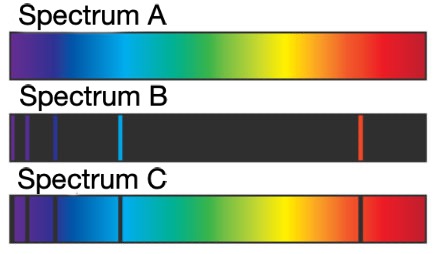
Light from a low-heat, low-density nebula would emit
Spectrum A
Spectrum B
Spectrum C
Question 12
12.
Light from a star passing through a dust cloud would emit
Spectrum A
Spectrum B
Spectrum C
Question 13
13.
If an object like a star is moving away from Earth, the spectral lines are observed to be
red shifted
blue shifted
green shifted
yellow shifted
Question 14
14.
The spectral lines are created by the movement between allowed energy levels of
electrons
neutrons
protons
quarks
Question 15
15.
What are the advantages of the Hubble Space Telescope over ground-based telescopes
Question 16
16.