unfinished Astronomy s1 w5 flipped classroom - What if week
star
star
star
star
star
Last updated 8 months ago
29 questions
1
1
1
1
1
1
1
1
1
1
1
1
1
1
1
1
1
1
1
1
1
1
1
1
1
1
1
1
1
Question 1
1.
Hollow earth
Do you have any questions?
Question 2
2.
why would digging a hole from pole to pole help you fall through the earth, rather than starting your dig in Austin?
Question 3
3.
Why would you be free floating as soon as you are in the center of earth?
Question 4
4.
in the hollow earth scenario, why would you be free floating when you are close to one side of the sphere,
Question 5
5.
Question 6
6.
Go try this with a flashlight on a wall to check your answer
Question 7
7.
Question 8
8.
Question 9
9.
Question 10
10.
Magentic striping
Do you have any questions
Question 11
11.
The video mentions one area of the seafloor that is spreading. what are some places on the earth that you think the plates are colliding?
Question 12
12.
Why does the polarity of the ocean floor keep flipping?
Question 13
13.
Read 5.6-5.7, pages 169-175
Question 14
14.
Question 15
15.
Question 16
16.
Question 17
17.
🎥. Solar storms
Do you have any questions
Question 18
18.
Question 19
19.
🤔 Why is it a sign of a problem when aurora borealis is seen too far south?
Question 20
20.
If the earth rotated more slowly, what effect would this have on the Earth's magnetic field?
Question 21
21.
Question 22
22.
Why is the inner core solid, even though it is hotter than the outer core?
Question 23
23.
(emoji signals calculation) A p-wave has a constant velocity of 18,000 miles/hour. Convert this to km/s
Question 24
24.
Question 25
25.
Calculate the amount of gravity the earth applies to the international space station, If the mass of the ISS is 419,725 kg, the mass of the earth is 5.9736 x 10^24 kg, The radius of the earth is 6,378.1km and the ISS orbits at 408 km. Pay attention to units and significant figures, the Gravitational constant G = 6.674×10⁻¹¹ m3⋅kg−1⋅s−2.
Question 26
26.
Calculate the amount of gravity the earth would apply to the ISS if it were on the ground.
Question 27
27.
Question 28
28.
The acceleration due to gravity on the surface of the earth is about 9.8 m/s^2. The acceleration due to gravity on the ISS is about 8.7 m/s^2. Why does all the footage of the ISS look like there is no gravity?
Question 29
29.
imagine you are inside the hollow sphere, shining a flashlight on a section of the sphere. The closer you are to that section of the sphere,
The larger the section of the sphere is lit up, and the more intense the light is on that section
The smaller the section of the sphere is lit up, and the less intense the light is on that section
The larger the section of the sphere is lit up, and the less intense the light is on that section of the sphere
the smaller the section of the sphere is lit up and the more intense the light is on that section
Using the same math we used from the parallax lab, we can find the relationship between the linear size of the circle of light, the linear distance to the circle of light and the angular size of the circle of light. Which of the following shows that relationship?
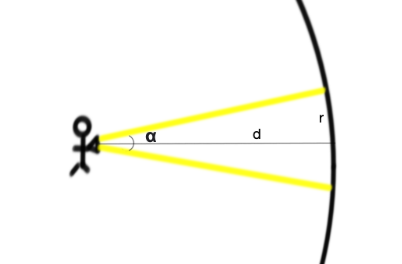
r/d = cos α
r/d = tan α
r/d = sin α
r/d = cot α
Using the equation you chose from above, solve for r and find the area of the circle of light.
A= 2 (dcos α)^2
A = (d tan α)^2
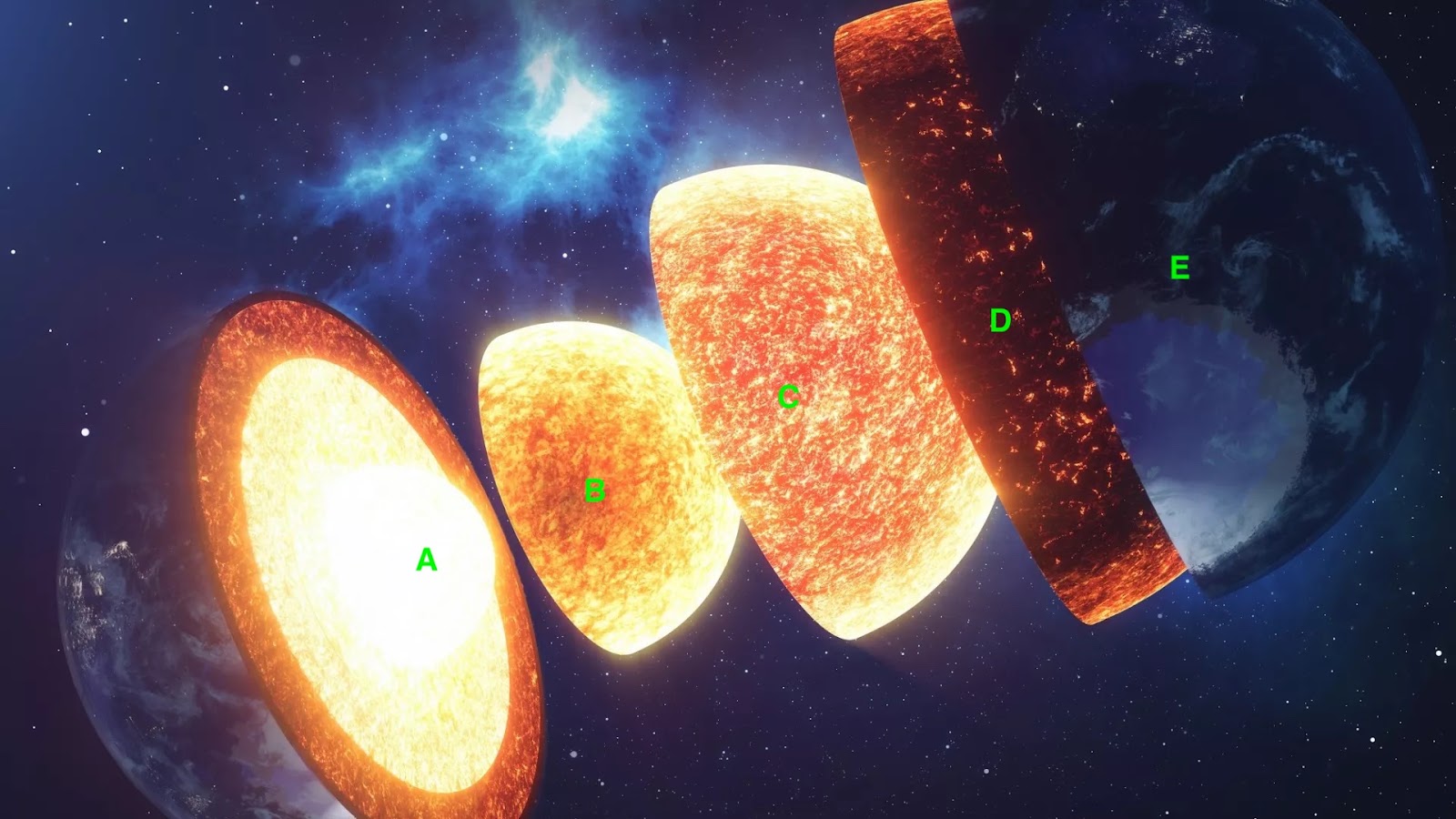
This wasn't covered in the video, just linking to knowledge you may or may not have - match the layers of the earth to what they are made of
A
B
C
D
E
Solid rock
Solid-ish rock, more like fudge in consistancy
solid iron
liquid iron
solid rock, but broken into lots of smaller pieces
The Coriolis effect is responsible for
Jet streams
the bands of Jupiter
deflects ocean currents
all of the above
Solar particles heading towards the earth are prevented from hitting the surface by the
Aurora
magnetosphere
van allen belt
coriolis effect
🔎 Those same solar particles get trapped in the _______, and are a significant barrier to astronauts leaving earth's orbit.
Aurora
magnetosphere
van allen belt
coriolis effect
🔗 What does CME stand for?
Center of mass energy
Composite magnetic emissions
Coronal mass ejections
None of these
🔎 Precession means
Eventually the orbit will be stretched because of Jupiter and Saturn, and we will be even further away in the summer.
The angle of the earth's tilt will decrease, making the seasons less extreme
the angle of the earths tilt will increase making the seasons more extreme
The earth will be closer to the sun in summer (in the northern Hemisphere) and farther in the winter, making both seasons more extreme.
A vector is described as 25 N, 43.0° from the horizontal. Break those down into two component vectors, A+B, where A is in the x direction, and B is in the y direction. Quick refresher how to do this here. http://www.phys.uwosh.edu/rioux/physlets/morephyslets/kinematics_6.html
A = 18.28 in the x direction, B = 17.05 in the y direction
A = 18 in the x direction, B = 17 in the y direction
A = 17.0 in the x direction, B=18.3 in the y direction
A = 17.05 in the x direction, B=18.28 in the y direction
If you calculate the amount of gravity the earth applies to the international space station, If the mass of the ISS is 419,725 kg, the mass of the earth is 5.9736 x 10^24 kg, The radius of the earth is 6,378.1km and the ISS orbits at 408 km. How many significant figures would you have to use?
2
3
4
5
6
How are you feeling about
gravity inside a solid body
inverse square law for light and gravity
plate tectonics, specifically divergent plates
how to calculate the force of gravity
why the sea floor is magnetized
why the sea floor flips from being north south to south north in stripes along the sea floor