Which of the following would be a good way to convert the gravitational constant G to different units?
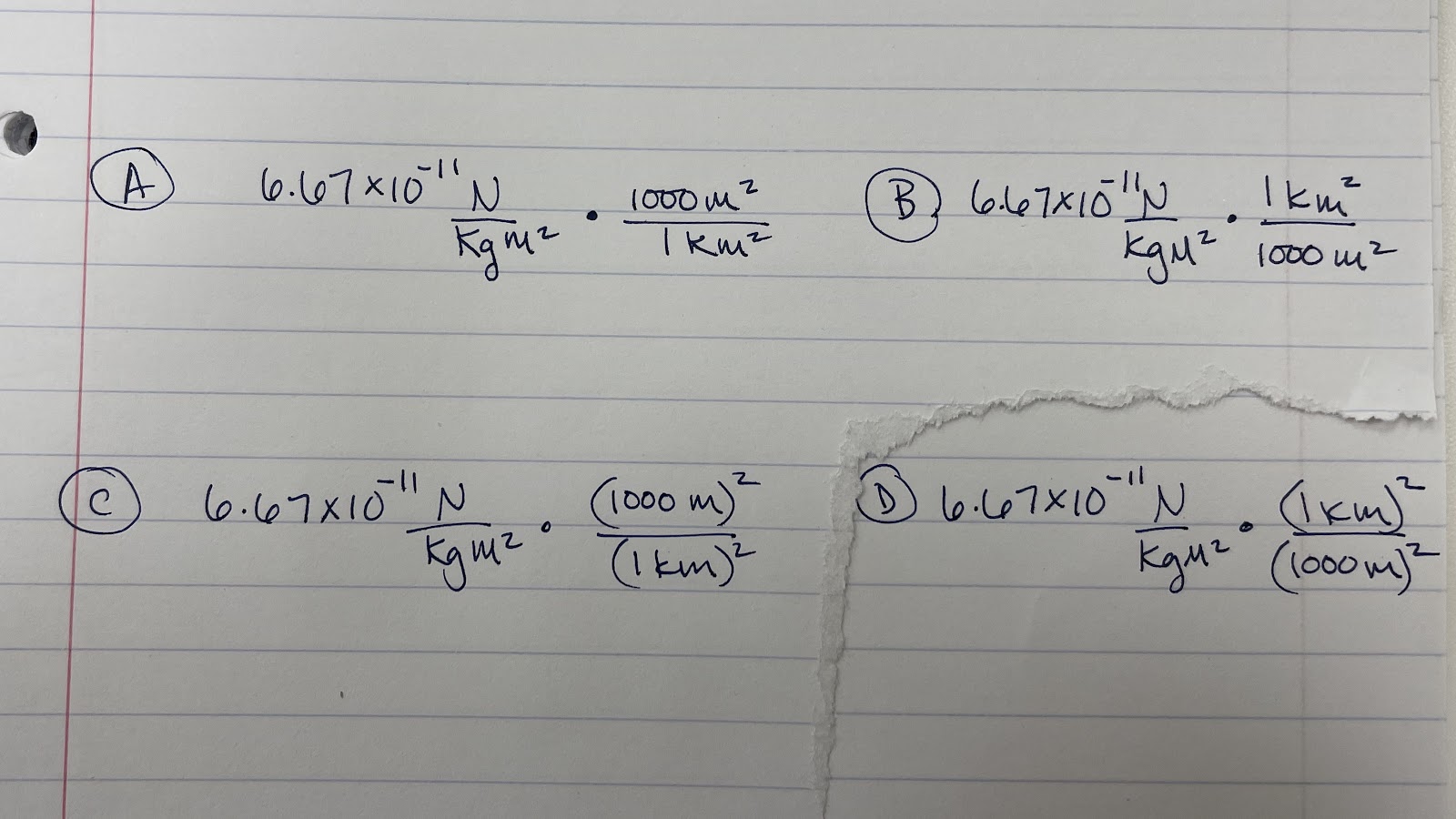
Which of the following would be a good way to convert the gravitational constant G to different units?
For which of the following examples would you count the zeros as a significant figure?
How many significant figures does each number have?
1 | 2 | 3 | 4 | |
|---|---|---|---|---|
0.023 | ||||
0.203 | ||||
1,230 | ||||
104.0 | ||||
1,040 | ||||
1.004 | ||||
1000 |
How many significant figures does the following addition problem have? 13.4+2.54
How many significant figures does answer to the following multiplication problem have? 13.2 x 3.2
Which of the following would be a good way to convert the gravitational constant G to different units?
1 AU is the same as
Three problems - Draw the following vectors on a sheet of paper, and add them. take a picture of the work and upload it here. problem 1 Draw a coordinate system and draw vector A from the origin to point (4,3), and Vector B from the origin to (2,5). Then then draw vector A+B Problem 2: draw one vector in the x direction with magnitude 3 and one vector in the y direction with magnitude 4. Then add those two vectors. Problem 3. draw a vector in the x direction with magnitude 5, and another vector in the x direction with magnitude -8. Add the two vectors Honors: Draw a vector of magnitude 8 at 20° from the x direction. Decompose this vector, and show the magnitude of its x and y components.
If a planet has a force of gravity of 3.24 x 10^22 N from the sun, and a force of 1.00 x 10^22 from a nearby massive planet that is farther from the sun than that planet, what is the net force on the planet?
Greater than/ less than question: Order these numbers from least (1) to greatest (4)
1 | 2 | 3 | 4 | |
|---|---|---|---|---|
3.4 x 10^8 | ||||
3.2 x 10^4 | ||||
3,245,132 | ||||
3.2 x 10^-9 |
Which of the following is not in scientific notation? check all that apply.
What was the purpose of constellations?
Why are some constellation in the zodiac, and others aren't
Why do stars never exhibit retrograde motion?
explain how stellar parallax argued against heliocentrism
Copernicus' calculations using heliocentrism still didn't predict where planets would be in their orbits compared to the geocentric models. What did he still not know that would have made a difference?
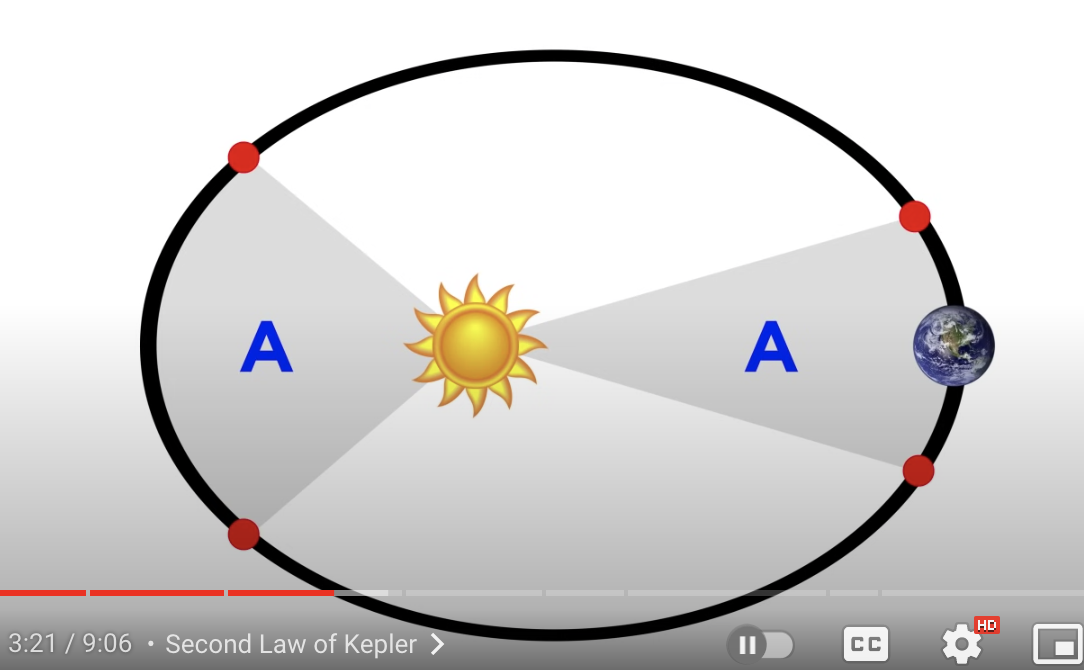
according to Kepler's second law,
Which of the following is a relative measure and which of the following an absolute measure?
Absolute | relative | |
|---|---|---|
position of an object | ||
distance between two objects | ||
angular distance | ||
angular diameter | ||
linear distance | ||
linear diameter | ||
velocity |
The farther a planet is from the sun, the orbital speed is
The force of gravity between two objects relies on which of the following factors, check all that apply
define ecliptic
define horizon
define tidal braking
define synchronous orbit
explain why even though the explanation of tidal forces is the moon pulling on the near side of the earth more than the center and far side of the earth is accurate, the actual tides are caused less by that pulling, and more by squeezing from the sides.
A spring tide happens when?
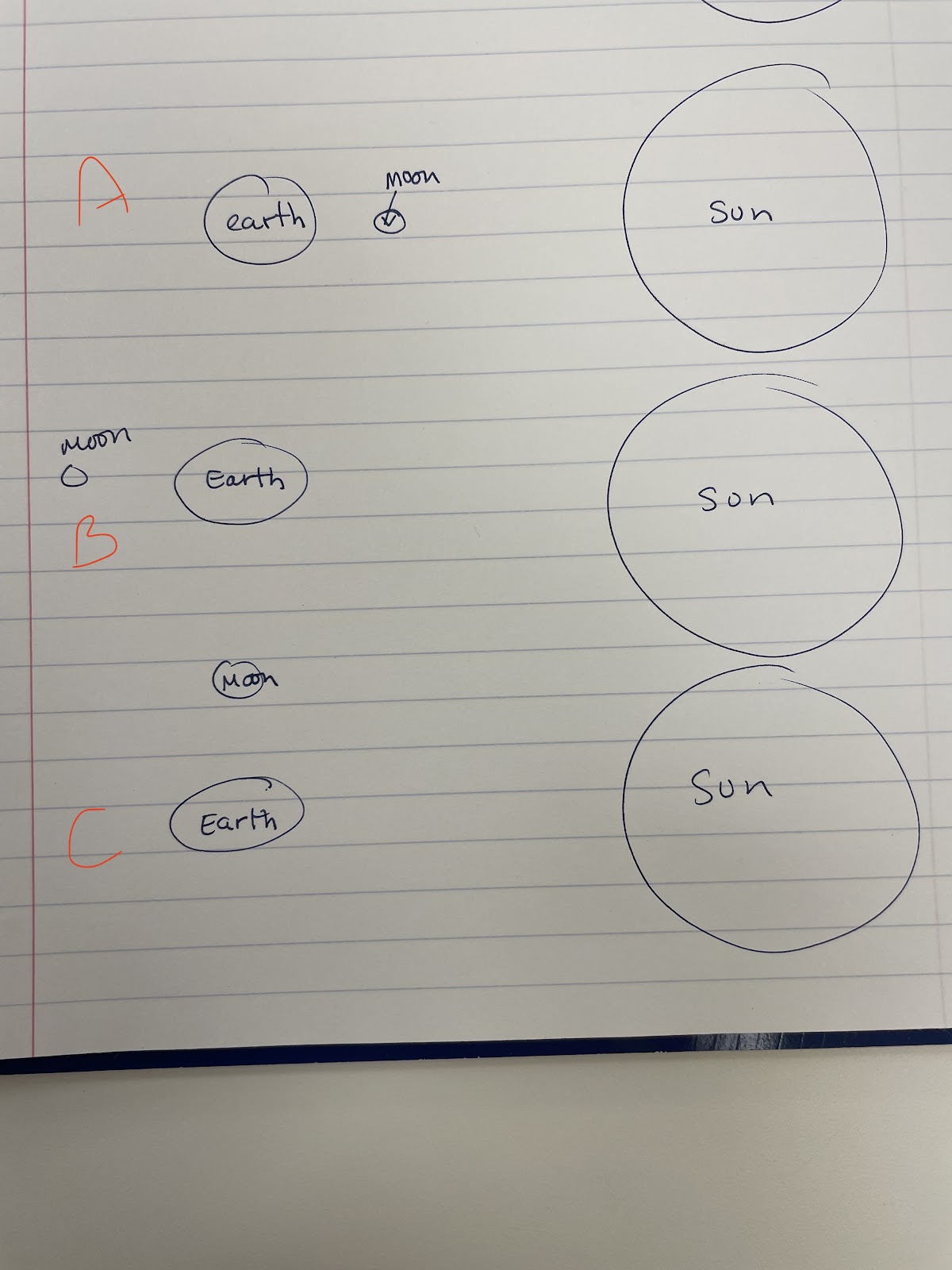
A neap tide happens when?
honors or on level
Titan, the largest moon of Saturn, has a mean orbital radius of 1.22x10^9 m. The orbital period of Titan is 15.95 days. Hyperion, another moon of Saturn, orbits at a mean radius of 1.48x10^9 m. Use Kepler’s third law of planetary motion to predict the orbital period of Hyperion in days.
create a question that requires the use of Newton's law of universal gravitation
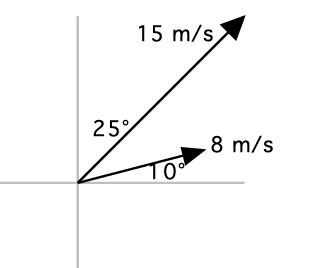
Using x=dcosθ and y=dsinθ, decompose both these vectors into their x and y components. Note that the 25° is NOT from the x axis (as in, you will have to do something with that)
Using Kepler's second law, explain why comets are slow far from the sun, and fast near the sun.
Using Kepler's third law, explain what would happen if something managed to slow down a planet's orbit
How do you depict a negative vector?