If something emits a continuous spectrum, what does that mean?
1 point
1
Question 2
2.
Why, if a sun emits a continuous spectrum do we record it as an absorption spectrum from earth?
1 point
1
Question 3
3.
The analogy - light is like the Flash, he always runs at avery specific speed, but he will stop and shake hands with all the people in his path. The people represent atoms in the path of the light. Thinking through this analogy, check all the boxes that are true
1 point
1
Question 4
4.
explain the sugared up toddler analogy from class.
1 point
1
Question 5
5.
What determines how much energy an electron has?
1 point
1
Question 6
6.
Read 4.1 - pages120-128. Be sure to read the "extending our reach" section. Do you have any questions?
1 point
1
Question 7
7.
how, apart from magnification, do binoculars help you see better?
1 point
1
Question 8
8.
Telescope A's mirror has three times the diameter of telescope B, how much greater is A's light gathering power?
1 point
1
Question 9
9.
a telescopes resolving power measures its ability to see
1 point
1
Question 10
10.
Considering this information about telescopes, what affect does light pollution have on astronomers. How does light from the ground get mixed up with light coming from the stars, even on a clear night?
1 point
1
Question 11
11.
Got find a glass of water and put a spoon in the glass. Try to use as clear and smooth a glass as possible. describe what the spoon looks like from the top.
1 point
1
Question 12
12.
Got find a glass of water and put a spoon in the glass. Try to use as clear and smooth a glass as possible. describe what the spoon looks like from the side. It should be different, explain why.
1 point
1
Question 13
13.
An incandescent lightbulb is a blackbody radiator. It is heated and 10% of the energy that goes through the filament is radiated as light, where the rest is radiated as heat. LED's are different. 80% of that electricity is converted to light. Do you think you can explain how LED's work? (you don't need to do research. if you know, tell, if you don't, say so.)
1 point
1
Question 14
14.
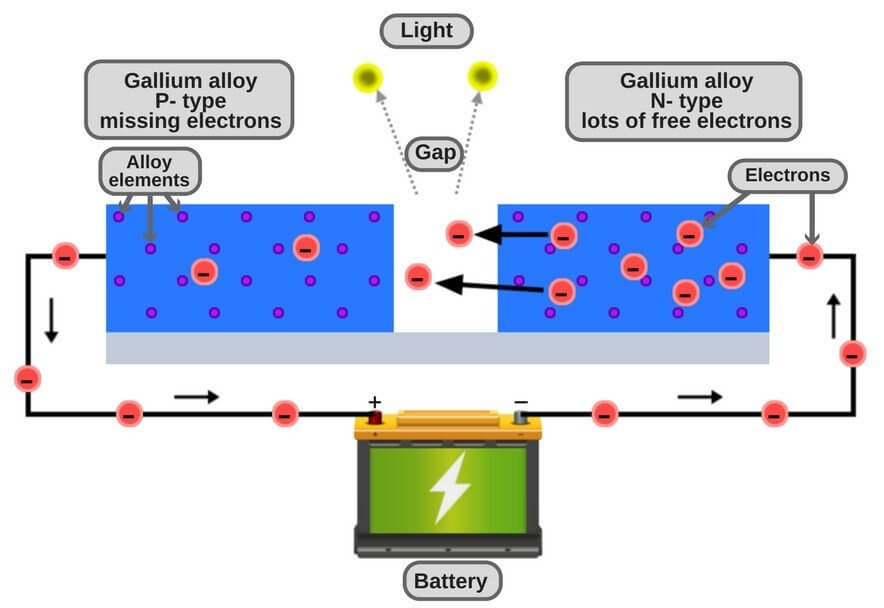
Below is a schematic of a LED light. Notice that you have two different alloys on either side of the gap. One side has lots of extra electrons, one side has a lot of missing electrons. Which of the following do you think is happening here?
1 point
1
Question 15
15.
Light, refraction and color do you have any questions?
ARGH!!!! I WAS WRONG IS CLASS. Cyan magenta and yellow are the primary colors for subtractive pigments, not light. sadness.
do you have any other questions?
1 point
1
Question 16
16.
When mixing paint, do those rules follow additive color or subtractive color?
1 point
1
Question 17
17.
When light hits a mirror, what determines what angle the light reflects off that mirror? select all that apply.
1 point
1
Question 18
18.
When light hits a another transparent medium, what determines what angle the light refracts through that medium? select all that apply.
1 point
1
Question 19
19.
I promise I understand that whenever someone in a video talks about the lower speed of light in a medium, I understand that it is the average speed through the medium, not the speed the light is moving at any given point, because that is always the same.
1 point
1
Question 20
20.
Why does your brain expect something underwater to be in a place where it is not?
1 point
1
Question 21
21.
You have produced a powerful, high tech, no refraction, no nothing, simple point and shoot instantaneous transporter. You carefully aim it at mars and transport you best friend. who then materialized a fair way into space far from mars. Why?