Essential Question: What happens when you apply more than one transformation to a figure?
Learning Target: Students will be able to apply a sequence of transformations on a figure after completing this assignment.
Use complete sentences for credit.
Complete the entire document and show work for full credit.
Essential Question: What happens when you apply more than one transformation to a figure?
Learning Target: Students will be able to apply a sequence of transformations on a figure after completing this assignment.
Use complete sentences for credit.
Complete the entire document and show work for full credit.
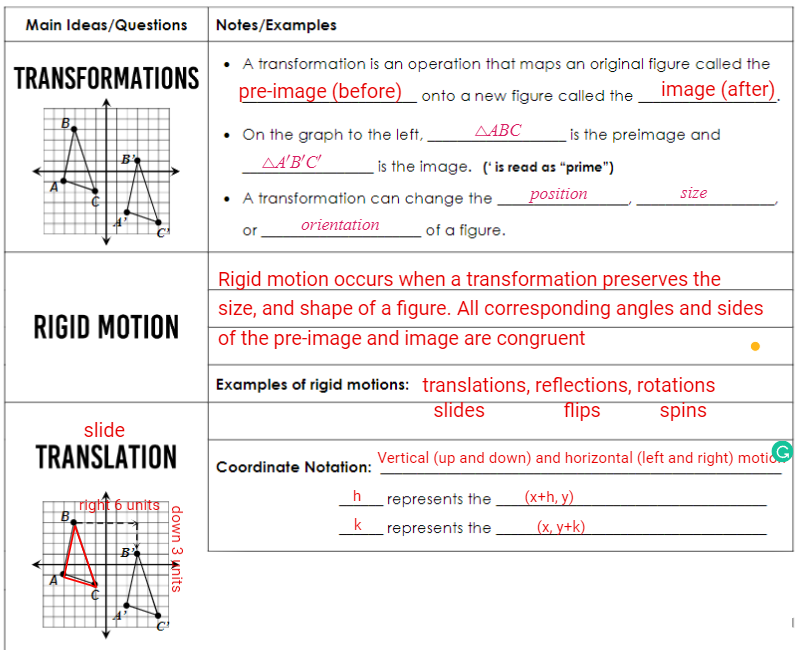
What does the following rule describe? (x, y) → (x+2, y-5)
Use your own words to describe the rule.
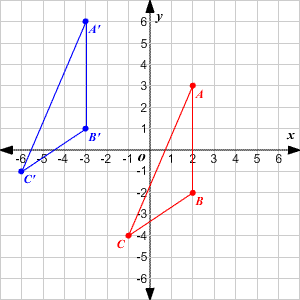
Write the translation rule in coordinate notation for the above image. (You can copy and paste the following notation)
(x,y) →
Match the description of a transformation to its coordinate form
| Stavka koja se može prevući | arrow_right_alt | Odgovarajuća stavka |
|---|---|---|
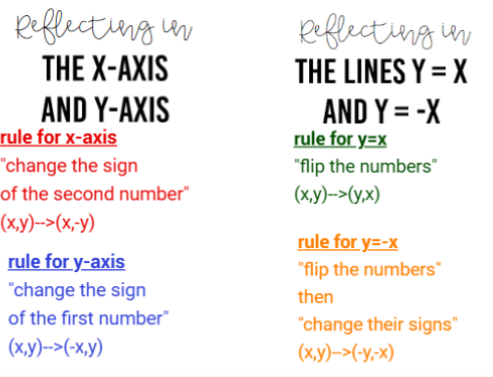
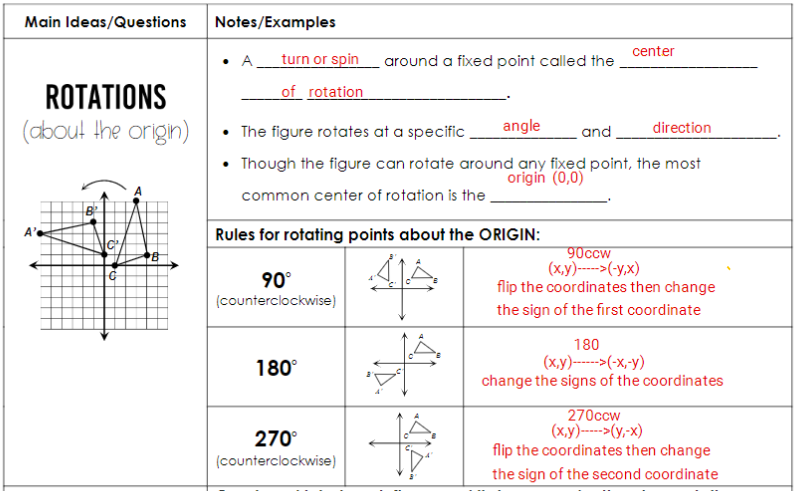
"flip the coordinates" | arrow_right_alt | reflect over the line y=-x |
"change the sign of the first number" | arrow_right_alt | rotate 270 degrees counterclockwise |
"change the signs of both number" | arrow_right_alt | rotate 90 degrees counterclockwise |
"flip the coordinates" then "change the signs of both number" | arrow_right_alt | reflect over the y - axis |
"flip the coordinates" then "change the sign of the second number" | arrow_right_alt | reflect over the x - axis |
"change the sign of the second number" | arrow_right_alt | rotate 180 degrees |
"flip the coordinates" then "change the sign of the first number" | arrow_right_alt | reflect over the line y=x |
Identify the point translated from the coordinate (-3,2). Using the rule: (x,y)-->(-x,y)
Identify the point translated from the coordinate (-3,2). Using the rule: (x,y)-->(x-2,y+3)
Identify the point translated from the coordinate (3,0). Using the rule: (x,y)-->(x,y-2)
Identify the point translated from the coordinate (0,6). Using the rule: (x,y)-->(x+3,y-8)
Identify the point reflected from the coordinate (5,5). Using the rule: (x,y)-->(-x,y)
Identify the point reflected from the coordinate (5,2). Using the rule: (x,y)-->(-y,-x)
Identify the point rotated from the coordinate (-5,1). Using the rule: (x,y)-->(-x,-y)