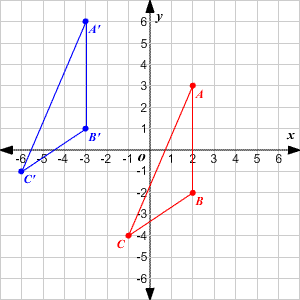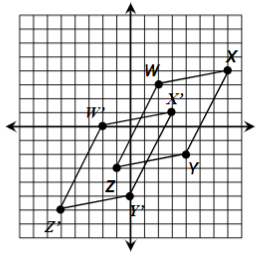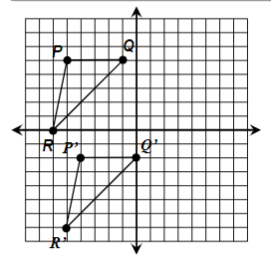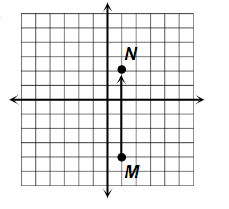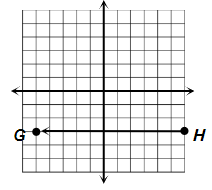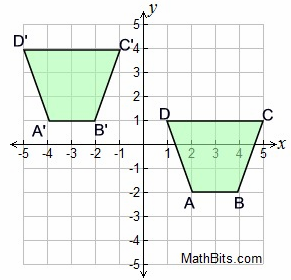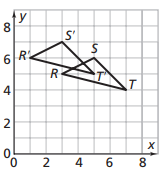
Which of the following shows the rule in coordinate notation for the translation above?
Which of the following shows the rule in coordinate notation for the translation above?
Essential Question: What happens when you slide objects on a coordinate plane?
Learning Target: Students will be able to perform translations on objects on a coordinate plane.
Complete the entire document and use full sentences when prompted for full credit.
Responses without work will receive no points.
Remember to upload work from paper when prompted to receive credit
What are the three types of rigid motion?
"Spin"
"Slide"
"Flip"
What is another word for translation besides "slide"?
Rigid motion like, translations, reflections, and rotations change the size and shape of a figure.
Match the description of a translation to its coordinate form
| Draggable item | arrow_right_alt | Corresponding Item |
|---|---|---|
to the right 1 units and down 7 units | arrow_right_alt | (x+2,y+3) |
to the right 2 units and up 3 units | arrow_right_alt | (x-5,y+6) |
to the left 3 units and down 3 units | arrow_right_alt | (x+1,y-7) |
to the left 5 units and up 6 units | arrow_right_alt | (x+3,y-3) |
to the right 3 units and up 3 units | arrow_right_alt | (x-3,y-3) |
to the left 2 units and up 8 units | arrow_right_alt | (x+3,y+3) |
to the right 1 units and up 1 units | arrow_right_alt | (x-2,y+8) |
to the right 3 units and down 3 units | arrow_right_alt | (x+1,y+1) |
When performing a translation, the image describes the object ____________ a the translation has been performed.
You need to move a figure to the right 3 units and down 4 units.
What is the coordiante notation for this rule?
What does the following rule describe? (x, y) → (x-2, y+5)
Use your own words to describe the rule.
Finish the rule for a transformation that translates 2 units up and 3 units left.
(x,y) →
Which of the following shows the rule in coordinate notation for the translation above?
Write the translation rule in coordinate notation for the above image. (You can copy and paste the following notation)
(x,y) →
Describe the translation that maps each preimage to its image in coordinate
notation.
Describe the translation that maps each preimage to its image in coordinate
notation. No Spaces
Graph and label each figure and its image under the given translation. Identify the coordinates of the image. Use coordinate form and your answer should have no spaces.
C'
D'
E'
Protip: Transform the points first then graph them.
Graph and label each figure and its image under the given translation. Identify the coordinates of the image. Use coordinate form and your answer should have no spaces.
J'
K'
L'
M'
Protip: Transform the points first then graph them.
Identify the point that is 3 units to the left and 3 units up from the coordinate (3,0).
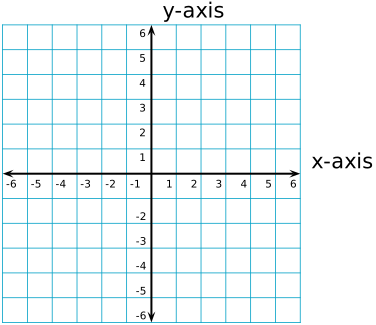
Identify the coordinate (-3,2) and the coordinate that is 1 unit to the left and 6 units down from it.
Identify the coordinate (-5,5) and the coordinate that is 5 units to the right and 1 unit up from it.
Identify the point that is 3 units to the left and 4 units down from the coordinate (3,0).
Perform the following translation:
(x,y)---->(x+3,y+2)
on the point (-1,5) and place both points on the graph.
Perform the following translation:
(x,y)---->(x-4,y+3)
on the point (-2,-1) and place both points on the graph.
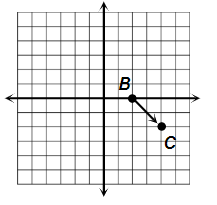
Describe the translation that maps each preimage to its image as a vector in component form: <a,b> No Spaces
Describe the translation that maps each preimage to its image as a vector in component form: <a,b> No Spaces
Describe the translation that maps each preimage to its image as a vector in component form: <a,b> No Spaces
Describe the translation that maps each preimage to its image as a vector in component form: <a,b> No Spaces
Describe the translation that maps each preimage to its image as a vector in component form: <a,b> No Spaces
You need to move a figure to the right 3 units and down 4 units.
What is the coordiante notation for this rule?
What does the following rule describe?
(x, y) → (x-2, y+5)
Finish the rule for a transformation that translates 5 units down and 2 units right.
(x,y) →
Are the two figures congruent? Explain your reasoning using complete sentences.
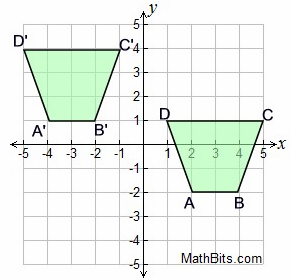
Describe the rule in coordinate notation of the translation from question 31 above?
Remember to use the coordinate notation (x,y)→(x+h,y+k)
△ABC has coordinates of A(0,4), B(-3,4), and C(-3, -1). What are the new coordinates of △A'B'C' when the figure is moved 3 units left and 1 unit up?
A'
B'
C'
Translate △RST 3 spaces down and 5 space to the right. Graph the new image. Be sure to have the correct labels of your new prime vertices.
What are the new coordinates on after you have performed the above translation?
R'-
S'-
T'-
△CAT has coordinates of C(6,1), A(6,-2), and T(2, -2). What are the new coordinates of △C'A'T' when the figure is translated 6 units down and 4 units to the left?
C'-
A'-
T'-
In your own words, describe what a translation is. (Use complete sentences)
Graph and label each figure and its image under the given translation. Identify the coordinates of the image. Use coordinate form and your answer should have no spaces.
What are the new coordinates on after you have performed the above translation?
L'
M'
N'
P'
Protip: Transform the points first then graph them.
Graph and label each figure and its image under the given translation. Identify the coordinates of the image. Use coordinate form and your answer should have no spaces.
What are the new coordinates on after you have performed the above translation?
F'
G'
H'
I'
Protip: Transform the points first then graph them.
Graph and label each figure and its image under the given translation. Identify the coordinates of the image. Use coordinate form and your answer should have no spaces.
W'
X'
Y'
Z'
Protip: Transform the points first then graph them.
Essential Question:
What was the Essential Question of this assignment?
(Use complete sentences for full credit)
Learning Outcomes
Does a translation ever change the orientation of a figure (the way it is facing)?
(Use complete sentences for full credit)
1 Question I have.
1 question I have is...
(Must be a question)
OR
What was the hardest part of the assignment?