Log in
Sign up for FREE
arrow_back
Library

Unit 5: Transformations Study Guide (Due 2/4/25)

star
star
star
star
star
Last updated 2 days ago
26 questions
Note from the author:
Required
5
Required
10
Required
10
Required
21
Required
5
Required
5
Required
10
Required
10
Required
5
Required
5
Required
5
Required
5
Required
5
Required
5
Required
5
Required
5
Required
5
Essential Question: What happens when you apply more than one transformation to a figure?

Learning Target: Students will be able to apply a sequence of transformations on a figure after completing this assignment.

Use complete sentences for credit.

Complete the entire document and show work for full credit.
Essential Question: What happens when you apply more than one transformation to a figure?

Learning Target: Students will be able to apply a sequence of transformations on a figure after completing this assignment.

Use complete sentences for credit.

Complete the entire document and show work for full credit.

Unit 6 Transformation Review

Translations:

Required
20
Question 1
1.
Transform the figure with the given translation.

Triangle ABC with vertices A(0, 7), B(7, 3), and C(1, 4): (x, y) → (x – 3, y – 4)

A'_______
B'_______
C'_______
Required
20
Question 2
2.

Reflections:


Required
20
Question 3
3.
Reflection the figure over the given line of reflection.

Triangle FGH with vertices F(1, 8), G(5, 7), and H(2, 3): x-axis

F'_______
G'_______
H'_______
Required
20

Reflections:


Required
20
Question 5
5.
Reflection the figure over the given line of reflection.

Triangle FGH with vertices F(1, 8), G(5, 7), and H(2, 3): y = x

F'_______
G'_______
H'_______
Required
20
Question 6
6.

Rotations:


Required
20
Question 7
7.
Rotate this figure with the given angle and direction.

Triangle FGH with vertices F(-7, 8), G(-1, 1), and H(-8, 4): 90° counterclockwise

F'_______
G'_______
H'_______
Required
20
Required
20

Transformation Practice

Question 10
10.

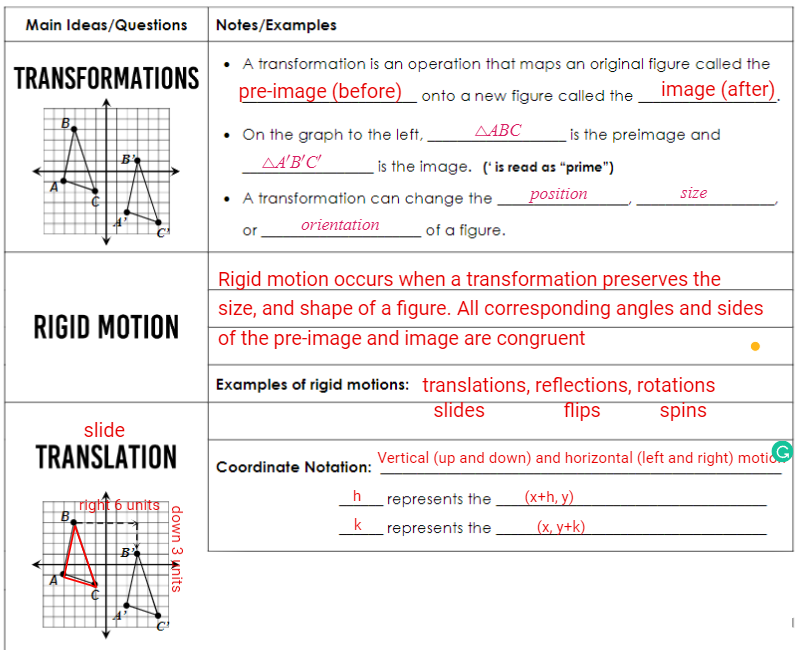
What does the following rule describe? (x, y) → (x+2, y-5)

Use your own words to describe the rule.

Question 11
11.


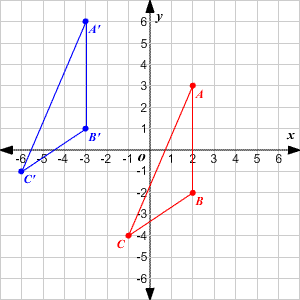
Write the translation rule in coordinate notation for the above image. (You can copy and paste the following notation)

(x,y) →

Question 12
12.
You need to move a figure to the right 3 units and down 4 units.

What is the coordinate notation for this rule?
(x, y) → _______

What is the vector notation that describes this rule?
_______
Question 13
13.

Draggable itemarrow_right_altCorresponding Item
arrow_right_alt
arrow_right_alt
arrow_right_alt
arrow_right_alt
arrow_right_alt
arrow_right_alt
arrow_right_alt
Question 14
14.
The point (3,-2) is reflected and the new point is (-2,3). The line of reflection was the line _______
Question 15
15.
The point (-5,2) is reflected and the new point is (-2,5). The line of reflection was the line _______
Question 16
16.
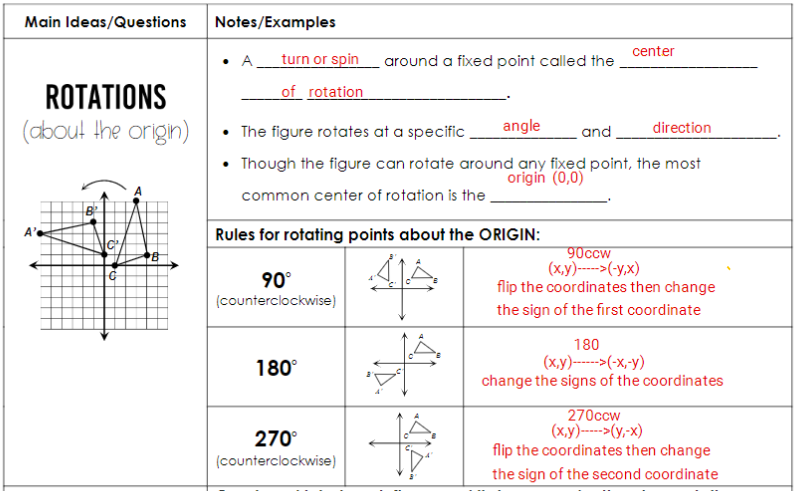
Finish each rule for counterclockwise rotations about the origin using coordinate form:

90⁰ rotation counterclockwise (x, y) →_______
180⁰ rotation counterclockwise (x, y) →_______
270⁰ rotation counterclockwise (x, y) →_______
Question 17
17.
Finish each rule for counterclockwise rotations about the origin using coordinate form:
90⁰ rotation counterclockwise is the same as _______⁰ rotation clockwise.

_______⁰ rotation counterclockwise is the same as 180⁰ rotation clockwise.
90⁰ rotation clockwise is the same as _______⁰ rotation counterclockwise.
Question 18
18.
What kind of rotation is this?
(2,-3)→(-3,-2)

Use " ⁰ " in your answer.
_______
Question 19
19.
What kind of rotation is this?
(4,0)→(-4,0)

Use " ⁰ " in your answer.
_______
Question 20
20.

Identify the point translated from the coordinate (-3,2). Using the rule: (x,y)-->(-x,y)

Question 21
21.

Identify the point translated from the coordinate (-3,2). Using the rule: (x,y)-->(x-2,y+3)

Question 22
22.

Identify the point translated from the coordinate (3,0). Using the rule: (x,y)-->(x,y-2)

Question 23
23.

Identify the point translated from the coordinate (0,6). Using the rule: (x,y)-->(x+3,y-8)

Question 24
24.

Identify the point reflected from the coordinate (5,5). Using the rule: (x,y)-->(-x,y)

Question 25
25.

Identify the point reflected from the coordinate (5,2). Using the rule: (x,y)-->(-y,-x)

Question 26
26.

Identify the point rotated from the coordinate (-5,1). Using the rule: (x,y)-->(-x,-y)

Transform the figure with the given translation.

Translate the triangle ABC with vertices A(-2, 3), B(6, -2), and C(0, 0) with the vector <-5,-2>

A'_______
B'_______
C'_______
Question 4
4.
Reflection the figure over the given line of reflection.

Triangle FGH with vertices F(1, 8), G(5, 7), and H(2, 3): y-axis

F'_______
G'_______
H'_______
Reflection the figure over the given line of reflection.

Triangle FGH with vertices F(-2, -3), G(-4,0), and H(-6, 1): y = - x

F'_______
G'_______
H'_______
Question 8
8.
Rotate this figure with the given angle and direction.

Triangle FGH with vertices F(-7, 8), G(-1, 1), and H(-8, 4): 180°

F'_______
G'_______
H'_______
Question 9
9.
Rotate this figure with the given angle and direction.

Triangle FGH with vertices F(-7, 8), G(-1, 1), and H(-8, 4): 270° counterclockwise

F'_______
G'_______
H'_______
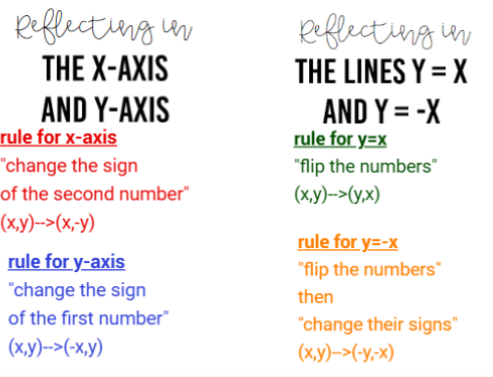
Match the description of a transformation to its coordinate form
"flip the coordinates"
reflect over the line y=-x
"change the sign of the first number"
rotate 270 degrees counterclockwise
"change the signs of both number"
rotate 90 degrees counterclockwise
"flip the coordinates" then "change the signs of both number"
reflect over the y - axis
"flip the coordinates" then "change the sign of the second number"
reflect over the x - axis
"change the sign of the second number"
rotate 180 degrees
"flip the coordinates" then "change the sign of the first number"
reflect over the line y=x