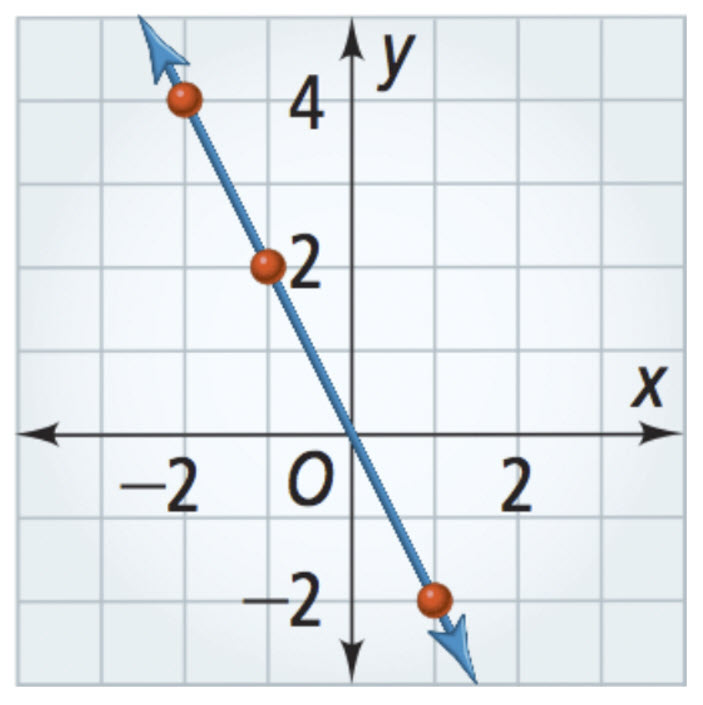
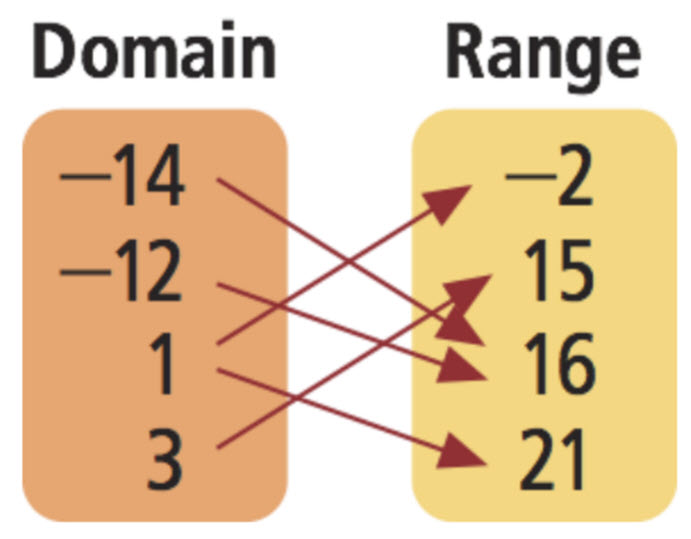
Categorize each representation of a relation on the left based on its type.
Categorize each representation of a relation on the left based on its type.
\{(3,-9),(11,21),(121,34),(34,1)\} 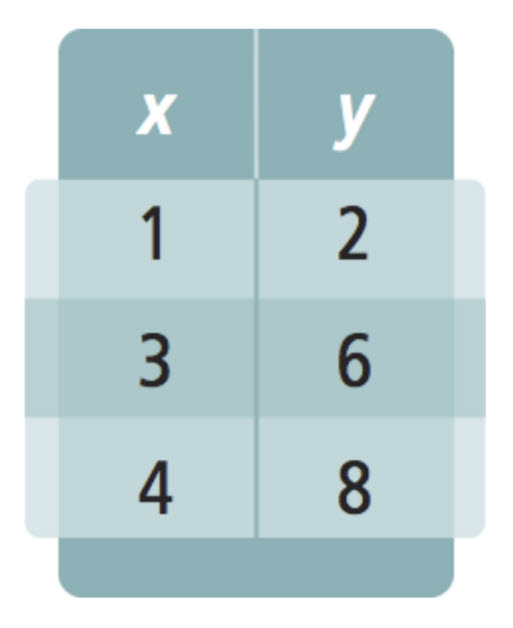
Ordered Pairs
Mapping Diagram
Table of Values
Graph
Essential Question: How can functions be used to model real-world relationships and solve problems in everyday situations?
Learning Target: Students will be able to apply functions to represent relationships between variables and use them to solve problems in various contexts, such as finding outputs for given inputs, interpreting graphs, and understanding how changes in one variable affect another.
Show your work for credit.
Categorize each representation of a relation on the left based on its type.
Ordered Pairs
Mapping Diagram
Table of Values
Graph
Classify each item on the left based on whether it describes the domain or range of a relation.
Represented on the horizontal axis of a coordinate plane
The output values of a relation
The y-values of a relation (usually)
The input values of a relation
Represented on the vertical axis of a coordinate plane
The x-values of a relation (usually)
Domain
Range
Directions: Complete each function table, then graph the function.
Directions: Complete each function table, then graph the function.
Solve this multi-step equation. Show your work (SYW)
Complete the following notes regarding how to use function notation.
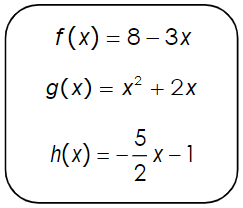
Evaluate each function for the given value.
Evaluate each function for the given value.
Evaluate each function for the given value.
Evaluate each function for the given value.
Evaluate each function for the given value.
Evaluate each function for the given value.
Evaluate each function for the given value.
Anthropologists use the length of certain bones of the human skeleton to estimate the height of the living person. One of these bones is the femur. To estimate the height in centimeters of a female with a femur length of x, the function h(x) = 61.41 + 2.32x can be used. If a 46 cm femur bone is discovered at a dig site, using the height function, estimate how tall the person was that bone belonged to.
Drag the values from the left to identify the domain and range of the relation.
Place each value only once.
-2
-1
1
4
2
-4
7
-7
Domain
Range
Consider the relation {(-2, -3), (-1, 4), (0, 5), (1, 6)}.
Represent the relation with a mapping diagram. Remember to label the domain and range in your diagram.
Translate this expression.
“eighteen less than a number”
Which words or phrases have the same meaning as addition?
Which words or phrases have the same meaning as subtraction?
Which words or phrases have the same meaning as division?
Which words or phrases have the same meaning as multiplication?
Solve this equation
Solve each proportion.
Solve and graph the inequality for the given variable.
Evaluate each expression using the variable replacements.
Evaluate each expression using the variable replacements.
Directions: Give the perimeter of each figure as a simplified expression.
Now find the actual perimeter if y=13 meters
Finally, find the area if y=7 meters
Directions: Give the perimeter of each figure as a simplified expression.
Now find the actual perimeter if y=8 meters


The amount of water w in a wading pool, in gallons, depends on the amount of time t, in minutes, the wading pool has been filling, as related by the function rule w = 3t.
1) Graph the function rule.
Be sure to include relevant graph detail: label axes, indicate units on both axes, and use arrows to represent end behavior, as appropriate.
2) If the pool can hold 70 gallons, how long would it take to fill it.
Use the function w(x) = 250x, which represents the average number of words a person can read in one minute to determine many words the average person can read in 6 minutes.
Using w(x)=250x, how many minutes would it take to read the first Harry Potter book if the it has 76944 words?
Essential Question:
What was the Essential Question of this assignment?
(Use complete sentences for full credit)
Learning Outcomes
What is one thing you learned?
(Use complete sentences for full credit)
Summarize the Topic
What was this lesson about?
(Use complete sentences for full credit)
Evaluate each function for the given value.
Evaluate each function for the given value.
1 Question I have.
1 question I have is...
(Must be a question)
OR
What was the hardest part of the assignment?