Thanksgiving Break Extra Credit: IM 1 Semester Review (Due 12/1/25)
star
star
star
star
star
Last updated 5 months ago
61 Nsɛmmisa
Solve the equation for the given variable.
Solve the equation for the given variable.
Solve the equation for the given variable.
Solve the equation for the given variable.
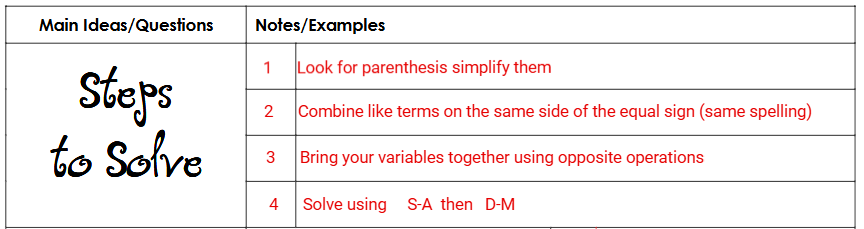
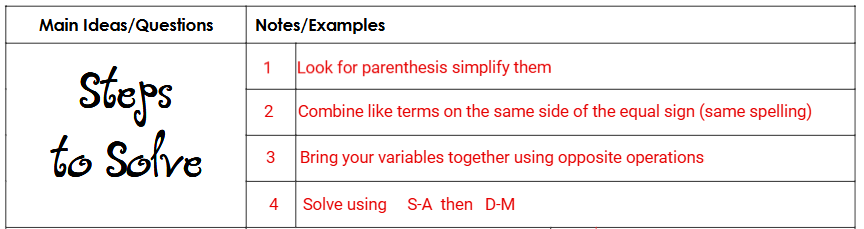
Rules to solve Two-Step Equations:
1. Undo the Addition/Subtraction
(to remove the constant term)
2. Undo the Multiplication/Division
(to remove the coefficient in front of
the variable)
Solve and graph the inequality for the given variable.
Solve and graph the inequality for the given variable.
Solve and graph the inequality for the given variable.
Solve the equation for the given variable.
Solve the equation for the given variable.
Solve the equation for the given variable.
Use the set of ordered pairs to complete the relation table, relation mapping, and coordinate graph.
Use the set of ordered pairs to complete the relation table, relation mapping, and coordinate graph.
Evaluate each function for the given value.
Evaluate each function for the given value.
Evaluate each function for the given value.
Translate the verbal phrase into an algebraic expression. Do not use spaces.
"The quotient of w and ten."
Translate the verbal phrase into an algebraic expression. Do not use spaces.
"One less than the product of four and a number x."
Translate the verbal phrase into an algebraic expression. Do not use spaces.
"Seven more than twice a number n."
Translate the verbal phrase into an algebraic expression. Do not use spaces
"Seventeen more than a number x."
Translate the expression into a verbal phrase.
This question will may not turn green or red until I read and grade it since there are many ways to write it and spell things.
Translate the expression into a verbal phrase.
This question will may not turn green or red until I read and grade it since there are many ways to write it and spell things.
Translate the expression into a verbal phrase.
This question will may not turn green or red until I read and grade it since there are many ways to write it and spell things.
Translate the expression into a verbal phrase.
This question will not turn green or red until I read and grade it since there are many ways to write it and spell things.
Simplify this expression:
Simplify the expression. Show your work on a separate piece of paper.
Simplify this expression:
Simplify this expression:
Evaluate the expression. Show your work on a separate piece of paper.
Simplify this expression:
What is the value of this expression if x=5?
Write the perimeter of the triangle as a simplified expression.
Perimeter-
If x=3 inches what is the perimeter? (Don't forget to use the unit of measurement in your answer)
Solve the equation for the given variable.
Solve the equation for the given variable.
Solve the equation for the given variable.
Solve the equation for the given variable.
Solve the equation for the given variable.
Solve the equation for the given variable.
Solve the equation for the given variable.
Solve the equation for the given variable.
Solve the equation for the given variable.
Solve the equation for the given variable.
Solve the equation for the given variable.
Solve the equation for the given variable.
Determine whether the given relation is a function. (Function or Not a Function)
Determine whether the given relation is a function. (Function or Not a Function)
Determine whether the given relation is a function. (Function or Not a Function)
Determine whether the given relation is a function. (Function or Not a Function)
Determine whether the given relation is a function. (Function or Not a Function)
Determine whether the given relation is a function. (Function or Not a Function)
Determine whether the given relation is a function. (vor Not a Function)
Determine whether the given relation is a function. (Function or Not a Function)
Determine whether the given relation is a function. (Function or Not a Function)
Determine whether the given relation is a function. (Function or Not a Function)
Determine whether the given relation is a function. (Function or Not a Function)
Determine whether the given relation is a function. (Function or Not a Function)
Determine whether the sequences are arithmetic. If yes, identify the common difference.
Is this an arithmetic sequence?
What is the common difference? (If it is not a sequence state n/a)
d=
Determine whether the sequences are arithmetic. If yes, identify the common difference.
Is this an arithmetic sequence?
What is the common difference? (If it is not a sequence state n/a)
d=
Given the arithmetic sequence, find the next three terms.
9, 13, 17, 21,
Given the arithmetic sequence, find the next three terms.
-8, -2, 4, 10,
-2, 0, 2, 4, ...
Rule
30, 26, 22, 18, ...
Rule
-11, -8, -5, -2 ...
Rule