Guided Practice:
Connecting intercepts and factors
Graph the Function y=(x − 3)(x + 5)
Where does the parabola intercept (cross) the x-axis?
Connecting intercepts and factors
Graph the Function y=(x + 6)(x - 1)
Where does the parabola intercept (cross) the x-axis?
x=
Connecting intercepts and factors
Graph the Function y=2(x - 8)(x - 8)
Where does the parabola intercept (cross) the x-axis?
x=
Connecting intercepts and factors
Graph the Function y=-6(x + 3)(x)
Where does the parabola intercept (cross) the x-axis?
x=
Graph the Function y=(x + 6)(x + 2)
1) What are the x-intercepts? (Where the graph crosses the x-axis)
x=
2) What is the axis of symmetry? (The middle of the parabola, put your hands together)
x=
Graph the Function y=(x - 6)(x + 2)
1) What are the x-intercepts? (Where the graph crosses the x-axis)
x=
2) What is the axis of symmetry? (The middle of the parabola, put your hands together)
x=
Graph the Function y=2(x + 7)(x - 3)
1) What are the x-intercepts? (Where the graph crosses the x-axis)
x=
2) What is the axis of symmetry? (The middle of the parabola, put your hands together)
x=
Graph the function y=(x - 4)(x - 2). What is the relationship between the axis of symmetry and its intercepts?
Guided Practice
Graph the function using its intercepts.
Graph each quadratic function and each of its linear factors. Then identify the x-intercepts and the axis of symmetry of each parabola.
Left x-intercept (use coordinate form)
Right x-intercept (use coordinate form)
Axis of Symmetry (use x=___ form)
Vertex (use coordinate form)
Graph each quadratic function and each of its linear factors. Then identify the x-intercepts and the axis of symmetry of each parabola.
Left x-intercept (use coordinate form)
Right x-intercept (use coordinate form)
Axis of Symmetry (use x=___ form)
Vertex (use coordinate form)
Guided Practice: Graphing and Interpreting Quadratic Functions
The height of a football after it has been kicked from the top of a hill can be modeled by the equation:

Where h is the height of the football in feet and t is the time in seconds.
How long is the football in the air?
How high does the football get?
Graph the function to answer the question.
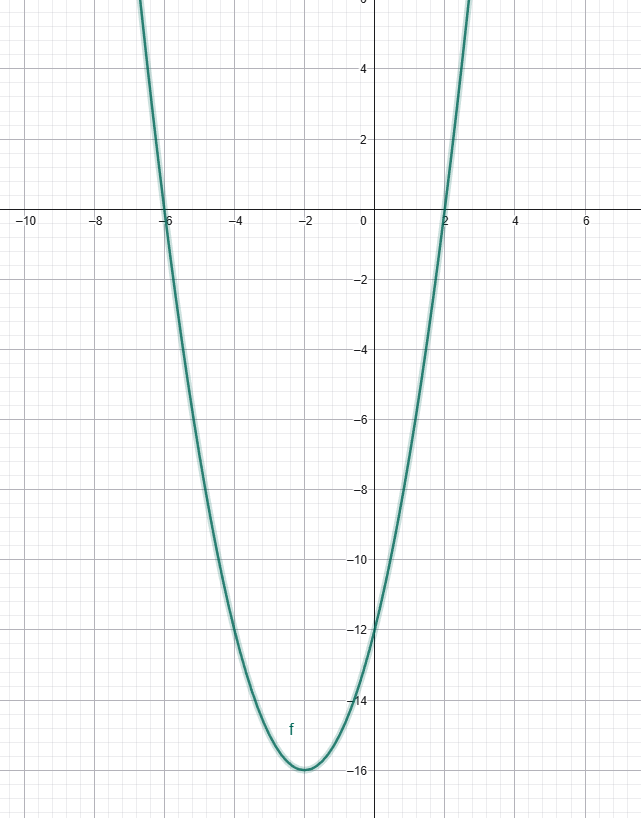
Graphing and Interpreting Quadratic Functions:
The height of a flare fired from the deck of a ship can be modeled by h = (−4t + 24)(4t + 4) where h is the height of the flare above water in feet and t is the time in seconds.
Find the number of seconds it takes the flare to hit the water.
How many seconds does it take to reach its highest point?
Graph the function to answer the question.
A trampolinist steps off from 15 feet above ground to a trampoline 13 feet
below. The function h (t) = -16 t²+ 15, where t represents the time in seconds, gives
the height h, in feet, of the trampolinist above the ground as he falls. When will the
trampolinist land on the trampoline? (Round your answer to the nearest hundredth)
t=
Graph the quadratic equation to help you answer the question.
Graph each quadratic function and each of its linear factors. Then identify the x-intercepts and the axis of symmetry of each parabola.
Left x-intercept (use coordinate form)
Right x-intercept (use coordinate form)
Axis of Symmetry (use x=___ form)
Vertex (use coordinate form)
Graph each quadratic function and each of its linear factors. Then identify the x-intercepts and the axis of symmetry of each parabola.
Left x-intercept (use coordinate form)
Right x-intercept (use coordinate form)
Axis of Symmetry (use x=___ form)
Vertex (use coordinate form)
Graph each quadratic function and each of its linear factors. Then identify the x-intercepts and the axis of symmetry of each parabola.
Left x-intercept (use coordinate form)
Right x-intercept (use coordinate form)
Axis of Symmetry (use x=___ form)
Vertex (use coordinate form)
Graph each quadratic function and each of its linear factors. Then identify the x-intercepts and the axis of symmetry of each parabola.
Left x-intercept (use coordinate form)
Right x-intercept (use coordinate form)
Axis of Symmetry (use x=___ form)
Vertex (use coordinate form)
Solve this linear equation.
What does is it mean to solve an equation?
Click on the x-intercepts to this quadratic equation.

Sometimes x-intercepts are called the "zeroes" of a equation. Based on the graph of quadratic equations why do you think that is?
How many intercepts can a quadratic equation have?
How many zeroes can a quadratic equation have?
When the graph of an equation crosses the x-axis it is called an
Another name for an x-intercept is a .
The reason it is called a zero is because the graph crosses the x-axis when the y-value of the equation is .
Another name for when y=0 is the of the equation.
Click on the solutions to this quadratic equation.

Find the x-intercepts the following Quadratic function:
y=(x - 7)(x + 7)
x-intercepts
x=
x=
Solve the quadratic equation (x - 7)(x + 7)=0 ←(this is when y=0)
Left solution
Right solution
What is the difference between the solutions to a quadratic equation and its x-intercepts?
How many solutions can a quadratic equation have?
What are the intercepts to this quadratic equation
Left Intercept:
Right Intercept:
What are the zeroes to this quadratic equation
Left Solution:
Right Solution:
Solve this quadratic equation graphing
x=
x=
Solve this quadratic equation graphing.
x=
x=
Solve this quadratic equation graphing.
x=
x=
Solve this quadratic equation graphing.
x=
x=
Solve this quadratic equation graphing.
x=
x=
Solve this quadratic equation graphing.
x=
x=
Solve this quadratic equation graphing.
x=
x=
Draw an example of a quadratic equation with 0 solutions.
Solve this quadratic equation graphing.
x=
x=
A bird is in a tree 30 feet off the ground and drops a twig that lands on a
rosebush 25 feet below. The function h (t) = -16t²+ 30, where t represents the time
in seconds, gives the height h, in feet, of the twig above the ground as it falls. When
will the twig land on the bush?
Solve this quadratic equation graphing.
t=
Solve the following Quadratic function:
(2x + 3)(x + 1) = 0
x=
x=
Solve the following Quadratic function:
x(8x + 3) = 0
x=
x=