Is this an open or closed interval?
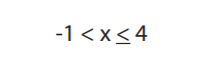
Is this an open or closed interval?
Use the graph to create a function with the following features:
1) As x gets smaller; the function gets larger. x→ - ∞; f(x)→ ∞
2) As x gets larger; the function gets larger. x→ ∞; f(x)→ ∞
3) The graph of the function passes through the x-axis at -3.
Use the graph to create a function with the following features:
1) As x gets smaller; the function get larger. x→ - ∞; f(x)→ ∞
2) As x gets larger; the function get smaller. x→ ∞; f(x)→ - ∞
3) The graph of the function passes through the x-axis at -3.
4) The graph of the function passes through the x-axis at 0.
Fill in the blanks for the attributes of the functions shown in the graph.
∞
f (x) is positive on the interval=
f (x) is negative on the interval=
f (x) has a zero(s) at x=
f(x) is increasing on the interval=
f (x) is decreasing on the interval=
f (x) has a local minimum of f(x)=
f (x) has a local minimum of f(x)=
f (x) has a local minimum of f(x)=
Fill in the blanks for the attributes of the functions shown in the graph.
f (x) is positive on the interval=
f (x) is negative on the interval=
f (x) has a zero at =
f(x) is increasing on the interval=
f (x) is decreasing on the interval=
f (x) has a local minimum of f(x)=
f (x) has a local minimum of f(x)=
Fill in the blanks for the attributes of the functions shown in the graph.
f (x) is positive on the interval=
f (x) is negative on the interval=
f (x) has a zero(s) at x =
f(x) is increasing on the interval=
f (x) is decreasing on the interval=
f (x) has a local minimum of f(x)=
f (x) has a local maximum of f(x)=
Fill in the blanks for the attributes of the functions shown in the graph.
f (x) is positive on the interval=
f (x) is negative on the interval=
f (x) has a zero(s) at =
f(x) is increasing on the interval=
f (x) is decreasing on the interval=
f (x) has a local minimum of f(x)=
f (x) has a local maximum of f(x)=
Fill in the blanks for the attributes of the functions shown in the graph.
f (x) is positive on the interval=
f (x) is negative on the interval=
f (x) has a zero(s) at =
f(x) is increasing on the interval=
f (x) is decreasing on the interval=
f (x) has a local minimum of f(x)=
f (x) has a local maximum of f(x)=
For what interval of x is the function f(x) increasing?
For what interval of x is the function f(x) decreasing?
Identify one interval of (x) where the function f(x) positive.
Identify one interval of time (x) where the function f(x) decreasing.
Identify one interval of time (x) where the function f(x) increasing.
Identify the intervals of x where the function f(x) increasing.
For what interval of x is the function f(x) decreasing?
Find the missing value of c.
Is this an open or closed interval?
Use interval notation to describe the domain of this function.
Simplify. Your answer should not have negative exponents.
Essential Question:
What was the Essential Question of this assignment?
(Use complete sentences for full credit)
Learning Outcomes
What is one thing you learned?
(Use complete sentences for full credit)
1 Question I have.
1 question I have is...
(Must be a question)
OR
What was the hardest part of the assignment?