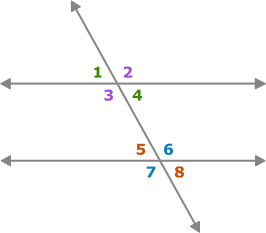
Select all the adjacent angles to ∠5
Select all the adjacent angles to ∠5
Create a visual representation of this theorem:
If a quadrilateral is a parallelogram then its opposite angles are congruent.
Use the properties of parallelograms to solve for the unknown values.
y=
∠B=
∠C=
Create a visual representation of this theorem:
If a quadrilateral is a parallelogram then its opposite sides are congruent.
Use the properties of parallelograms to solve for the unknown values.
x=
B̅C̅=
Create a visual representation of this theorem:
If a quadrilateral is a parallelogram then its adjacent angles are supplementary.
Use the properties of parallelograms to solve for the unknown values.
n=
∠P=
∠Q=
Create a visual representation of this theorem:
If a quadrilateral is a parallelogram then its diagonals bisect each other.
Use the properties of parallelograms to solve for the unknown values.
x=
y=
T̅S̅=
TP=
Match the definition of the angle relationship with the angle relationships it describes...
| Draggable item | arrow_right_alt | Corresponding Item |
|---|---|---|
Any two angles whose sum is 180° | arrow_right_alt | Vertical angles |
Two angles that are next to each other and share a common side. | arrow_right_alt | Supplementary angles |
Two angles across from each other on intersecting lines. They are always congruent! | arrow_right_alt | Complementary angles |
Any two angles whose sum is 90° | arrow_right_alt | Linear pairs |
Two angles that are adjacent and supplementary. They form astraight line! | arrow_right_alt | Adjacent Angles |
Draw an example of supplimentary angles.
Draw an example of complimentary angles.
Select all the adjacent angles to ∠5
Select all the congruent angles to ∠1
Select all the supplement angles to ∠4
Select the alternate interior angle to ∠4
Select the c angle to ∠5
If m∠PQT = (12x - 40)° and m∠SQR = (7x + 25)°, find the value of x.
x=
m∠SQR =
m∠TQP =
Label the remote interior angles of the triangle.
Solve for x. Then find the measure of each angle.
x=
∠4=
Solve for z.
z=
Find the measures.
m∠ACB=
m∠CAB=
m∠ABC=
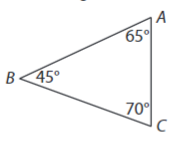
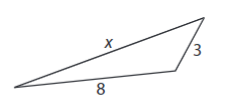
For each triangle, write the side lengths in order from least to greatest.
Find the range of possible values for x using the Triangle Sum Theorem from your page 5 notes.
<x<
Solve for x.
Find the measure of the indicated angle.
x=
m∠T=
m∠R=
Solve for x.
Find the length of the indicated side.
x=
DE=
m∠E=
Solve for x.
Find the length of the indicated side.
x=
OM=
m∠G=