Twa kɔ nsɛm atitiriw so
Log in
Sign up for FREE
arrow_back
Laabri

Copy of #9 Isosceles and Equilateral Triangles and Triangle Inequalities (Due 2-17-22) (4/17/2024)

star
star
star
star
star
Last updated 3 months ago
18 Nsɛmmisa

Essential Question: How can we determine the angles and side lengths of Isosceles and Equilateral Triangles. Learning Target: Students will be able to calculate the angles and side lengths of Isosceles and Equilateral Triangles. Complete the entire document and show all work for full credit.

Part I

Isosceles and Equilateral Triangles

Ɛhia
10
Ɛhia
10
Ɛhia
10
Ɛhia
10
Ɛhia
10

Ɛhia
10
Ɛhia
10

5
5
Ɛhia
10
Ɛhia
10
Ɛhia
10
Ɛhia
10
Ɛhia
9
Ɛhia
9
Ɛhia
9
Ɛhia
9
Ɛhia
9
Asemmisa {{asɛmmisaAhyɛnsode}}
1.

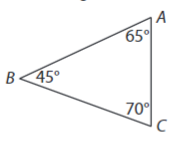
Find the measure of the indicated angle.

m∠C=

m∠A=

Asemmisa {{asɛmmisaAhyɛnsode}}
2.

Solve for x.

Find the measure of the indicated angle.

x=

m∠T=

m∠R=

Asemmisa {{asɛmmisaAhyɛnsode}}
3.

Solve for x.

Find the measure of the indicated angle.

x=

m∠C=

m∠B=

Asemmisa {{asɛmmisaAhyɛnsode}}
4.

Solve for x.

Find the length of the indicated side.

x=

DE=

m∠E=

Asemmisa {{asɛmmisaAhyɛnsode}}
5.

Solve for x.

Find the length of the indicated side.

x=

OM=

m∠G=

Asemmisa {{asɛmmisaAhyɛnsode}}
6.

Solve for x.

Find the length of the indicated side.

x=

KL=

m∠J=

Asemmisa {{asɛmmisaAhyɛnsode}}
7.

A regular pentagon has five congruent sides and five 108° angles, as

shown in the figure. Find the angle measures: x = ; y = ;

z =

Part II

Triangle Inequalities

Asemmisa {{asɛmmisaAhyɛnsode}}
8.

Determine if the side lengths could form a triangle. Use an inequality to prove your answer.

16 m, 21 m, 39 m

Asemmisa {{asɛmmisaAhyɛnsode}}
9.

Determine if the side lengths could form a triangle. Use an inequality to prove your answer.

18 in, 6 in, 13 in

+ =; and 19 18

Therefore this a triangle

Asemmisa {{asɛmmisaAhyɛnsode}}
10.

Is it possible to have a triangle with sides of 6cm, 4cm, and 3cm?

Asemmisa {{asɛmmisaAhyɛnsode}}
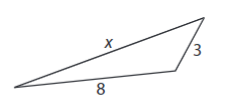
11.

Find the range of possible values for x using the Triangle Sum Theorem from your page 5 notes.

<x<

Asemmisa {{asɛmmisaAhyɛnsode}}
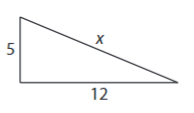
12.

Find the range of possible values for x using the Triangle Sum Theorem from your page 5 notes.

<x<

Asemmisa {{asɛmmisaAhyɛnsode}}
13.

In △ PQR, PQ = 3x + 1, QR = 2x − 2, and PR = x + 7. Determine the range of possible values of x.

Use the Triangle Sum Theorem from your page 5 notes.

≤ x <

Asemmisa {{asɛmmisaAhyɛnsode}}
14.

For each triangle, write the order of the angle measures from least to greatest.

Be sure to include the angle symbol in your answer. ----> ∠ <----

< <

Asemmisa {{asɛmmisaAhyɛnsode}}
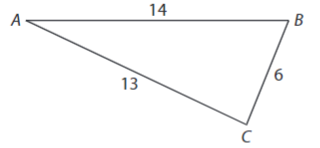
15.

For each triangle, write the order of the angle measures from least to greatest.

Be sure to include the angle symbol in your answer. ----> ∠ <----

< <

Asemmisa {{asɛmmisaAhyɛnsode}}
16.

Suppose a triangle has side lengths PQ, QR, and PR, where PR = 2PQ = 3QR. Write the angle measures in order from least to greatest.

Be sure to include the angle symbol in your answer. ----> ∠ <----

< <

Asemmisa {{asɛmmisaAhyɛnsode}}
17.

For each triangle, write the side lengths in order from least to greatest.

< <

Asemmisa {{asɛmmisaAhyɛnsode}}
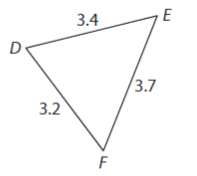
18.

For each triangle, write the side lengths in order from least to greatest.

< <