Click Here for help - the questions all come from a website and Mr. H works through each of the series of questions on his website.
26 points
26
Question 1
1.
Identify the following objects as being either ...
a. positive b. negative c. neutral
If there is no conclusive evidence, then select all that could be true and put them in alphabetical order. So if you think it can be both positive and neutral you would write ac
Description of Object
i. An object possesses more protons than electrons._______
ii. An object possesses more neutrons than electrons._______
iii. A formerly neutral object that just lost some electrons._______
iv. A formerly neutral object that just gained some electrons._______
v. An object that attracts a negatively charged balloon._______
vi. An object that attracts neutral paper bits and attracts a negatively-charged balloon._______
vii. An object that attracts neutral attracts paper bits and repels a negatively-charged balloon._______
viii. An object that attracts a negatively-charged balloon and attracts a positively-charged balloon._______
ix. An object that attracts a charged balloon (balloon A) which is attracted to a negatively-charged balloon (balloon B)._______
x. An object that attracts a balloon (balloon C) which is repelled by a negatively-charged balloon (balloon D)._______
xi. An object that repels a balloon (balloon E) which is repelled by a positively-charged balloon (balloon F)._______
xii. An object around which the electric field vector is directed inwards._______
xiii. An object around which the electric field vector is directed outwards._______
10 points
10
Question 2
2.
Which of the following are true of static charges? Choose all that apply.
26 points
26
Question 3
3.
Identify the following objects as being either ...
a. positive b. negative c. neutral
If there is no conclusive evidence, then select all that could be true and put them in alphabetical order. So if you think it can be both positive and neutral you would write ac
Description of Object
i. An object possesses more protons than electrons._______
ii. An object possesses more neutrons than electrons._______
iii. A formerly neutral object that just lost some electrons._______
iv. A formerly neutral object that just gained some electrons._______
v. An object that attracts a negatively charged balloon._______
vi. An object that attracts neutral paper bits and attracts a negatively-charged balloon._______
vii. An object that attracts neutral attracts paper bits and repels a negatively-charged balloon._______
viii. An object that attracts a negatively-charged balloon and attracts a positively-charged balloon._______
ix. An object that attracts a charged balloon (balloon A) which is attracted to a negatively-charged balloon (balloon B)._______
x. An object that attracts a balloon (balloon C) which is repelled by a negatively-charged balloon (balloon D)._______
xi. An object that repels a balloon (balloon E) which is repelled by a positively-charged balloon (balloon F)._______
xii. An object around which the electric field vector is directed inwards._______
xiii. An object around which the electric field vector is directed outwards._______
18 points
18
Question 4
4.
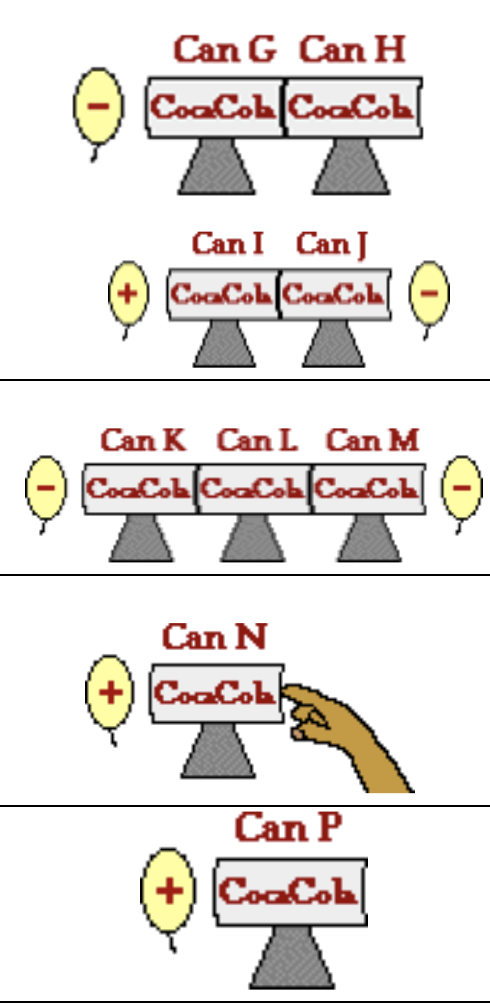
Charged balloons are used to induce a charge upon neutral metal pop cans. Identify the type of excess charge that would be present on cans G, H, I, J, K, L, M, and N as shown in the diagrams below. (positive, negative, neutral)
G
H
I
J
K
L
M
N
P
Positive
Negative
Neutral
18 points
18
Question 5
5.
Charged balloons are used to induce a charge upon neutral metal pop cans. Identify the type of excess charge that would be present on cans G, H, I, J, K, L, M, and N as shown in the diagrams below. (positive, negative, neutral)
G
H
I
J
K
L
M
N
P
Positive
Negative
Neutral
10 points
10
Question 6
6.
Which of the following are true of static charges? Choose all that apply.
10 points
10
Question 7
7.
Upload a copy of your notes with Mr. B's signature to indicate you have had a micro-conversation with him