A Siberian tiger sleeps as much as 15 hours a day, or 105 hours per week.
About how many hours does a tiger sleep in a year?
Step 1 - Estimate
Step 2 - Multiply by ones
Step 3 - Multiply by tens
Step 4 - Add partial products
Step 1 - Estimate: 105 × 52 → × =
Step 2 - Multiply by the ones.
105
× 52
→ 105 × 2 ones = ones (first partial product)
Step 3 - Multiply by the tens.
105
× 52
→ 105 × 5 tens = tens or ones (second partial product)
Step 4 - Add the partial products.
+ = (final product - answer)
Observe the example below.

What is 64 being multiplied by in the red circle?
What are you multiplying in the first partial product?
What is the answer to the first partial product?
What are you multiplying in the second partial product?
What is the answer to the second partial product?
What is the final product?
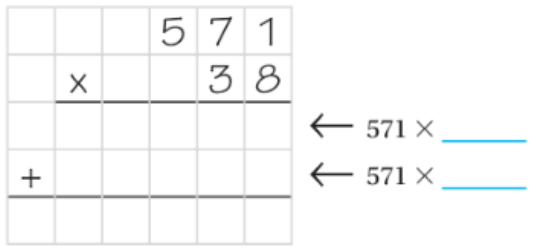
Observe the example below.
What are you multiplying in the first partial product?
What is the answer to the first partial product?
What are you multiplying in the second partial product?
What is the answer to the second partial product?
What is the final product?
Find the product. 54 x 31 =
A farmer has 42 rows of corn. Each row has 26 ears of corn. How many ears of corn does the farmer have altogether?
There are 64 people going to the Houston Rodeo. Each person pays $38 to enter the rodeo. How much money did the rodeo collect from the 64 people?
Find the product. 63 × 16 =
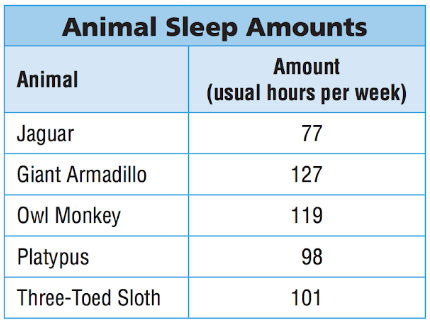
Use the table below.
Hint: there are 52 weeks in 1 year
How many hours of sleep does a Giant Armadillo sleep in 1 year?
Use the table below.
Hint: there are 52 weeks in 1 year
How many more hours sleep does a Three-Toed Sloth sleep than a Jaguar in 1 year?
Find the product. 722 × 39 =
Find the product. 957 × 43 =
Number that are multiplied together are called
Words to consider: multiples, digits, decimals, factors, products, sums, differences, estimations
Spelling counts!
The answer to a multiplication problem is a called
Words to consider: multiple, digit, decimal, factor, product, sum, difference, multiply
Spelling counts!