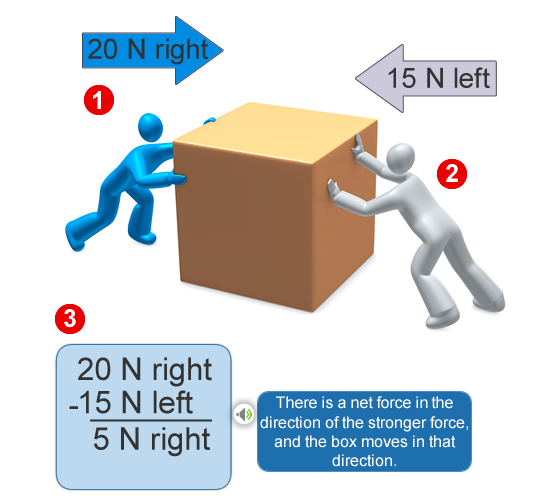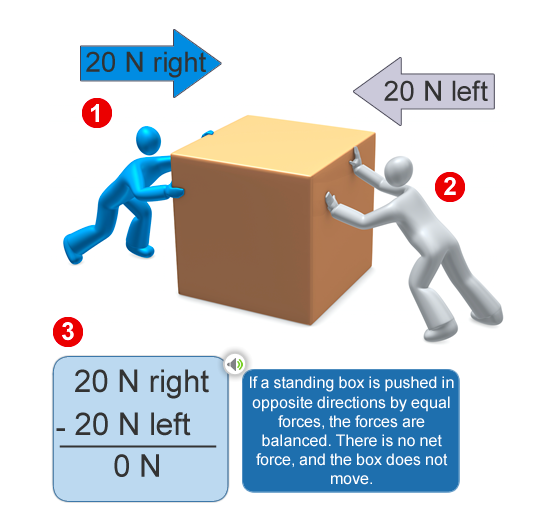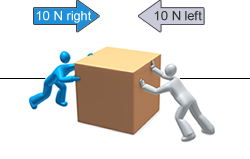
These two people are arguing over where to move this box. The white figure wants to move it to the left side of the room, and he pushes it with a force of 10 N to the left. At the same time, the blue figure wants to move the box to the right side of the room, and he pushes with a force of 10 N to the right. What will happen to the box?
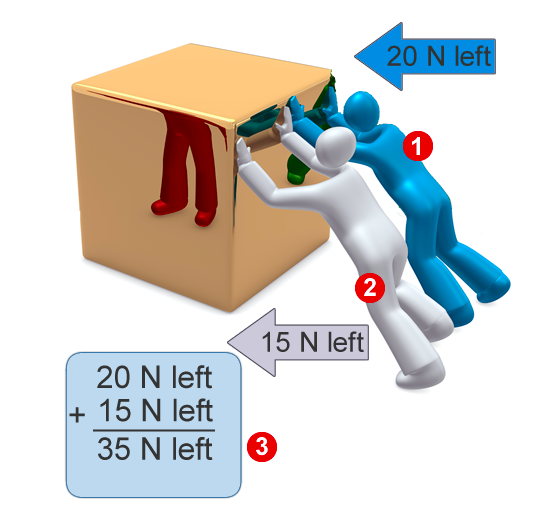
There can be many different forces acting on an object at the same time. These forces may be working in the same direction or different directions. Some forces may be strong and others might be weak. The combination of all these forces is the net force.
Net force determines what an object will do. An object could:
•start moving
•stop moving
•change direction
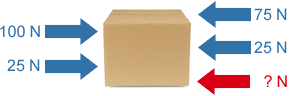
To calculate net force, you add the forces that are being exerted in the same direction, and you subtract forces that are exerted in opposite directions. Select the buttons in numerical order to see how to calculate the net force below.
When forces are working in opposite directions, the smaller force should be subtracted from the larger force. The object always moves in the direction of the larger force. Select the buttons in numerical order to see how to calculate the net force.
In this picture, the box is in equilibrium. Select the buttons in numerical order to see how to calculate the net force.
It should take a net force of 25 N to move a box. Tina tries to push the heavy box with 10 N of force to the right. It does not budge. She gets tired and takes a break. Then, Carla pushes it with 15 N of force to the right, and still cannot move the box.
Neither girl provides enough force (25 N) to move the box. A net force measures all of the forces on an object happening at one time. The girls need to push the box at the same time and in the same direction to move the box.
Required
1 point
1
Question 2
2.
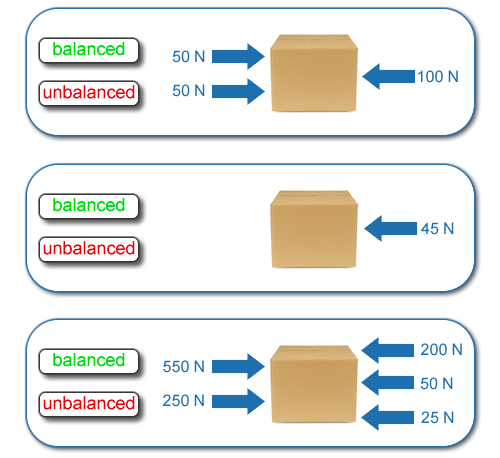
Decide if the forces are balanced or unbalanced.
Required
1 point
1
Question 3
3.
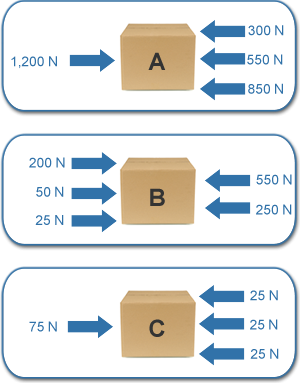
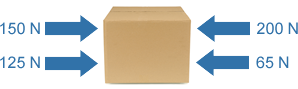
Calculate the net force of each box. Do not forget to include the direction (left or right) with your answer. The first one has been done for you.
1. The net force of box A is 500 N to the left.
2. The net force of box B is_______ N to the_______ .
3. The net force of box C is_______ N.
Required
1 point
1
Question 4
4.
A boat is moving forward in the water at 15 miles per hour. The water is pushing back on the boat with a lesser force than the boat is pushing on the water. Which direction will the boat travel?
Required
1 point
1
Question 5
5.
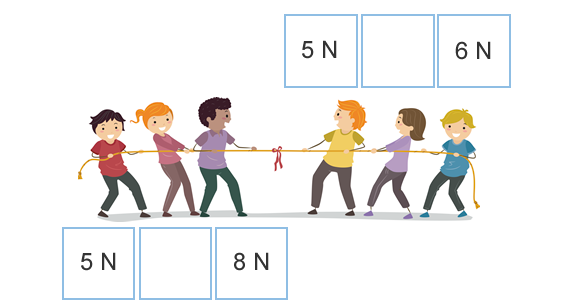
This game of tug of war is in equilibrium. The forces are balanced. What would the force of each girl be for this to be true?
Other Answer Choices:
10 N
1 N
12 N
5 N
Check for Understanding:
1. Net forces are all the forces acting on an object at one time.
2. The net force determines what direction an object will move, if it moves at all.
3. Net forces are unbalanced when force in one direction is greater than force in the opposite direction.
4. Net forces are balanced, or in equilibrium, when equal forces act in opposite directions.
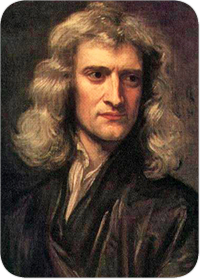
Sir Isaac Newton lived from 1643-1727. He is known as one of the most influential scientists of his time. He is well known for using math to study nature and describing the three laws of motion.
The first law of motion Newton described was that an object in motion will remain in motion unless acted upon by an unbalanced force. Things like air and friction are examples of unbalanced forces. He also noted that an object at rest will remain at rest unless acted upon by an unbalanced force.
Required
1 point
1
Question 6
6.
This picture shows an object in motion that is about to hit an object at rest. What is the unbalanced force that is about to hit the object at rest?
Required
1 point
1
Question 7
7.
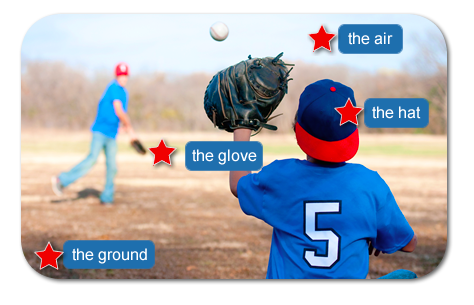
Which is most likely to be the unbalanced force that stops this baseball from moving?
Required
1 point
1
Question 8
8.
If a soccer field's grass did not cause friction, what would happen to a soccer ball that was kicked on a flat surface?
Check for Understanding:
Newton's first law of motion states:
1. an object in motion will remain in motion unless acted upon by an unbalanced force.
2. an object at rest will remain at rest unless acted upon by an unbalanced force.
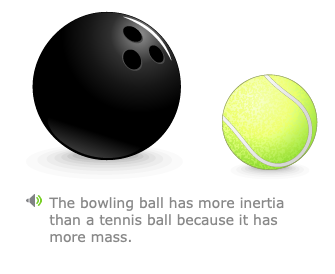
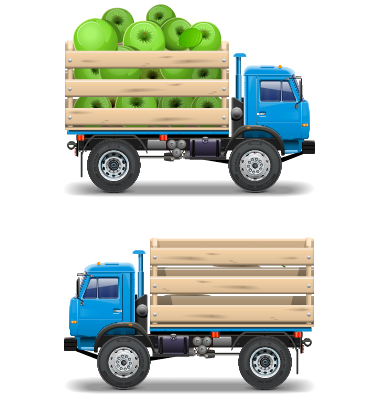
Newton also noticed that when an object had more mass, it resisted moving more than an object with less mass. The tendency of an object to resist any change in motion is known as inertia.
Required
1 point
1
Question 9
9.
Which truck has more inertia?
Required
1 point
1
Question 10
10.
Select the object that will stop more quickly if the same stopping force is applied.
Required
1 point
1
Question 11
11.
Inertia means that the object's motion will stay constant in terms of __________.
Required
1 point
1
Question 12
12.
The __________has more inertia.
Newton's first law teaches us that:
1. inertia is the tendency of an object to resist any change in motion
2. when an object has more mass, it has more inertia
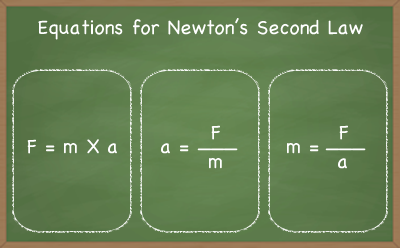
Newton's second law of motion describes how acceleration, mass, and net forces are related. Acceleration is the change in velocity over time. When an object is pushed with more force, it will move faster and farther away.
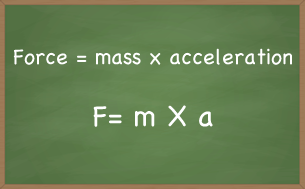
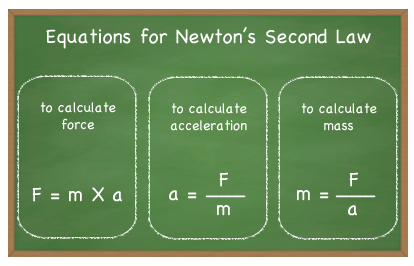
To calculate force, multiply the mass of an object by its acceleration. This means that when a greater force acts on an object, it will have a greater acceleration. Objects with less mass are easier to accelerate.
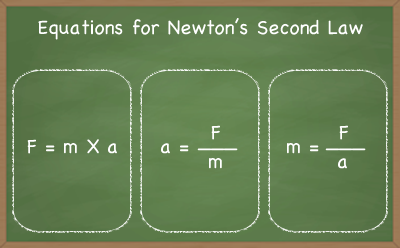
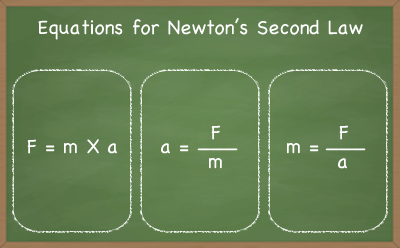
There are three different formulas associated with Newton's second law. Select the buttons to see the different formulas.
Required
1 point
1
Question 13
13.
Which formula is used to calculate force?
Required
1 point
1
Question 14
14.
Which student correctly used the formula to find the acceleration of a 20 kg car being pushed by a force of 140 N?
Required
1 point
1
Question 15
15.
It is time to move your desks at school. You begin moving your desk on your own. A friend comes over and helps you move your desk to the correct location. Your desk had__________acceleration when your friend helped. Your friend explains that your desk feels heavier than her desk.__________would accelerate faster if the same forces were applied.
Required
1 point
1
Question 16
16.
If an object has a force of 56 N and an acceleration of 7 m/s2, the mass is_______
kg.
Required
1 point
1
Question 17
17.
How much force is required to accelerate a 50 kg mass at 2 m/s2?
The answer is_______
Newton's second law teaches us:
1. force = mass × acceleration.
2. acceleration is the change in velocity over time.
3. when a greater force acts on an object, it has a greater acceleration.
4. when an object has less mass, it is easier to accelerate.
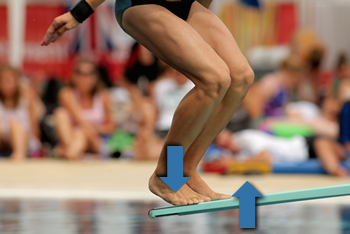
Newton's third law shows us that for every action there is an equal and opposite reaction. For example, when the diver pushes down on the diving board, the diving board will push up on the diver with an equal force.
Required
1 point
1
Question 18
18.
This teenager is leaning against the wall. The wall gives a(n) __________ and opposite reaction.
Required
1 point
1
Question 19
19.
When a large truck pushes a small car with a given force, the small car applies an equal and opposite force on the truck.
Required
1 point
1
Question 20
20.
Mr. Hawking is in a car, and he notices a bug that hits the windshield. Which has the greater force?
Check for Understanding:
1. Newton's third law states that for every action there is an equal and opposite reaction.
Required
1 point
1
Question 21
21.
What is the definition of net force?
Required
1 point
1
Question 22
22.
What is inertia?
Required
1 point
1
Question 23
23.
What is the definition of acceleration?
1. The combination of all the forces acting on an object is net force.
2. Newton's first law teaches us that inertia is the tendency of an object to resist any change in motion.
• An object at rest stays at rest.
• An object in motion stays in motion.
3. Newton's second law describes the relationship between acceleration, mass, and net force.
4. To calculate force, multiply the mass times the acceleration.
5. Newton's third law states that for every action there is an equal and opposite reaction.
Required
1 point
1
Question 24
24.
Which answer choices will result in an unbalanced force?
Required
1 point
1
Question 25
25.
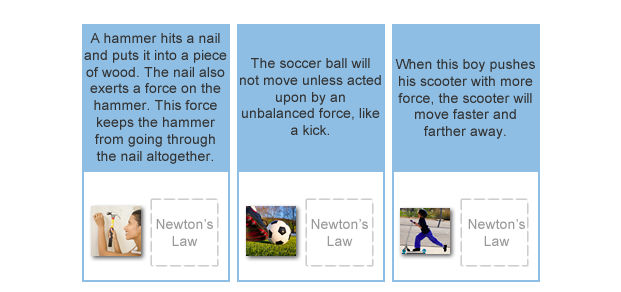
Match the law with the correct scenario.
Other Answer Choices:
Required
1 point
1
Question 26
26.
A helicopter has a mass of 100 kg and accelerates at a rate of 150 m/s2. The force of the helicopter is _______ N.
Required
1 point
1
Question 27
27.
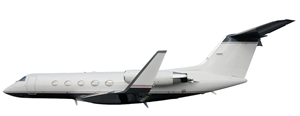
This plane is flying in the air at 600 miles per hour to the left. The wind is pushing back with a lesser force to the right. Which direction will the plane travel?
Required
1 point
1
Question 28
28.
For an object to be in equilibrium, __________.
Required
1 point
1
Question 29
29.
What will this object do?
Required
1 point
1
Question 30
30.
I am well-known for using math to study nature and describing the three laws of motion. Who am I?
Required
1 point
1
Question 31
31.
Which law says the marble will keep rolling until an unbalanced force stops it?
Required
1 point
1
Question 32
32.
Jamal wants to plant a garden. Before he can, he will need to move 10 kg of sand, 13 kg of pebbles, and a 25 kg boulder out of the way. Which object will have the greatest inertia?
Required
1 point
1
Question 33
33.
Leticia has a motorcycle that accelerates at 5 m/s2. If the motorcycle has a mass of 800 kg, how much force does the motorcycle produce?
Required
1 point
1
Question 34
34.
For every action there is an __________ reaction.
Required
1 point
1
Question 35
35.
When you are sitting in a chair, your body pushes down on the chair. The __________.