LR247.0.1: IV, DV, Constants

Last updated over 1 year ago
27 questions
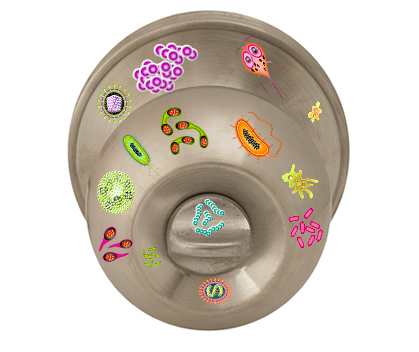
Alexis learned about bacteria in her science class and started to wonder about how many bacteria are on the items she touches every day, like doorknobs. She decides to use the scientific method to find out more about bacteria in her school. The scientific method is the series of steps that a scientist takes to answer a question about nature.
Step 1: Question/Purpose
Scientists attempt to answer questions about the natural world. Deciding on a clear and specific question is the first step in a scientific investigation. Alexis decides to ask the question, "Which doorknob in the school has the most bacteria?"
Step 2: Research
Scientists must find out about their topic. This ensures that they do not repeat past mistakes that others have made.
Step 3: Hypothesis
Once a scientist has a clear and specific question, she creates a hypothesis. A hypothesis is a possible answer to a scientific question. A hypothesis may not be correct, so scientists must test their hypotheses to learn more. Alexis’s hypothesis is that the bathroom door will have the most bacteria.
Step 4: Experiment
In order to answer a scientific question and test a hypothesis, a scientist has to create an experiment. Alexis decides to get samples from various doorknobs at her school. After getting the samples, she will count how many bacteria each sample has.
Step 5: Results/Data
During an experiment, a scientist collects empirical evidence or data. Data is a collection of facts and evidence. Alexis collects samples and then uses a microscope to count the number of bacteria in the samples. Next, she records her data. After a scientist collects data, she looks closely at the data to understand what it means. Alexis examines her data and realizes that the doorknobs at the entrance of the school have the most bacteria.
Step 6: Conclusions
At the end of an experiment, a scientist comes to a conclusion. She decides if her hypothesis was right or wrong. If it was incorrect, she might have to create a new hypothesis and conduct a new experiment. Because the bathroom doorknobs do not have the most bacteria, Alexis’s hypothesis is wrong. She will need to conduct more experiments to determine why the entrance doors had the most bacteria. Once a scientific experiment is finished, it might be published. At this point, the rest of the scientific community is able to weigh in on it. The original scientist might have to defend her work if it is challenged. Alexis presents her experiment in her school’s science fair. She explains her process and her results to her classmates.
Scientists might not use these steps in the same order each time. In fact, some steps may be repeated. Scientists will mold the steps to fit the experiments that they are doing.
Required
1
A hypothesis is__________. A hypothesis __________ be incorrect.
Required
1

Match the actions that Alexis took during her experiment with the steps of the scientific method.

Draggable itemCorresponding Item
experiment
She decided to collect samples from each doorknob around the school.
question/purpose
Alexis discovered her hypothesis was incorrect and presented her findings in a during the science fair. She also began planning a new experiment.
conclusion
She predicted that the bathroom doorknob would be the dirtiest.
research
Alexis learned about bacteria growth and studied other experiments that had been conducted.
hypothesis
She wondered which doorknob in the school had the most bacteria.
results/data
Alexis used a microscope to count the bacteria from the samples.
Required
1

The scientific method is performing in the same way each time.

Required
1

Grace is studying a chart that she created with temperatures and wind speeds she collected during a recent experiment. Which step of the scientific method is she performing?

Required
1

Hari is documenting the appearance of plant leaves in his greenhouse for his experiment on plant diseases. Which step of the scientific method is he performing?

Required
1

Kourtney is publishing a paper that explains an experiment that she recently completed. It includes the experiment’s plan, the data she collected, and the conclusions that she came to. What step of the scientific method is she performing?

Required
1

Ling decided that she wanted to learn about the effects of soda on tooth enamel. After reading some information about enamel, she planned an experiment in which she soaked teeth in a mixture of soda and water. She tracked the appearance of the teeth for several weeks. Which steps has she not yet completed?

Checking for Understanding:

1, The scientific method is the series of steps that a scientist takes to answer a question about nature.

2. A hypothesis is a possible answer to a scientific question.

3. The steps of the scientific method are deciding on a question, creating a hypothesis, planning an experiment, collecting data, interpreting data, drawing conclusions, and communicating with the scientific community.

4. The steps of the scientific method might be completed in a different order. The steps may even be repeated, depending on the needs of experiment.
In Alexis’s first experiment, she found that the entrance doorknob had the most bacteria. She wondered if the amount of bacteria found on a doorknob might be affected by how many people touch it. To find an answer, Alexis decided to create a new experiment. Alexis’s experiment will focus on two variables, or factors that can change in an experiment.
There are two types of variables in scientific experiments.

An independent variable is the variable that is changed by the person conducting the experiment in order to test a hypothesis. In Alexis’s experiment, the independent variable will be the number of people that touch a doorknob. Alexis purchased doorknobs from the hardware store and is keeping them in her science class so she can control how many people touch each doorknob.


A dependent variable is the variable that is affected and measured during an experiment. It can be impacted or changed by the independent variable. The dependent variable in Alexis’s experiment will be the number of bacteria that are on each doorknob. The dependent variable will be affected by the independent variable, or the number of people that touch the doorknob. After completing her experiment, Alexis discovers that the doorknobs that were touched more had more bacteria. Doorknobs that were touched less had less bacteria.

A dependent variable cannot impact or change an independent variable. The number of bacteria on a doorknob cannot change the amount of people who touched the doorknob. Similarly, the growth of the plants described in the caption above does not change the type of fertilizer used.
Required
1
Fatima is doing an experiment to see which brand of insect repellent is more effective. She uses different brands each day that the conditions and weather are the same. At the end of each day, she counts how many mosquito bites she has. The brand of insect repellent is the __________ variable. The number of mosquito bites is the __________ variable.
Required
1

Hannah has a cream bowl and a navy bowl that she fills with equal amounts of water. She puts the bowls under a heat lamp for one hour. After that time, Hannah records the temperature of the water in each of the bowls. What are the independent and dependent variables in this experiment?

Required
1

The neighborhood is having a bake sale. Makayla decides to treat the bake sale like an experiment so that she can find the way to earn the most money. The amount of money made by the bake sale is the dependent factor because it is affected by other factors. Which of these options could be independent variables in her experiment?

Required
1

Marcus loves fishing, so he wants to create a science project to find out how to catch the most fish. Which of these variables could be used as the independent variable in his experiment?

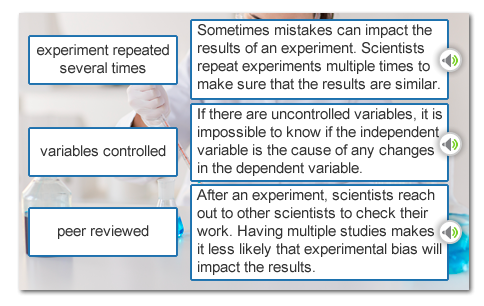
If variables are not controlled and carefully considered, results from experiments cannot be trusted. For instance, if Marcus is trying to determine the most effective bait and uses different baits each day, but does not fish at the same time each day, the results of the experiment will be unclear. Carefully controlling variables helps scientists avoid experimental bias, or mistakes in the design of an experiment. Some characteristics of strong experiments are experiments that are tested several times, variables that are controlled, and experiments that are peer reviewed.

Required
1

Jenna wants to study the effects of fertilizer on the growth of plants. She decides to grow her plants outside. Which possible variables could affect her experiment?

Required
1

How could Jenna control her experiment?

Required
1

Jenna decides to move her experiment to her school’s greenhouse. She tracks the growth of four identical plants. One plant receives no fertilizer. The other three each get a different brand of fertilizer. After six weeks, she concludes that one brand, Grow-A-Bunch, is most effective. Which steps could she take next to make sure that her conclusion is correct?

Required
1
__________is a mistake in the design of an experiment. It can be avoided by __________.
Check for Understanding:

1. Variables are factors that can change in an experiment. An independent variable is changed by scientists to impact the dependent variable.

2. If variables are not controlled in a scientific experiment, the results will not be clear.

3. Strong scientific experiments have controlled variables, are repeated multiple times, and are peer reviewed.
Required
1

What is the scientific method?

Required
1

What is a hypothesis?

Required
1

What is results/data?

Required
1

What is a variable?

Required
1

What is an independent variable?

Required
1

What is a dependent variable?

Required
1

What is a controlled experiment?

1. The scientific method is the series of steps that a scientist takes to answer a question about nature. The steps of the scientific method are deciding on a question, creating a hypothesis, planning an experiment, collecting data, interpreting data, drawing conclusions, and communicating with the scientific community.

2. Variables are factors that can change in an experiment. An independent variable is changed by scientists to impact the dependent variable. If variables are not controlled in a scientific experiment, the results will not be clear.
Required
1

Match the activity to the part of the scientific method it represents.

Draggable itemCorresponding Item
conclusion
Sarah wants to know why some plants grow faster than others.
question/purpose
Sarah learns about plant growth and other experiments that have been done.
experiment
Sarah thinks that more rainfall will impact plant growth.
results/data
Sarah gives varying amounts of water to plants.
hypothesis
Sarah tracks how much water she gives her plants and how much they grow. She looks closely at this data to see patterns.
research
Sarah sees that more water results in more plant growth up to a certain amount.
Required
1

Jessica is interested in health and fitness. She would like to create an experiment to see what results in the most muscle growth. Which of the following factors could be independent variables in her experiment?

Required
1

Julia is interested in finding out if pollution impacts asthma. Her hypothesis is that areas with more pollution will have more people with asthma. Which of the following are some of the steps she will have to take to test her hypothesis?

Required
1

Dennis is doing an experiment about sunburns. Which of the following could be a possible independent variable in his experiment?

Required
1

Why should scientists control variables in an experiment?