Truth Tables and Conditional/Biconditional HW
star
star
star
star
star
Last updated 3 months ago
22 Nsɛmmisa
1
1
1
1
1
1
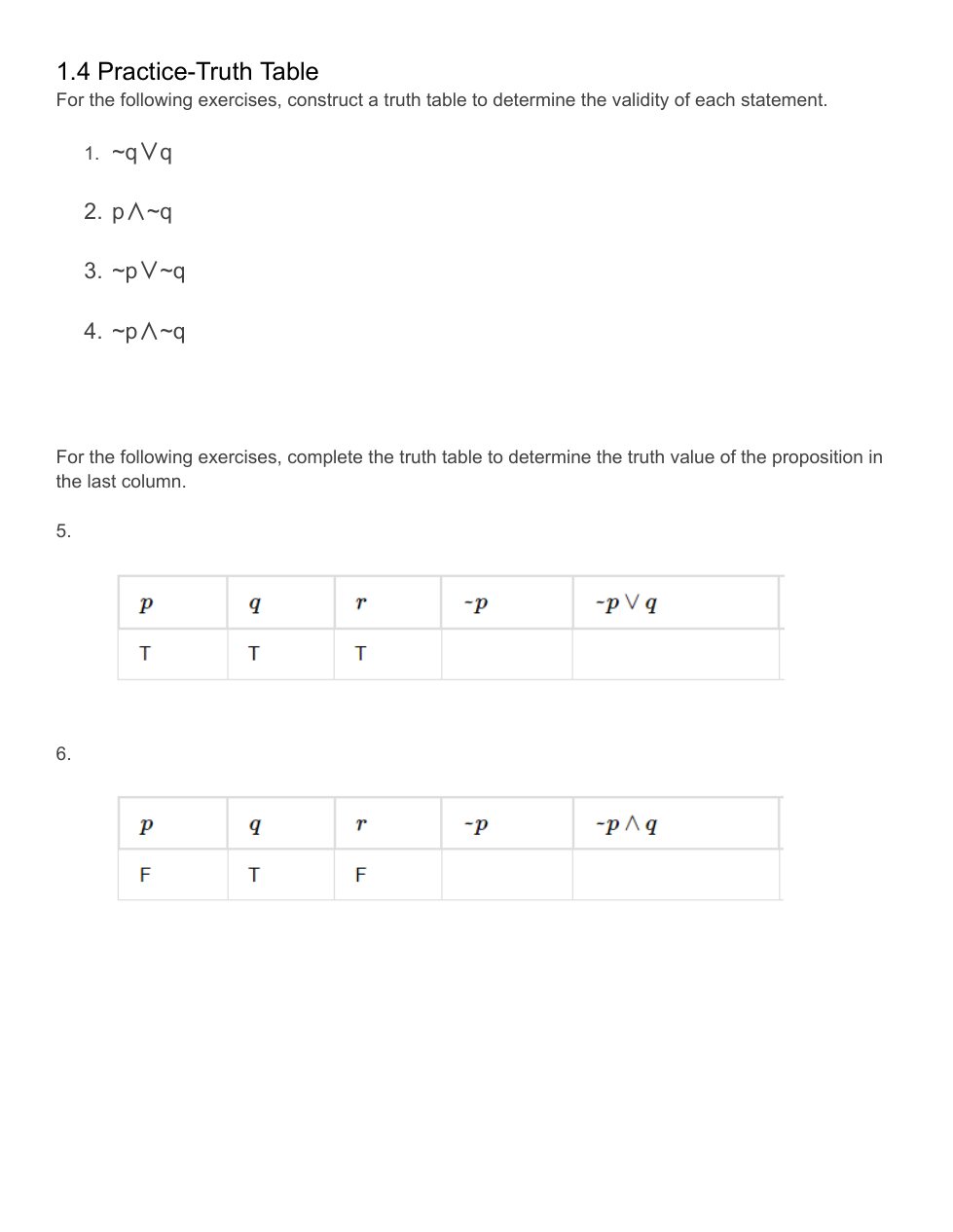
Create a truth table to determine the validity of ~q∨q. (q is a column of t,f,t,f)
Create a truth table to determine the validity of p∧~q. (p is a column of t,t,f,f and q is a column of t,f,t,f)
Create a truth table to determine the validity of ~p∨~q. (p is a column of t,t,f,f and q is a column of t,f,t,f)
Create a truth table to determine the validity of ~p∧~q. (p is a column of t,t,f,f and q is a column of t,f,t,f)
Complete the Truth Table
Complete the Truth Table
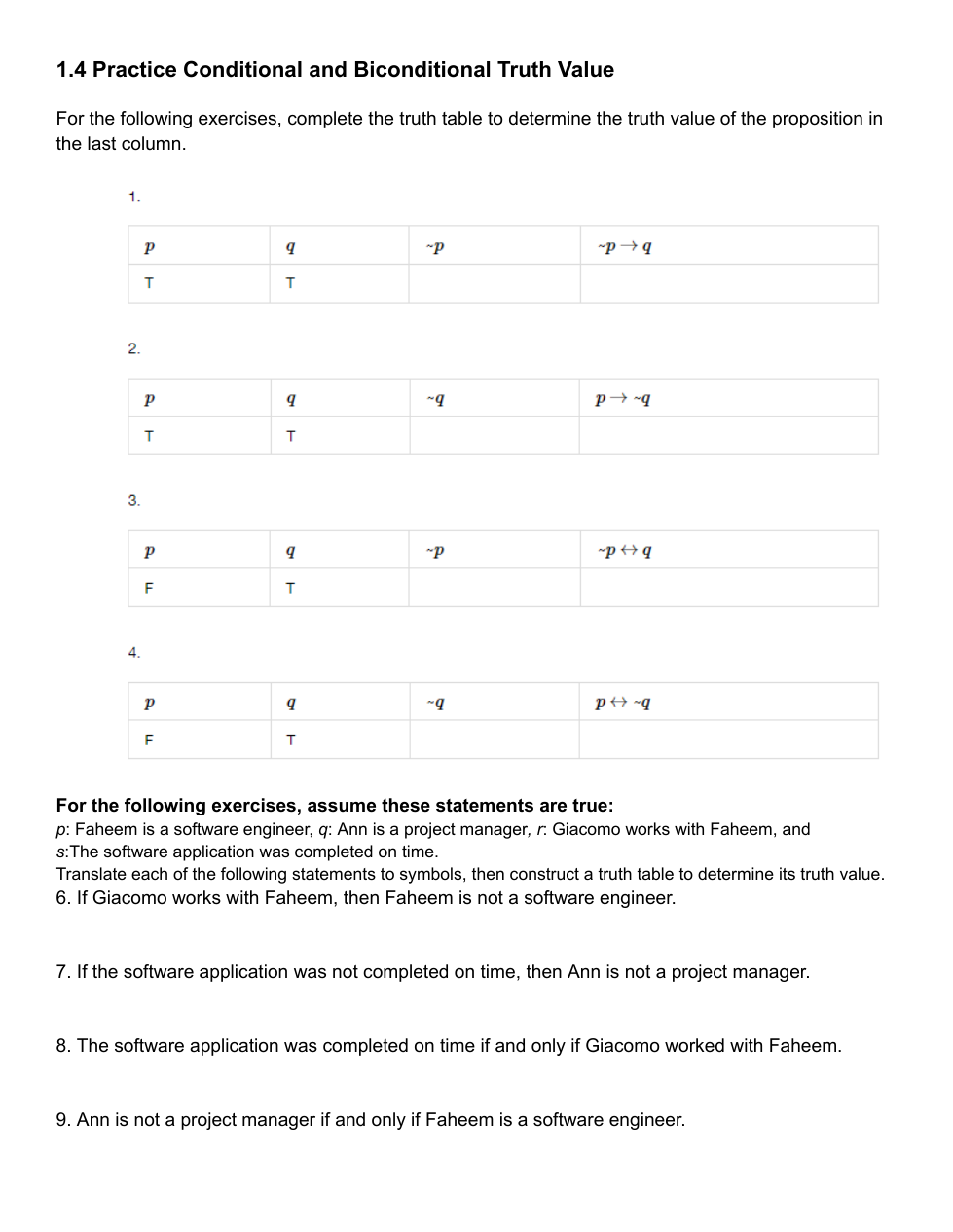
Determine if True or False
Determine if True or False
Determine if True or False
Determine if True or False
Determine if True or False
Determine if True or False
Determine if True or False
Determine if True or False
Translate into symbols. (use two dashes for the line part of an arrow, ex: --> or <-->)
Make a truth table for the statement to determine its truth value.
Translate into symbols. (use two dashes for the line part of an arrow, ex: --> or <-->)
Make a truth table for the statement to determine its truth value.
Translate into symbols. (use two dashes for the line part of an arrow, ex: --> or <-->)
Make a truth table for the statement to determine its truth value.
Translate into symbols. (use two dashes for the line part of an arrow, ex: --> or <-->)
Make a truth table for the statement to determine its truth value.