Log in
Sign up for FREE
arrow_back
Library

RGSHW Thinking skills 2017 paper

star
star
star
star
star
Last updated 10 months ago
15 questions
1
1
1
1
1
1
1
1
1
1
1
1
1
1
1
Question 1
1.

Question 2
2.

Question 3
3.

Question 4
4.

Question 5
5.

Question 6
6.

Question 7
7.

Question 8
8.

Question 9
9.

Question 10
10.

Question 11
11.

Question 12
12.

Question 13
13.

Question 14
14.

Question 15
15.

Which of the following is the conclusion of the above argument?
(a) Commitment to a form of entertainment is shown in attendance at a match or show.
(b) The dominance of football on our televisions and in our newspapers is unjustified.
(c) Thirteen million people attend Premier League football matches each year.
(d) Twenty-two million people visit the theatre in London every year.
‘Season tickets are available for football, but not for theatres.’ How does this additional claim, if true, affect the above argument?
(a) It both strengthens and weakens the argument.
(b) It neither strengthens nor weakens the argument.
(c) It strengthens the argument.
(d) It weakens the argument.
Question 3 refers to the following passage: Schools are encouraging families to get into debt.

The rise of the American-style school ‘prom’ has become a £100 million industry in the UK.

Many schools are using the prom as a way of celebrating good attendance and behaviour in Year 11 and/or Year 13.

Schools promote proms as a memory-making event. According to MoneyWise.co.uk, in 2014, the average cost of attending a school leavers' ball or high school prom was a huge £186, whereas the average national weekly income, after tax and National Insurance, in 2014 was merely £379.

Schools are aware that students and their families spend too much on the proms.

This is shown by the results of a Holiday Inn survey in 2011, which showed that one in 10 people spent more than £500 on their school prom and 2% spent more than £1500. Which of the following is an assumption used in the above argument?
Proms are a memory-making event.
Schools should not encourage people to spend £186 on the prom.
There are no other ways to celebrate good attendance and behaviour in Year 11 and/or Year 13.
When families spend money on the prom, they get into debt.
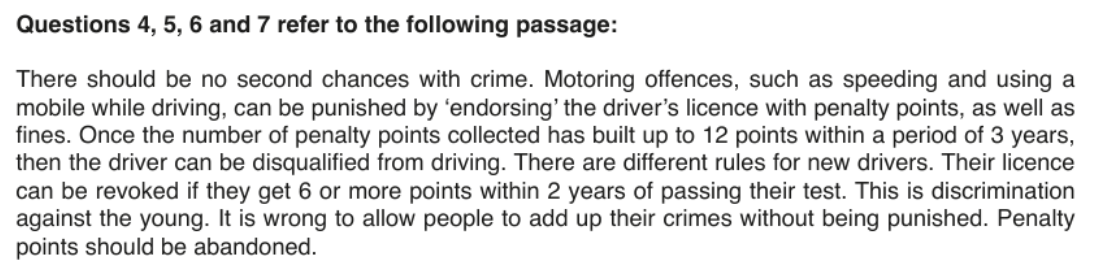
What is the name of the following argument element in the above passage? "There should be no second chances with crime."
a) evidence
b) example
c) explanation
d) reason
Which of the following is an underlying assumption of the following part of the argument? "There are different rules for new drivers. Their licence can be revoked if they get 6 or more points within 2 years of passing their test. This is discrimination against the young."
a) Different rules cause discrimination.
b) Discrimination is always wrong.
c) New drivers are young.
d) Revoking a person’s licence is discrimination.
Which of the following is a weakness in the following part of the argument? "It is wrong to allow people to add up their crimes without being punished. Penalty points should be abandoned."
a) It assumes that penalty points are not punishment.
b) It conflates punishment and penalty points.
c) It creates a slippery slope from speeding to licences being revoked.
d) It creates a straw man flaw, distorting the argument for penalty points.
Which of the following, if true, would most weaken the above argument?
Insurance companies only require information on the number of penalty points a person has, not the fines.
Penalty points are often accompanied by fines.
The system of penalty points is too complex for most people to understand.
Three quarters of people surveyed saw penalty points as a harsher punishment than fines.
Which of the following is the main conclusion of the above argument?
Countries should receive charitable aid to help the lives of the people who live there, not make it more possible for that country to kill people around the world.
Countries who give charitable aid expect it to be spent on health and education.
No country should be trying to develop weapons of mass destruction.
Where a country is putting money into developing nuclear research, they should not receive charitable aid from another country.
Which of the following is a principle in the above argument?
Countries should receive charitable aid to help the lives of the people who live there.
Countries who give charitable aid expect it to be spent on health and education.
Every country has a right to protect itself.
No country should be trying to develop weapons of mass destruction.
‘Nuclear research helps to provide sustainable energy.’ How does this additional claim, if true, affect the above argument?
It both strengthens and weakens the argument.
It neither strengthens nor weakens the argument.
It strengthens the argument.
It weakens the argument.
Which of the following is the correct assessment of the evidence used in the above argument?
(a) Disarming its nuclear weapons was not a necessary or a sufficient condition for South Africa to receive significant aid from other countries.
(b) Disarming its nuclear weapons was a sufficient condition for South Africa to receive aid from other countries, but it was not necessary for it to have been done.
(c) It was necessary and sufficient for South Africa to disarm its nuclear weapons in order to receive aid from other countries.
(d) It was necessary for South Africa to disarm its nuclear weapons, but not sufficient in order to receive aid from other countries.
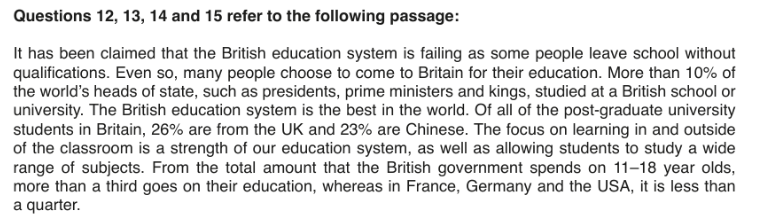
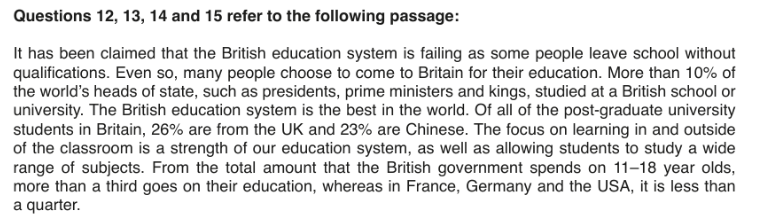
Which of the following is the conclusion of the above argument?
(a) Many people choose to come to Britain for their education.
(b) The British education system is failing.
(c) The British education system is the best in the world.
(d) The focus on learning in and outside of the classroom is a strength of our education system.

What is the name of the following argument element in the above passage? 'It has been claimed that the British education system is failing as some people leave school without qualifications.'
(a) counter-argument
(b) counter-assertion
(c) counter-conclusion
(d) counter-reason
Which of the following is an underlying assumption of the argument?
(a) Coming to Britain to study at a school or university demonstrates that it is the best.
(b) It is important to study a wide range of subjects at school.
(c) Post-graduate study in China is not as good as in Britain.
(d) The more money a government invests in education, the more improvement an education system will have.
Nearly half of the money spent by Cyprus and Niger on 11–18 year olds is spent on education. How does this additional claim, if true, affect the above argument?

It both strengthens and weakens the argument.
It neither strengthens nor weakens the argument.
It strengthens the argument.
It weakens the argument.