Log in
Sign up for FREE
arrow_back
Library

RGSHW Thinking skills practice paper 2

star
star
star
star
star
Last updated 10 months ago
20 questions
1
1
1
1
1
1
1
1
1
1
1
1
1
1
1
1
1
Question 1
1.

Question 2
2.

Question 3
3.

Question 4
4.

Question 5
5.

Question 6
6.

Question 7
7.

Question 8
8.

Question 9
9.

Question removed

Question 10
10.

Question 11
11.

Question 12
12.

Question 13
13.

1
1
1
Question 17
17.

Question 18
18.

Question 19
19.

Question 20
20.

Which of the following is an argument?
A) Before the second world war there was no concept of national foods. People’s main concern was getting enough food. Then British people became interested in Indian, Chinese and Italian food.
B) Ice cream did not exist in Britain until the late nineteenth century, when Italians imported it. The British transformed delicious Italian gelatto into solid blocks of white, lard-like coldness.
C) Indian food has become part of British culture. In India, ‘balti’ means bucket not dinner. People feel very strongly that food is related to national identity.
D) Specific dishes shouldn’t be considered to have any particular nationality. Any dish has influences from all over the world. Take the example of fish and chips – frying is a Jewish way of cooking fish, and French pommes frites were probably around before British chips.
Which of the following is a valid argument?
A) All exercise is unhealthy. Walking is exercise. Therefore walking is unhealthy.
B) Extreme exercise is unhealthy. Watching TV all day is extreme. Therefore watching TV all day is unhealthy.
C) Health is important. Work is important. Therefore work is healthy.
D) Some exercise is healthy. Running is exercise. Therefore running is healthy.
Which of the following is the main conclusion of the argument?
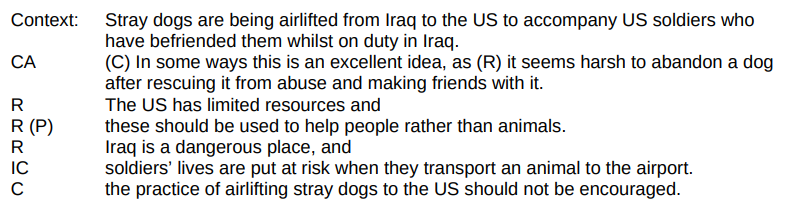

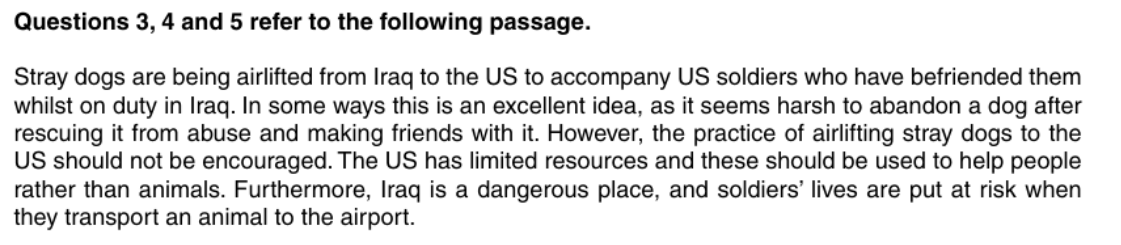
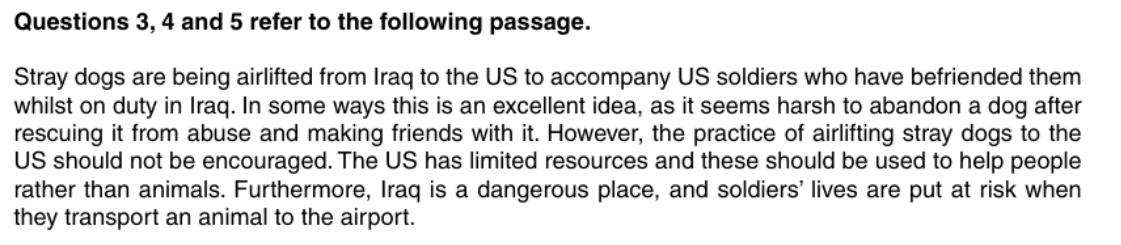
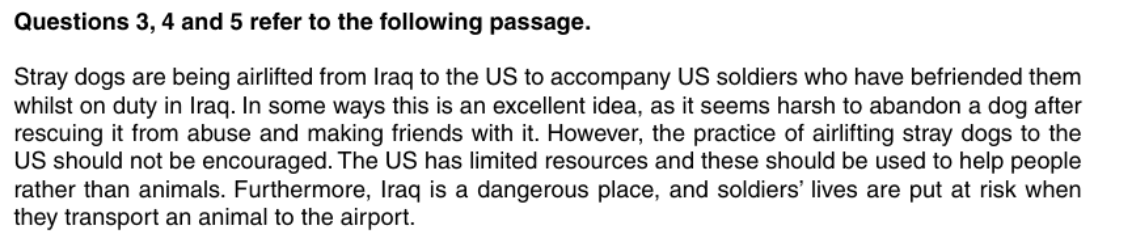
A. In some ways this is an excellent idea.
B. Soldiers’ lives are put at risk when they transport an animal to the airport.
C. Stray dogs are being airlifted from Iraq to the US.
D. The practice of airlifting stray dogs to the US should not be encouraged.
Which of the following, if true, most weakens the support for the conclusion?
A. Almost 50,000 signatures have been gathered in an online petition to save some of these army pets.
B. Pets befriended in a war zone often help soldiers to adjust back to normal life.
C. Stray Iraqi dogs need a health check and programme of vaccinations on arrival in the US.
D. US soldiers have rescued many abused animals while serving in Iraq.
Which of the following is a principle that would counter the argument?
A. People should put right the harm that people have done to animals.
B. People’s lives are more important than animals’ lives.
C. Soldiers are inevitably going to be at risk while they are in a war zone.
D. The consequences of abandoning pet dogs should be weighed against the consequences of airlifting them to the US.
‘


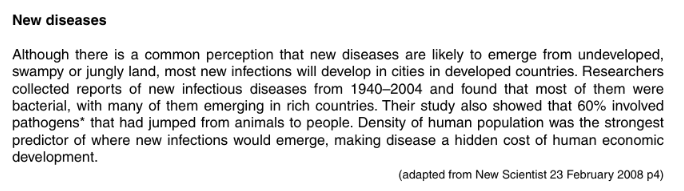
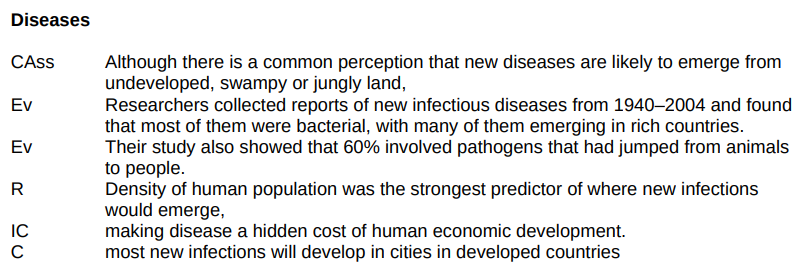
There is a common perception that new diseases are likely to emerge from undeveloped, swampy, or jungly land.’ What is the function of this element in the structure of the argument?
Assumption
Conclusion of counter argument
Counter assertion
Example
‘60% (of new infectious diseases) involved pathogens that had jumped from animals to people.’ What is the function of this element in the structure of the argument?
Evidence
Example
Intermediate conclusion
Reason
If I buy that magazine, I won’t have enough money to buy my friend’s birthday present. It is important to buy my friend a birthday present. So I shouldn’t buy the magazine. Which of the following most closely parallels the reasoning used in the argument?
A. If I do my homework now, I won’t have to do it later. I want to go out later, so I should do my homework now.
B. If I eat my cake now, I won’t have it for later. I want it later, so I shouldn’t eat it now.
C. If I go to the cinema, I won’t be in when my Uncle comes round. That’s a shame, but he’ll still be here when I get back, so I’ll go anyway.
D. If I take the dog for a long walk, I won’t be able to watch my favourite programme on TV. But I really fancy a long walk, so I’ll watch my programme on the iPlayer.


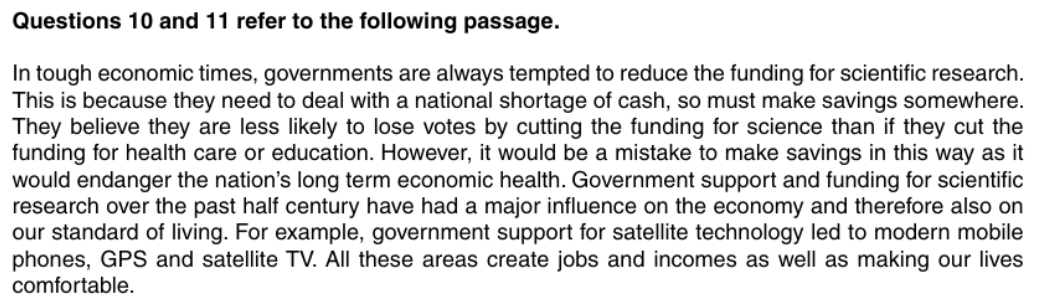
'It would be a mistake to make savings in this way as it would endanger the nation’s long-term economic health.' What is the function of this sentence in the structure of the argument?
A. A reason supporting an intermediate conclusion.
B. An intermediate conclusion supporting a further intermediate conclusion.
C. An intermediate conclusion supporting the main conclusion.
D. Evidence supporting a reason.
Which of the following is an assumption underlying the argument?
A. Future investment in scientific research is likely to have positive effects on the economy.
B. Science is a fundamental part of our economy.
C. Science is more important than health care or education.
D. There is enough money to invest in scientific research even in tough economic times.
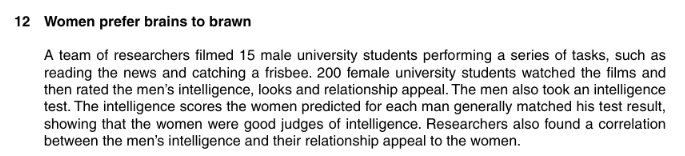
Which of the following is a reason why the headline 'Women prefer brains to brawn' does not follow from the evidence in the passage?
A. Frisbee catching is not representative of normal male activity.
B. It is possible that men might be both good looking and good partners.
C. Intelligence does not necessarily mean that a man will be a good partner.
D. We have no information about how looks and relationship appeal were correlated.
The Templeton Foundation asked leading scientists and Christians to answer the question, 'Does science make God obsolete?' This question does not make sense. It is like asking, 'Do cars make houses obsolete?'

This analogy:
A. Highlights the overlap between scientific understanding and religious understanding.
B. Highlights the similarities between scientific understanding and religious understanding.
C. Suggests that neither scientific understanding nor religious understanding is useful to people at all.
D. Suggests that scientific understanding and religious understanding are useful to people in different ways.
Question 14
14.

Question 15
15.

Question 16
16.

If a chimp sees an actor turn on a light switch with his forehead even though his hands are free, the chimp is likely to use its own forehead to turn the switch. Yet if the actor uses his forehead to turn the switch only because his hands are full, the chimp imitates the task by using its hands and not its forehead. (New Scientist 2 February 2008 p8 extract) 'This shows that chimps are able to make rational inferences, just like people.' This is:
A. A claim which can reasonably be drawn as a conclusion from the evidence.
B. A claim which cannot be drawn as a conclusion from the evidence because it is irrelevant.
C. A claim which is too strong to be drawn as a conclusion from the evidence.
D. A claim which is too weak to be drawn as a conclusion from the evidence.
Lemons are fruit.

Ripe fruit is yellow.

Therefore ripe lemons are yellow. Which one of the following is the most accurate evaluation of this argument?
A. The argument is not valid and one of the reasons is false therefore the conclusion is false.
B. The argument is valid and both reasons are true therefore the conclusion is true.
C. The argument is valid and one of the reasons is false therefore the conclusion is false.
D. The argument is valid and one of the reasons is false but the conclusion is true.


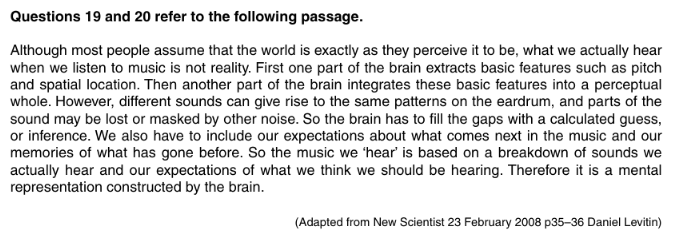
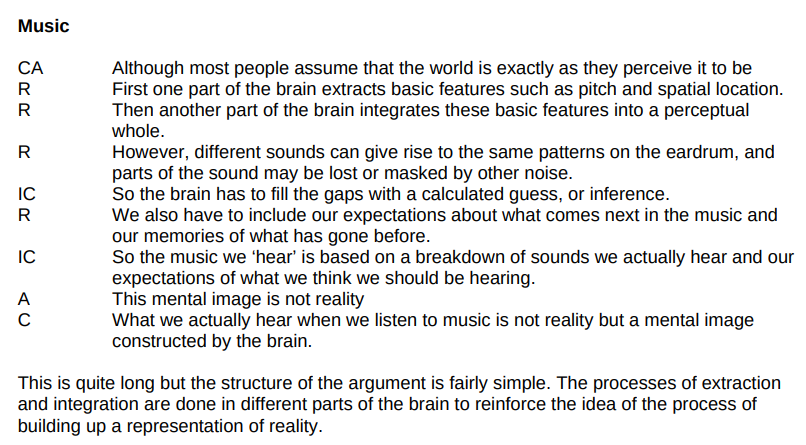
Which of the following is the main conclusion of the argument?
A. Most people assume that the world is exactly as they perceive it to be.
B. The brain has to fill the gaps with a calculated guess, or inference.
C. The music we ‘hear’ is based on a breakdown of sounds we actually hear and our expectations of what we think we should be hearing.
D. What we actually hear when we listen to music is not reality.
Which of the following is an assumption underlying the argument?
A. Calculated guesses are not normally accurate.
B. Ideas are the same as mental representations.
C. Mental representations are not real.
D. None of us constructs the same mental representations.

Which of the following can be inferred from the argument?
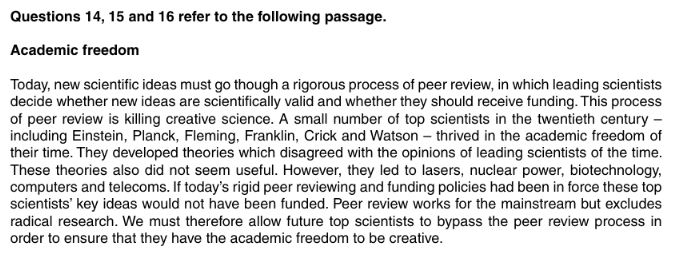
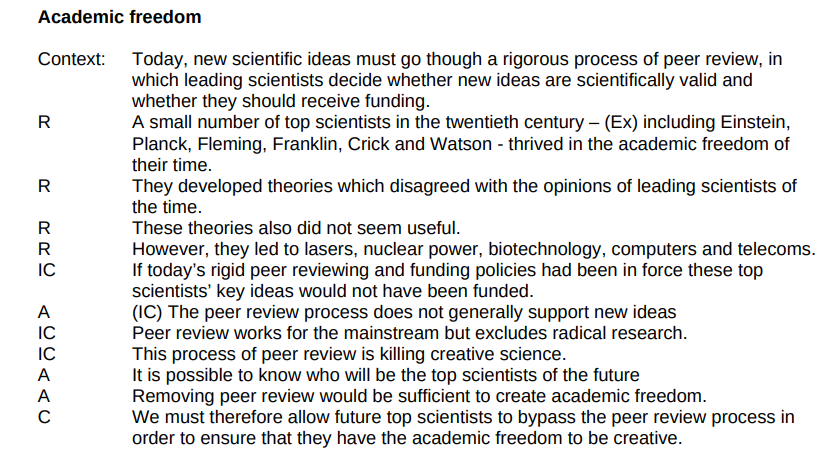
A. If peer review had been in force for scientists like Einstein, we would not now have lasers, nuclear power, biotechnology, computers, or telecoms.
B. It would have been better if peer review had prevented the development of dangerous technologies such as nuclear power and biotechnology.
C. No leading scientist has the imagination to understand and support creative new ideas which might lead to technologies as important as computers or lasers.
D. Peer review may be preventing the development of new ideas as important as those which led to lasers, nuclear power, biotechnology, computers, and telecoms.
Which of the following is an assumption underlying the argument?
(i) It is possible to know who will be the top scientists of the future. (ii) The peer review process does not support new ideas.
A. (i) only
B. (i) and (ii)
C. (ii) only
D. Neither (i) nor (ii)
According to this author, academic freedom is:
A. Necessary and sufficient for creative scientific advance.
B. Necessary but not sufficient for creative scientific advance.
C. Neither necessary nor sufficient for creative scientific advance.
D. Sufficient but not necessary for creative scientific advance.