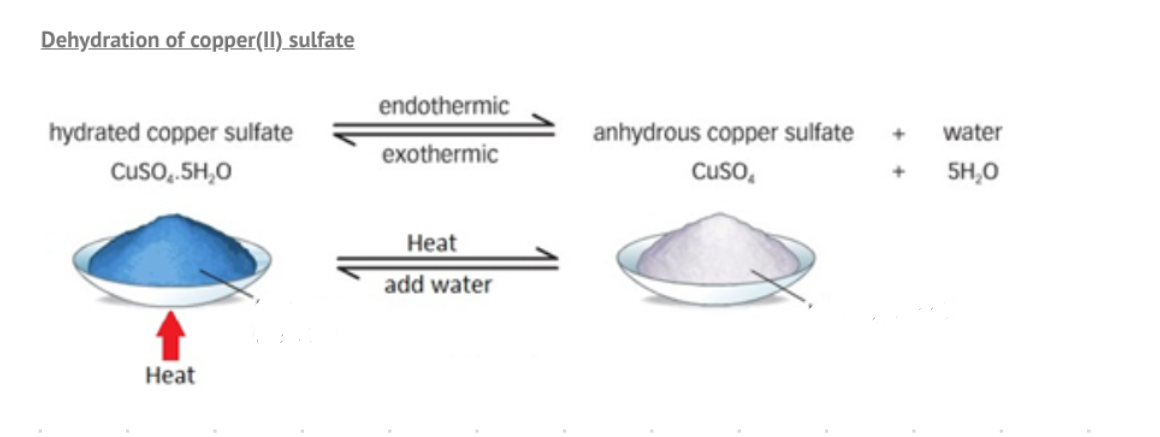
Showing that thermal decomposition of hydrated copper sulfate is reversible.
https://screencast.apps.chrome/1Fjq9QA6e20NQe5aOjJVYvL8s7sGZ4tks?createdTime=2025-06-15T08%3A08%3A43.688Z
Mmuae Afoforo a Wobɛpaw:
White powder
Blue crystals
Showing that thermal decomposition of hydrated copper sulfate is reversible.
https://screencast.apps.chrome/1Fjq9QA6e20NQe5aOjJVYvL8s7sGZ4tks?createdTime=2025-06-15T08%3A08%3A43.688Z
12. Devise an experiment to show that the reaction converting hydrated copper sulfate (blue solid) to anhydrous copper sulfate (white solid) and water is a reversible reaction.
Reaction: CuSO₄·5H₂O ⇌ CuSO₄ + 5H₂O
Step 1: Demonstrate the forward reaction (decomposition).
Place a sample of hydrated copper sulfate crystals in a test tube.
the crystals with a Bunsen burner.
Observation: The crystals will turn , and will be observed coming off.
This shows the conversion to anhydrous copper sulfate and water.
steam
white
Heat
blue
reversible
anhydrous
Step 2: Demonstrate the reverse reaction (rehydration).
Allow the white copper sulfate to cool.
Then, add a few drops of to the white solid using a dropping pipette
Observation: The white solid will turn again.
You may also observe that heat is released (the water turns to .
Step 3: Conclude reversibility.
Since the substance can be converted from blue hydrated copper sulfate to white anhydrous copper sulfate and back again, the reaction is .
Heat
anhydrous
white
steam
reversible
blue
Compound A is a dark brown gas.
Compound B is a colourless gas.
Two molecules of A combine to form one molecule of B in a reversible reaction.
2A ⇌ B
Dark brown colourless
You are given
a sealed glass tube containing an equilibrium mixture of A and B
a beaker
a kettle
some ice
At room temperature, the equilibrium mixture is a pale brown colour.
Devise an experiment to show how the position of equilibrium of this reaction is affected by temperature.
1. Note the colour at room temperature
METHOD OF HEATING AND COOLING
put tube into water (1) and observe the colour
then into cold (1) and observe the colour
OBSERVATIONS • colour goes AND colour goes lighter /
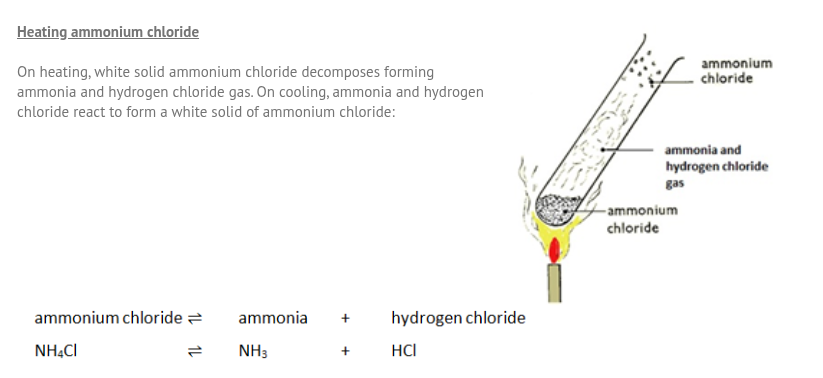
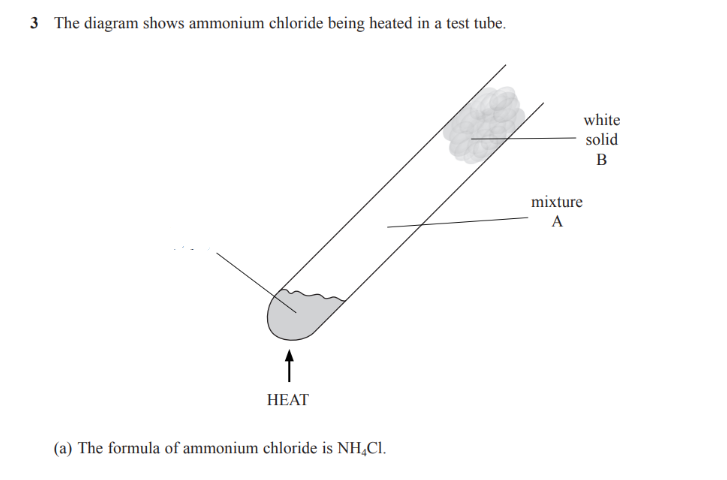
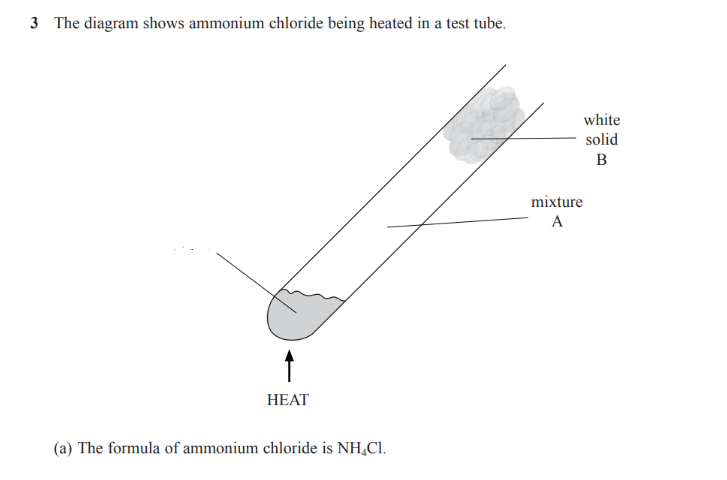
At the , base of the boiling tube the solid Ammonium chloride to form and hydrochloric acid.
At the top of the boiling tube the ammonia and react to form ammonium chloride.
Note that ammonium chloride is an ionic compound even though all of the elements are non-metals.
NH4+ and Cl-
Match the labels to their correct position.
Copy the diagram into your book.
Describe the experiment
Match the labels to their correct position.
Copy the diagram into your book.
Describe the experiment
NH3 and HCl
NH4Cl
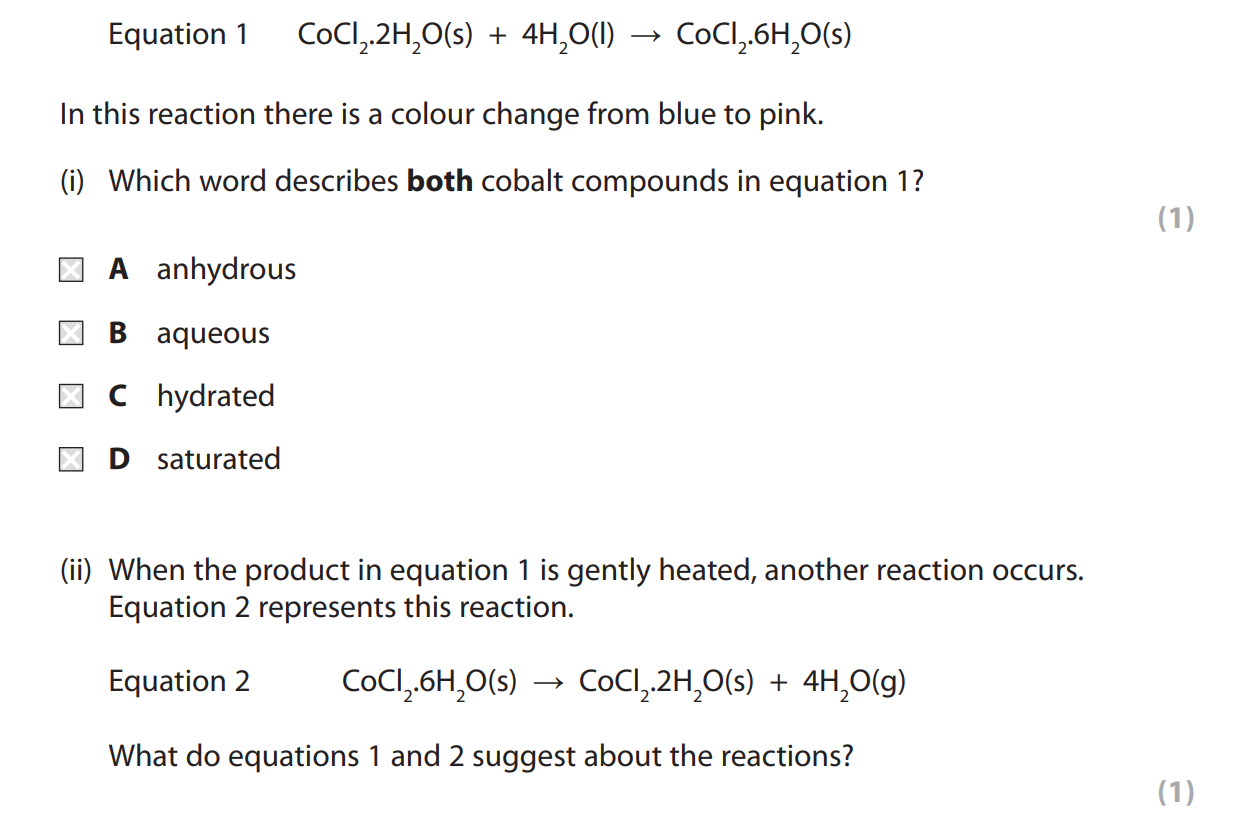
Cobalt chloride experiment
(ii) the reaction is reversible
Shifts in the equilibrium position.
a) Changing the concentration of a reactant
An increase in concentration of a reactant will cause equilibrium to shift to the (the product side).
This will oppose the change
This will the yield.
A decrease in concentration of a reactant will cause equilibrium to shift to the (the reactant side).
This will oppose the change.
This will the yield.
Shifts in the equilibrium position.
a) Changing the concentration of a product
An increase in concentration of a product will cause equilibrium to shift to the (the product side).
This will oppose the change
This will the yield.
A decrease in concentration of a reactant will cause equilibrium to shift to the (the reactant side).
This will oppose the change.
This will the yield.
Shifts in the equilibrium position.
a) Changing the Temperature
An increase in temperature will cause equilibrium to shift to the direction.
This will oppose the increase in temperature as energy taken in in the endothermic direction.
For a reaction (such as the Haber process where the reaction is exothermic in the forward direction) This will the yield
A decrease in temperature will cause equilibrium to shift to the direction. This will oppose the change.
This will the yield.
Shifts in the equilibrium position.
a) decreasing the concentration of a product
decrease in concentration of a will cause equilibrium to shift to the (the product side).
This will the yield.
The effect of changing pressure (affects gasses only).
The effect of changing pressure depends on the balanced equation.
An increase in pressure will shift equilibrium to the side with moles of gas.
A decrease in pressure will shift equilibrium to the side with moles of gas.
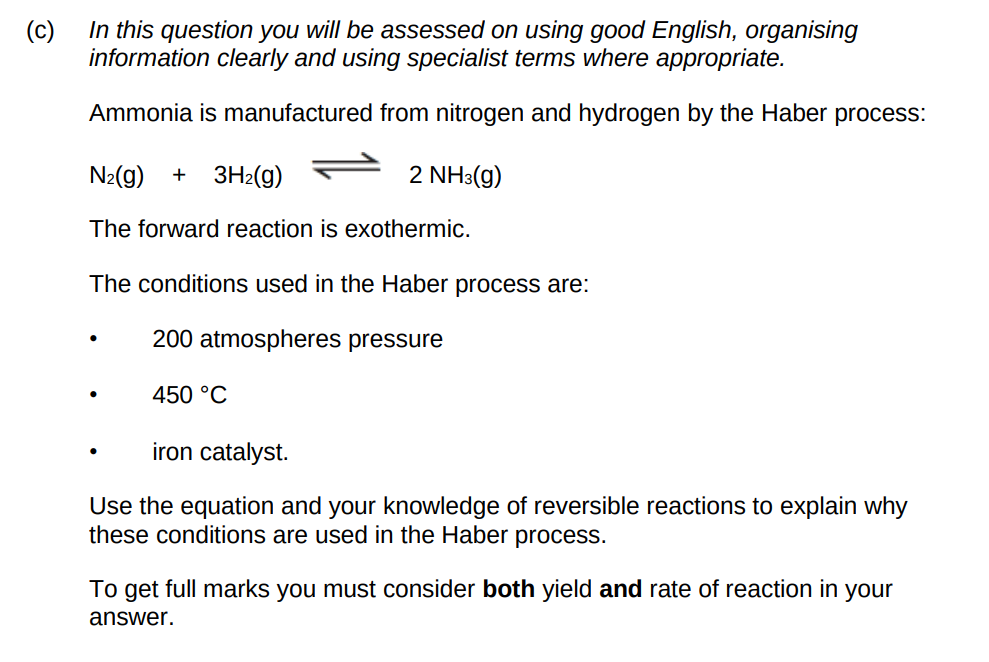
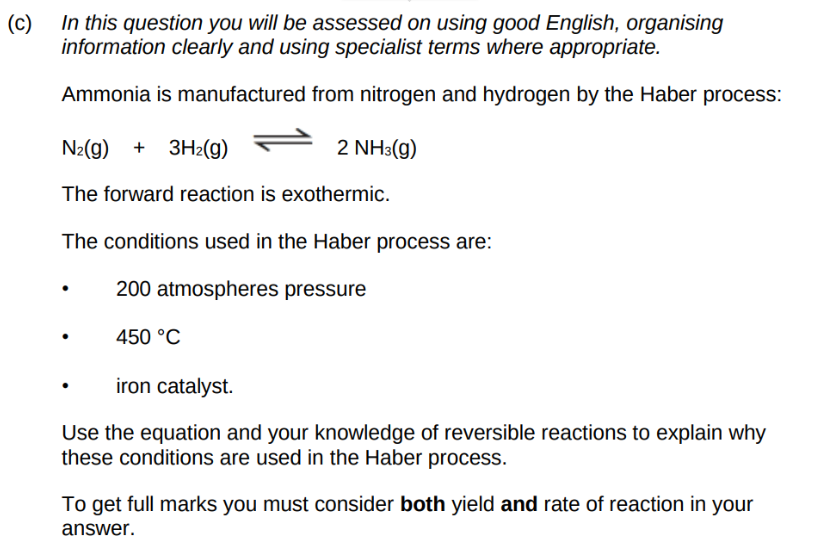
What is the pressure used in the Haber process?
What is the temperature for the Haber process?
The catalyst is used for the Haber process is the transition metal
Haber process and pressure
Pressure
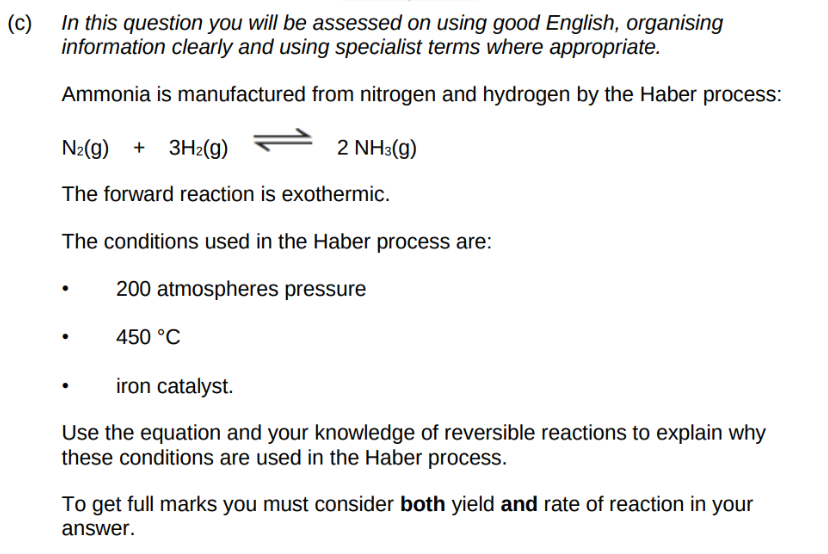
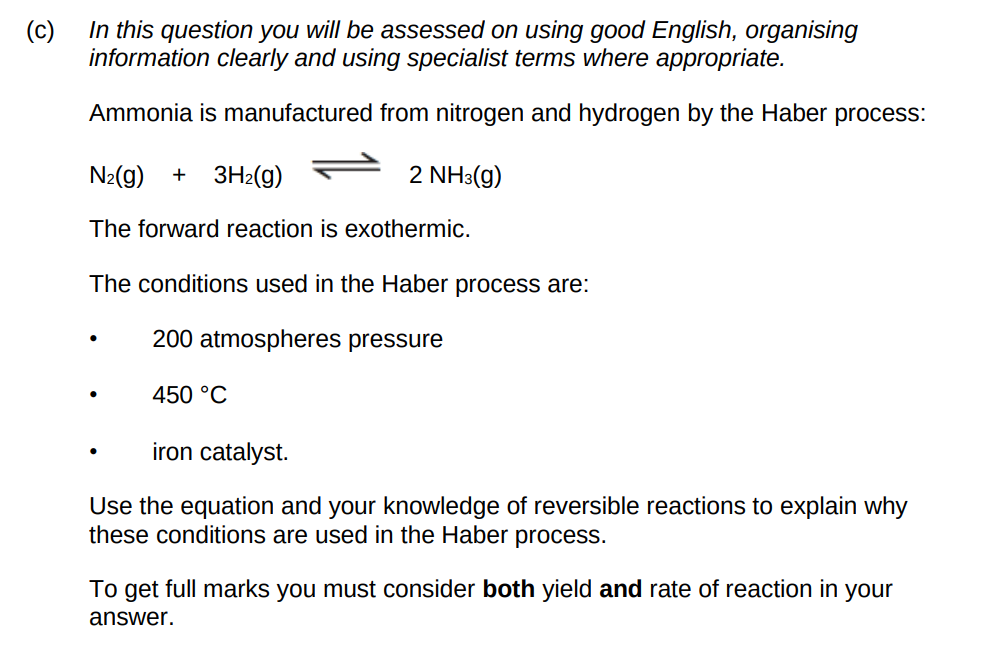
200 atmospheres pressure
higher pressure gives a yield of ammonia
too high a pressure causes risk of / high pressure costly to maintain
a high pressure will cause the to be higher
4 moles of gas become 2 (or moles of gas in products).
explosion
rate
higher
fewer
Answer for pressure
Pressure
200 atmospheres pressure
higher pressure gives a
too high a pressure causes risk of
a high pressure will cause the
4 moles of gas become 2 (or
Word bank
explosion / fewer / higher / rate
Temperature of 450 °C
A higher temperature the rate of reaction (more frequent and more forceful collisions)
However, The forward reaction is so a higher yield of ammonia requires a temperature.
Unfortunately if the temperature is low the rate of reaction to be too
The temperature is a compromise between rate (better at higher temperatures) and yield.(better at lower temperatures.
The reverse reaction is exothermic and an increase in temperature favours the direction.
exothermic
slow
lower
endothermic
Answer for temperature 450 °C
A higher temperature
optimum temperature
The forward reaction is
but too low a temperature causes the rate of reaction to be too
The temperature is a compromise between rate (better at higher temperatures) and yield.(better at lower temperatures as the reverse reaction is exothermic and an increase in temperature favours the
Word bank: Increases / endothermic / exothermic / lower / slow
Catalyst
iron catalyst
A catalyst up the reaction by providing an alternative pathway of activation energy.
an iron catalyst allows a lower temperature to be used (saving energy)
iron catalyst increases the rate of reaction equally in directions.
A catalyst does not change the position of equilibrium but does allow equilibrium to be reached more
both
speeds
lower
Answer for catalyst
iron catalyst
A catalyst
an iron catalyst allows a lower temperature to be used (saving energy)
iron catalyst increases the rate of reaction equally in
Word Bank: both / higher / lower / speeds /
N₂ + 3H₂ ⇌ 2NH₃
The reaction is exothermic in the forward direction
If Hydrogen is added equilibrium will shift to the
If f Nitrogen is added equilibrium will shift to the
If ammonia is added equilibrium will shift to the
If the pressure is increased the equilibrium will shift to the
If the temperature is increased the equilibrium will shift to the
right
left
N₂ + 3H₂ ⇌ 2NH₃
The reaction is exothermic in the forward direction
If Hydrogen is added equilibrium will shift to the
If f Nitrogen is added equilibrium will shift to the
If ammonia is added equilibrium will shift to the
If the pressure is increased the equilibrium will shift to the
If the temperature is increased the equilibrium will shift to the
N₂ + 3H₂ ⇌ 2NH₃
Note the reaction is exothermic in the forward direction
Hydrogen is added
Nitrogen is added
ammonia is added
pressure is increased
temperature is increased
Equilibrium will shift to the right
Equilibrium will shift to the left