Twa kɔ nsɛm atitiriw so
Log in
Sign up for FREE
arrow_back
Laabri

GCSE Chemistry Fuel cells

star
star
star
star
star
Last updated over 1 year ago
13 Nsɛmmisa
1
Asemmisa {{asɛmmisaAhyɛnsode}}
11.
Mmuae Afoforo a Wobɛpaw:
lit
glowing
splint relights
squeaky pop.
1
1
Question 1
00:15
keyboard_arrow_down
2
Question 2
00:28
keyboard_arrow_down
2
Question 3
01:25
keyboard_arrow_down
1
Questions 4 & 5
01:33
keyboard_arrow_down
1
1
Question 6
01:43
keyboard_arrow_down
1
Question 7
02:41
keyboard_arrow_down
2
Question 8
03:08
keyboard_arrow_down
1
Question 9
04:20
keyboard_arrow_down
1
Question 10
07:09
keyboard_arrow_down
1

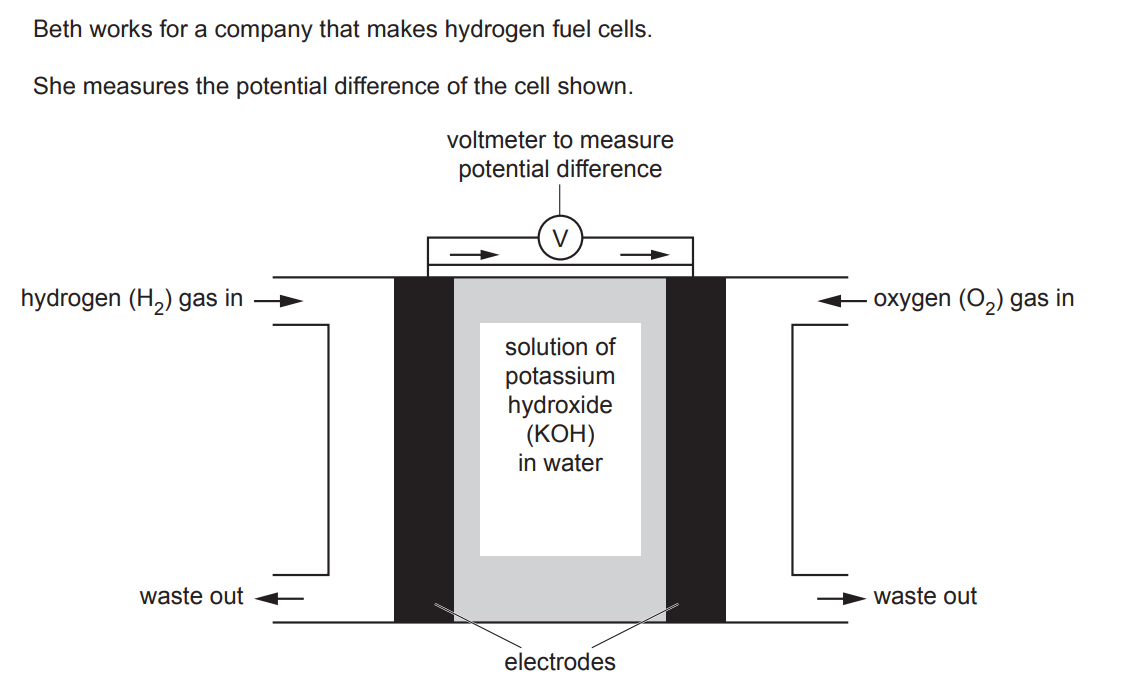
Beth works for a company that makes hydrogen fuel cells. She measures the potential difference of the cell shown. Before she sets up the cell, Beth tests each gas to check its identity. Describe the tests and the results for hydrogen and oxygen gas.

Test for hydrogen splint.

Result for hydrogen test

Test for oxygen splint.

Result for oxygen test
Asemmisa {{asɛmmisaAhyɛnsode}}
12.

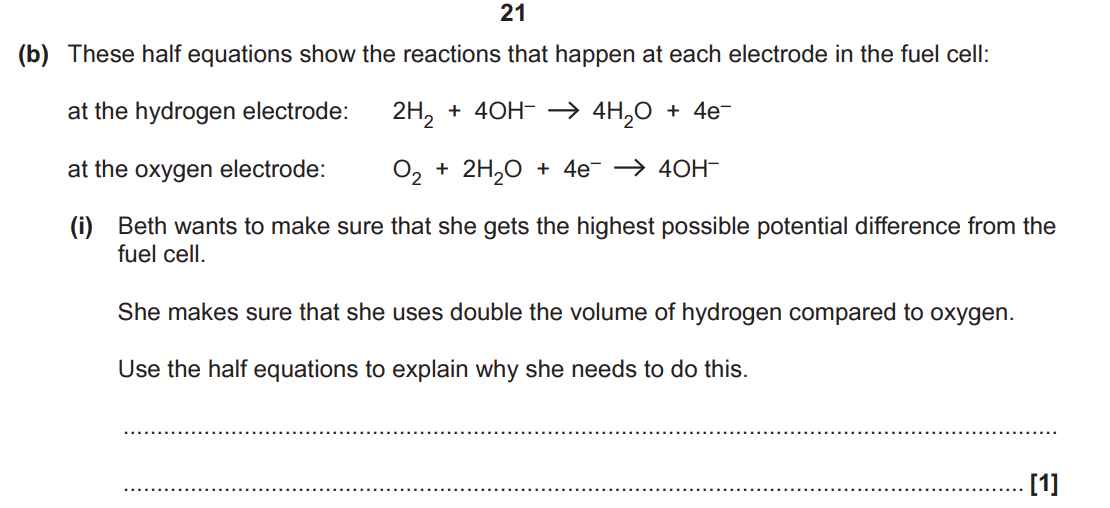
One mole of oxygen gas produces mole of electrons but one mole of hydrogen produces moles of electrons.

The electrons need to balance so twice as many moles of are required.

Mmuae Afoforo a Wobɛpaw:
4
2
hydrogen
Asemmisa {{asɛmmisaAhyɛnsode}}
13.

A fuel cell filled with potassium hydroxide solution works better than one filled with pure water. One reason is that potassium hydroxide solution is a better electrical conductor than pure water. Explain why potassium hydroxide solution is a better electrical conductor than pure water.

Water decomposes to produce H+ and OH- at very low concentrations so in pure water there is a low concentration of elctrolysts and therfore pure water is a poor of electricity.

Potassium hydroxide is very soluble so the concentration of the is higher and the solution is a better conductor..

Mmuae Afoforo a Wobɛpaw:
conductor
electrolyte
Asemmisa {{asɛmmisaAhyɛnsode}}
1.

What are the reactants in a hydrogen fuel cell

Asemmisa {{asɛmmisaAhyɛnsode}}
2.

The fuel cell converts energy between and forms (note this is a different treatment to the one in Physics where there is a chemical potential store and an electrical transfer)

Mmuae Afoforo a Wobɛpaw:
electrical
chemical
Asemmisa {{asɛmmisaAhyɛnsode}}
3.

What is the name of the compound that is often used as an electrolyte?

Asemmisa {{asɛmmisaAhyɛnsode}}
4.

The anode has a charge and is where occurs. This is the of electrons

Mmuae Afoforo a Wobɛpaw:
negative
loss
oxidation
Asemmisa {{asɛmmisaAhyɛnsode}}
5.

The cathode has a charge and is where occurs. This is the of electrons

Mmuae Afoforo a Wobɛpaw:
oxidation
positive
loss
reduction
negative
gain
Asemmisa {{asɛmmisaAhyɛnsode}}
6.

The electrons flow from the to the

Mmuae Afoforo a Wobɛpaw:
cathode
anode
Asemmisa {{asɛmmisaAhyɛnsode}}
7.

Hydrogen will enter at the .

Oxygen will enter at the

Mmuae Afoforo a Wobɛpaw:
cathode
anode
Asemmisa {{asɛmmisaAhyɛnsode}}
8.

The hydrogen is at the anode.

Asemmisa {{asɛmmisaAhyɛnsode}}
9.

The oxygen is at the cathode.

Asemmisa {{asɛmmisaAhyɛnsode}}
10.
  • Only require O2 and H2

  • Do not produce CO2

  • Long lasting so more sustainable

  • Hydrogen is a gas so difficult to store

  • Hydrogen is explosive

  • Hydrogen is produced from cracking fossil fuels

  • Advantages

  • Disadvantages