Log in
Sign up for FREE
arrow_back
Library
Year 11 quick quiz metals + salts 2
By Phoenix Hoyle
star
star
star
star
star
Share
share
Last updated 11 months ago
15 questions
Add this activity
1
1
1
1
1
1
1
1
1
1
1
1
1
1
1
Question 1
1.
Which two of the following substances dissolve in water to form alkaline solutions?
Aluminium hydroxide
Ammonia
Copper hydroxide
Iron hydroxide
Sodium hydroxide
Question 2
2.
This question is about sodium hydroxide and sulphuric acid and the reaction between them. Which two of the statements are correct?
Hydrogen ions make the sodium hydroxide solution alkaline
Sodium hydroxide and sulphuric acid react to produce a base
Sodium hydroxide and sulphuric acid react to produce the salt, sodium sulphate
Sodium hydroxide solution is alkaline because it contains OH⁻ (aq) ions
Sulphuric acid solution contains H
-
(aq) ions
Question 3
3.
The diagram shows part of an oil rig. Unprotected iron (steel) will corrode (rust) if it is in contact with oxygen and water.
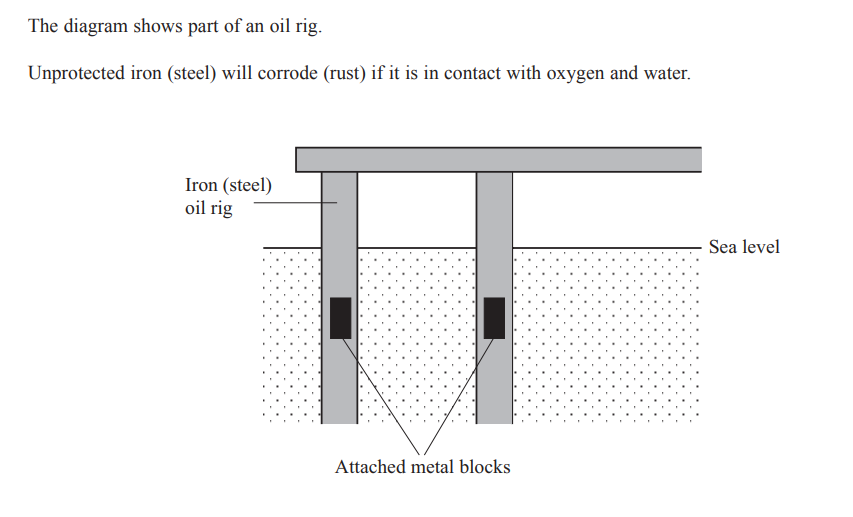
6.1 The iron (steel) will be protected from rusting if the metal of the attached blocks is:
A. an alloy.
B. less reactive than iron (steel).
C. more reactive than iron (steel).
D. a transition metal.
Question 4
4.
6.2 Stainless steel is a non-rusting alloy of iron. Stainless steel is an alloy of iron, nickel, and:
A. aluminium.
B. chromium.
C. magnesium.
D. zinc.
Question 5
5.
Aluminium does not corrode as quickly as iron (steel) because:
A. It develops a thin layer of oxide on its surface.
B. It is in Group 3 of the periodic table.
C. It is lower in the reactivity series than iron.
D. There is a thin layer of grease on its surface.
Question 6
6.
The compound formed on the surface of the copper when it is weathered is:
A. Black.
B. Green.
C. White.
D. Yellow.
Question 7
7.
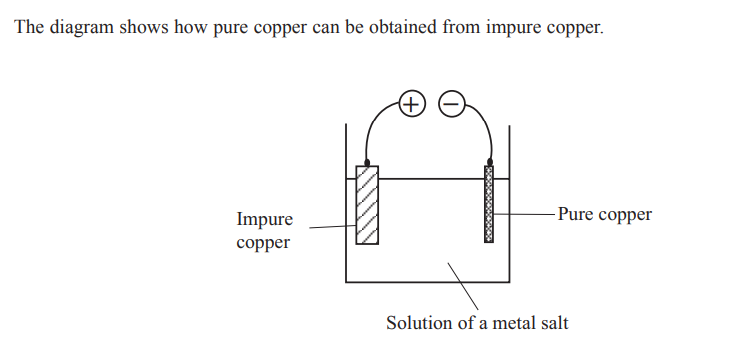
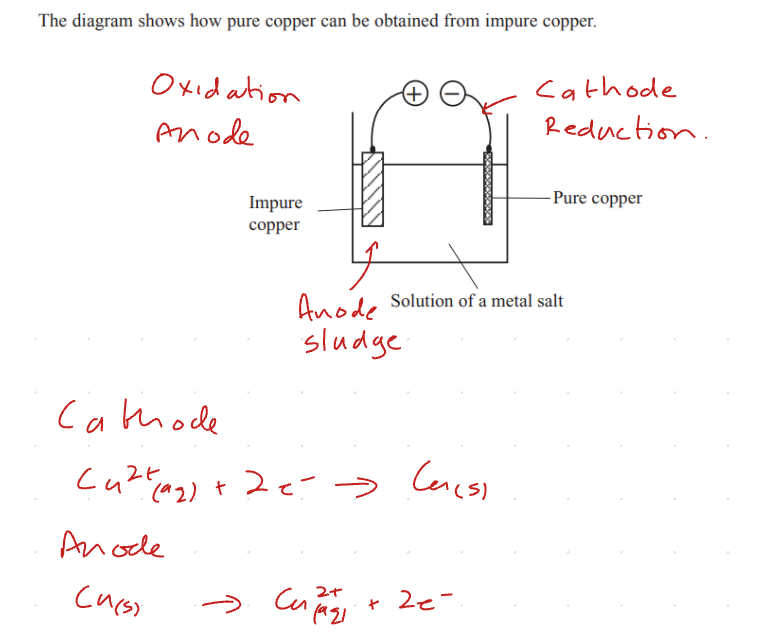
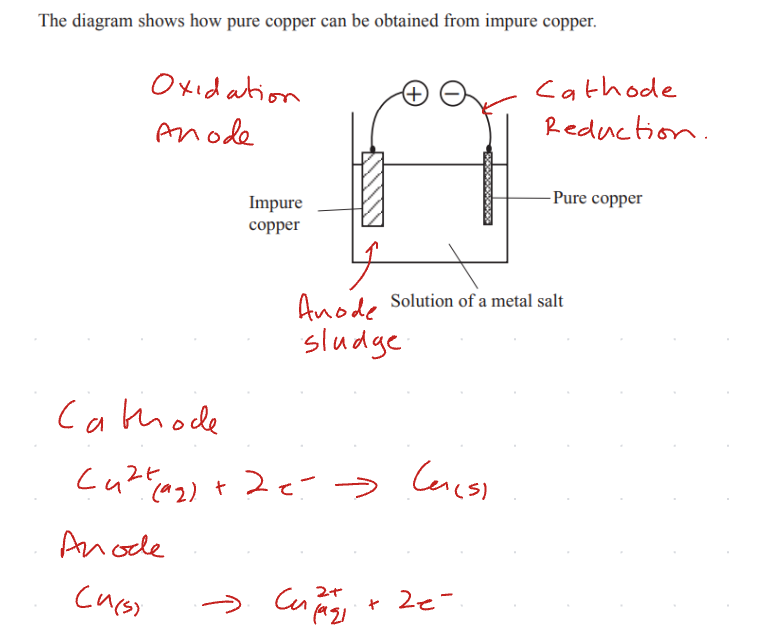
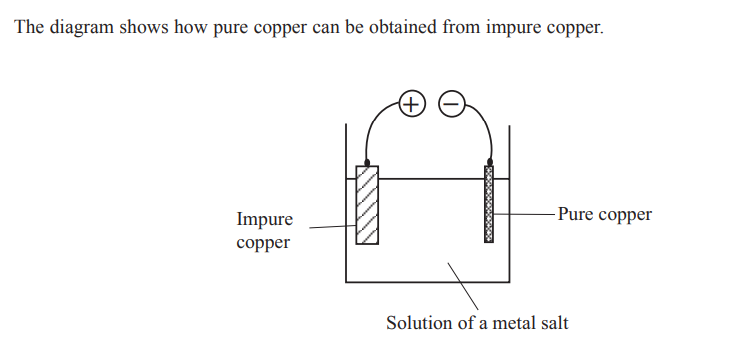
The diagram shows how pure copper can be obtained from impure copper. 8.1 A suitable metal salt would be:
A. Aluminium chloride.
B. Copper sulphate.
C. Magnesium chloride.
D. Magnesium sulphate.
Question 8
8.
8.2 Which of the following statements describes what happens at the positive electrode?
A. Copper atoms gain electrons and form copper ions.
B. Copper atoms lose electrons and form copper ions. (reduction)
C. Copper ions gain electrons and form copper atoms.
D. Copper ions lose electrons and form copper atoms.
Question 9
9.
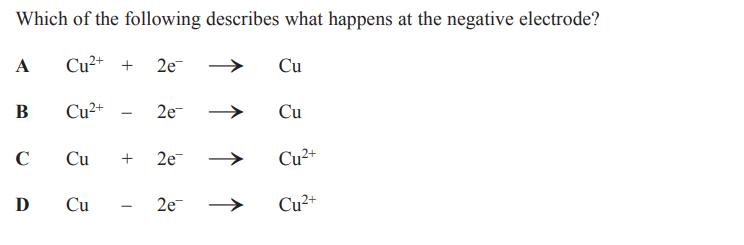
8.2 Which of the following statements describes what happens at the
negative
electrode?
A. Copper atoms gain electrons and form copper ions.
B. Copper atoms lose electrons and form copper ions. (reduction)
C. Copper ions gain electrons and form copper atoms.
D. Copper ions lose electrons and form copper atoms.
Question 10
10.
The reaction at the negative electrode is:
A displacement reaction.
A redox reaction.
A reduction reaction.
An oxidation reaction.
Question 11
11.
a
b
c
d
Question 12
12.
Which salt is produced in this reaction? Ammonia solution + nitric acid → ............................ + water
Ammonia
Ammonium chloride
Ammonium nitrate
Ammonium sulphate
Question 13
13.
To determine the volumes of ammonia and nitric acid to be used a ______________ should be used.
The tiration should then be repeated without the ______________.
Ammonium sulfate can be used as a _______________ and as an explosive.
Other Answer Choices:
drag_indicator
indicator
drag_indicator
fertiliser
drag_indicator
titration
Question 14
14.
When the ammonia solution is completely neutralised by the nitric acid solution, the reaction can be written as:
H⁻(aq) + OH⁺(aq) → H₂O(l)
H⁺(aq) + OH⁻(aq) → H₂O(l)
H⁺(aq)⁻ + OH⁻(aq) → H₂O(l)
H⁻(aq)⁻ + OH⁻(aq) → H₂O(l)
Question 15
15.
Which of these substances will react with nitric acid to produce the salt, copper nitrate?
A: Copper bromide
B: Copper chloride
C: Copper oxide
D: Copper sulphate