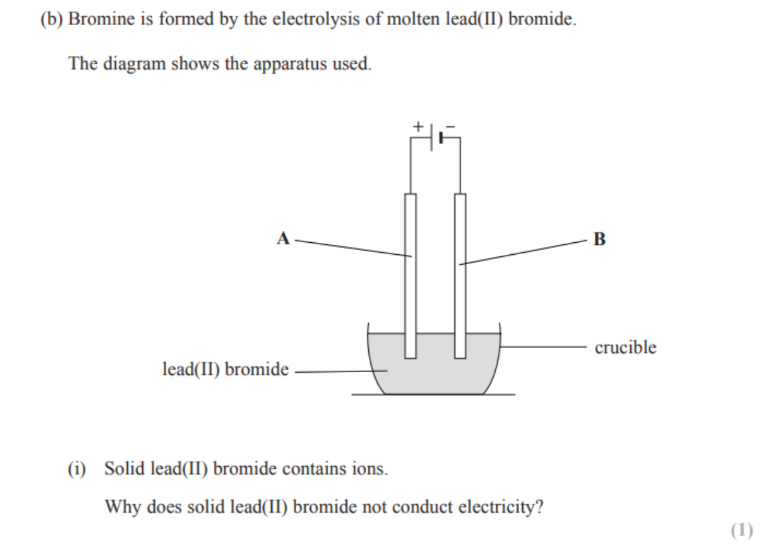
Solid lead (II) bromide does not conduct when solid as the are not free to move in the electrolyte.
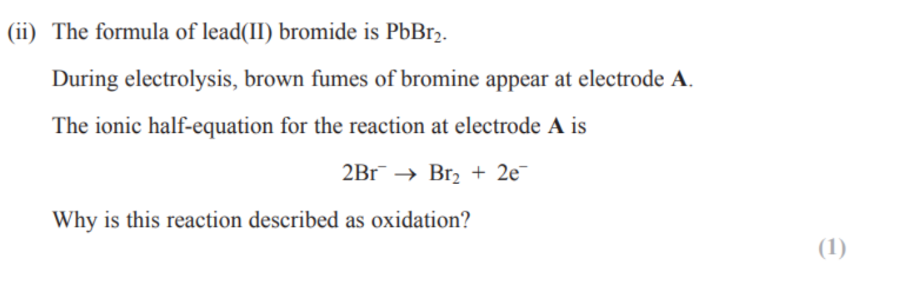
This is described as oxidation because the Bromide ions have lost .
Mmuae Afoforo a Wobɛpaw:
ions
electrons
Electrolysis plays an important part in extracting some metals from their ores e.g. and in purifying others e.g . (see diagrams in hints).
a) Define what is meant by the term electrolysis.
Electrolysis is of a substance using an current
Which metals are obtained from their ores by electrolysis.
Reactive metals at the of the reactivity series (above ) .
Write balanced, ionic equations to show the electrode reactions which occur when copper is purified.
At the anode (where takes place) Cu → Cu²⁺ + 2e⁻ At the (Where reduction takes place) Cu²⁺ + 2e⁻ → Cu)
The mass of the cathode will less than the mass of the anode will as impurities accumulate below the anode as .
The particles that are responsible for the conductivity of electricity in metals are The particles that are responsible for the conductivity of electricity in electrolytes are
The electrolysis of dilute sulphuric acid using inert electrodes produces two gases as products.
Name a material which could be used as the electrodes in this experiment.
Name the gas formed at the anode (4OH⁻→ O₂ + 2H₂O + 4e⁻)
Name the gas formed at the cathode .( 2H⁺ + 2e⁻ → H₂)
The term is used to describe a reaction which gives out heat is .
b) When drops of water are added to anhydrous copper sulphate heat is given out.
Describe what would be observed during this reaction.
The solid would turn blue
The addition of water to anhydrous copper sulphate is called Hydration
The anhydrous copper sulphate can be heated to remove the water of hydration so this reaction is an example of a reaction.
The forward and reverse reactions are not, however, both occurring at the same rate so this is not an example of equilibrium.
Temperature changes in chemical reactions
Heat is also given out during the reaction of sodium hydroxide with hydrochloric acid.
Give a balanced symbol equation for this reaction.
NaOH + HCl → + H₂O.
The reaction of an acid with an alkali is called .
The reaction of zinc with copper sulphate solution also gives out heat. Describe what would be observed during this reaction.
The zinc would become coated with red/ copper metal.
The copper sulfate solution colour fades and zinc disappears
The formula for this and redox reaction is
Zn + CuSO₄ → + Cu
Changing conditions for the Haber process
N₂ + 3H₂ ⇌ 2NH₃
Exothermic in the forward direction.
NH₃ is removed
N₂ is added
H₂ is added
Pressure is increased (4:2)
Temperature decreased
NH₃ is added
N₂ is removed
H₂ is removed
Pressure is decreased
higher temperature
Fe Catalyst added
Shifts equilibrium to the left
Shifts equilibrium to the right
No change
Solid lead (II) bromide does not conduct when solid as the are not free to move in the electrolyte.
This is described as oxidation because the Bromide ions have lost .
https://www.sciencephoto.com/media/718050/view/electrolysis-of-molten-lead-bromide
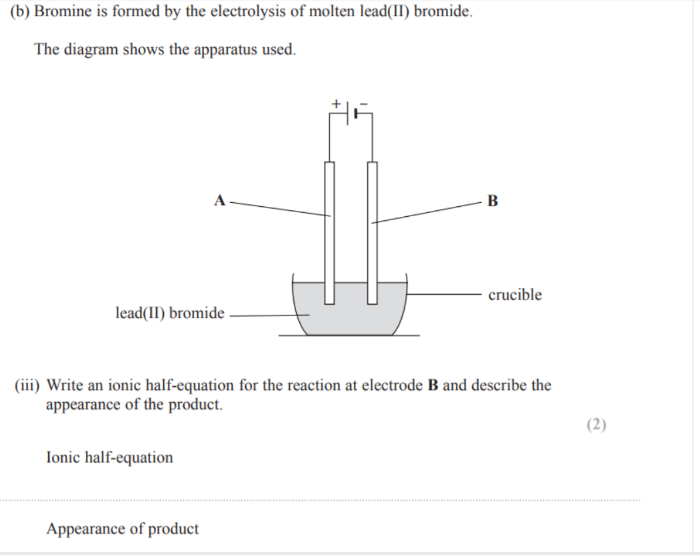
Pb²⁺ + →
The product would be coloured lead liquid.
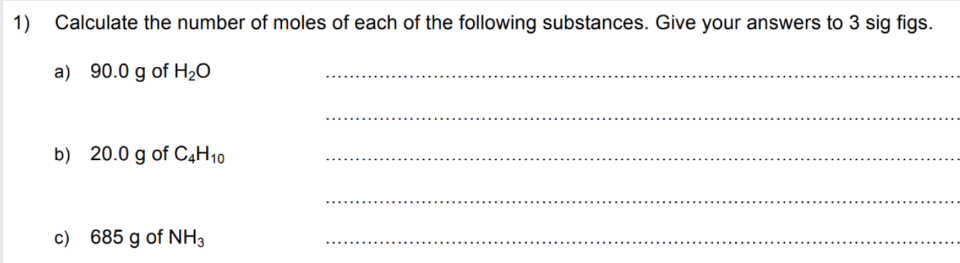
Note answer to 3 sig figs.
a)
b)
c)