Log in
Sign up for FREE
arrow_back
Library

LR257.0.1: Introduction to Formative

star
star
star
star
star
Last updated 4 months ago
27 questions
Required
1
Required
1
Required
1
Required
1
Required
1
Required
1
Required
1
Required
1
Required
1
Required
1
Required
1
Required
1
Required
1
Required
1
Required
1
Required
1
Required
1
Required
1
Required
1
Required
1
Required
1
Required
1
Required
1
Required
1
Required
1
Required
1
Required
1
There are two general types of energy: kinetic and potential energy. All moving objects have kinetic energy. Kinetic energy is energy due to motion.


The amount of kinetic energy that an object has is dependent on two factors: the object’s speed and mass. The more speed an object has, the greater its kinetic energy is. The more mass an object has, the greater its kinetic energy is. Kinetic energy also decreases when an object’s speed or mass decreases.


For example, a sailboat has more speed and mass than a swimmer does. The sailboat has more kinetic energy than the swimmer. On the other hand, a speedboat has more kinetic energy than a sailboat because it has a much greater speed.

Knowing the velocity and mass of an object is essential in calculating the object’s kinetic energy. The following equation is used to calculate kinetic energy:

Question 1
1.

Question 2
2.
Speed and __________ affect kinetic energy.
Question 3
3.
Miki rolled a ball of snow down a hill. The ball grew bigger and collected more snow as it approached the bottom of the hill. Its kinetic energy __________. When it reached the bottom, it slowed down. Its kinetic energy __________.
Question 4
4.
The two things needed to calculate kinetic energy are velocity and __________.
Question 5
5.

Question 6
6.

Question 7
7.

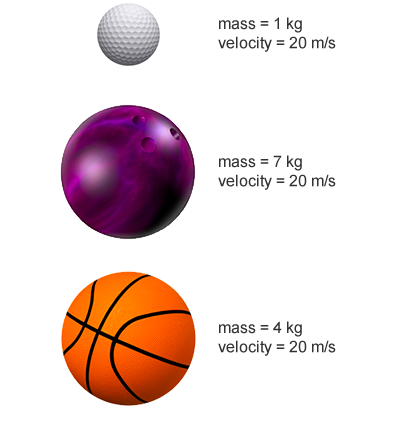
Select the object with the smallest amount of kinetic energy.

1. Kinetic energy is energy due to motion.

2. Kinetic energy is affected by speed and mass.
•Kinetic energy increases as speed increases.
•Kinetic energy increases as mass increases.

3. Kinetic energy can be calculated by using an equation:
KE =/12 × m × v2
Question 8
8.

Another general type of energy is potential energy. Potential energy is the energy an object has due to its position, condition, or chemical composition. There are many forms of potential energy that store energy in different ways. In fact, all matter has potential energy of some kind. When lifting a yo-yo, for example, some energy is transferred to the yo-yo. The energy that is transferred to the yo-yo is stored and can be used later if the yo-yo is released.

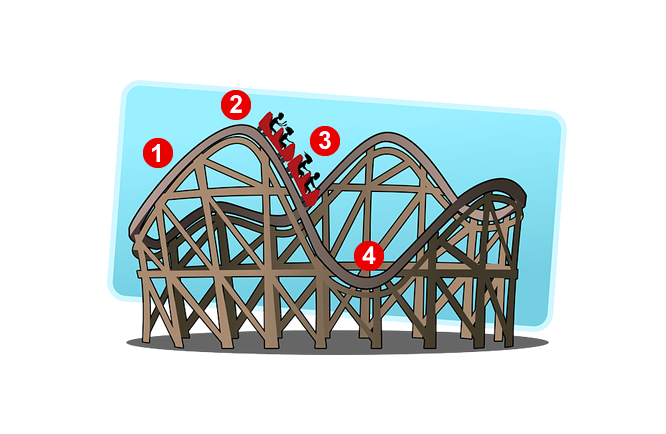
Objects often have both potential and kinetic energy. Everything has some potential energy, but not everything has kinetic energy. Click the buttons to explore how an object can have both potential and kinetic energy.
1. When the cars move up the rollercoaster, their height increases, and their speed decreases. The decrease in kinetic energy is equal to the increase in potential energy.

2. At the top of the rollercoaster, the cars have potential energy because gravity can pull them downward.

3. As the cars move towards the ground, the decrease in their potential energy is equal to the increase in their kinetic energy. Their kinetic energy increases because their speed increases. Their potential energy decreases because their distance from the ground decreases.

4. At the bottom of the rollercoaster, the cars kinetic energy is high because they are going the fastest. Their potential energy is low because they are closer to the ground than at any other point on the rollercoaster.
Question 9
9.

Question 10
10.
A dog running in a park _________________________________
A ball held above ground __________________________
A bird sitting on a tree top __________________________
An airplane flying in the air _________________________________
Other Answer Choices:
Only potential energy
Potential and kinetic energy

Question 11
11.

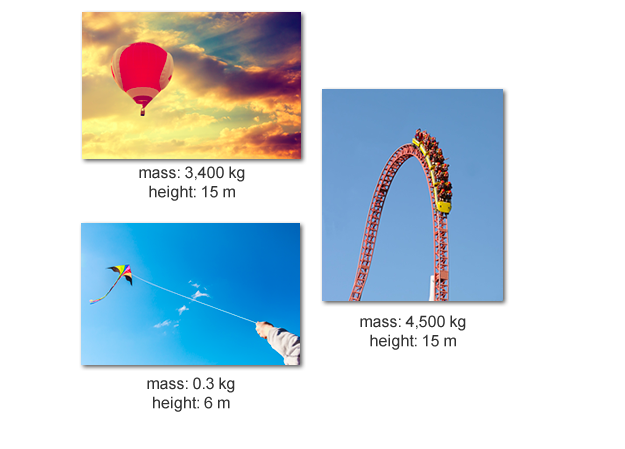
Click on the object that would have the MOST gravitational potential energy.

Question 12
12.

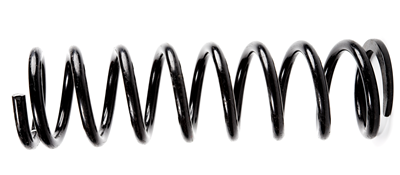
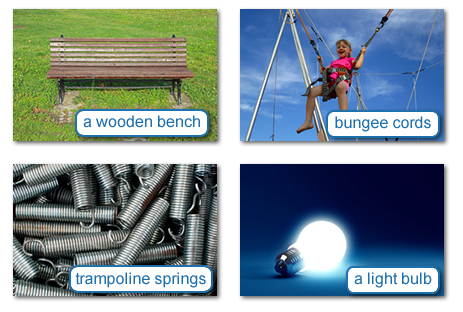
Another form of potential energy is elastic potential energy, which is energy that is stored when materials stretch or compress. Rubber bands and springs are examples of objects that have elastic potential energy.


Question 13
13.
Elastic Energy: __________
Question 14
14.

Click on the pictures that are an example of elastic energy.

1. Potential energy is the energy an object has due to its position, condition, or chemical composition.

2. Objects can have both potential energy and kinetic energy.

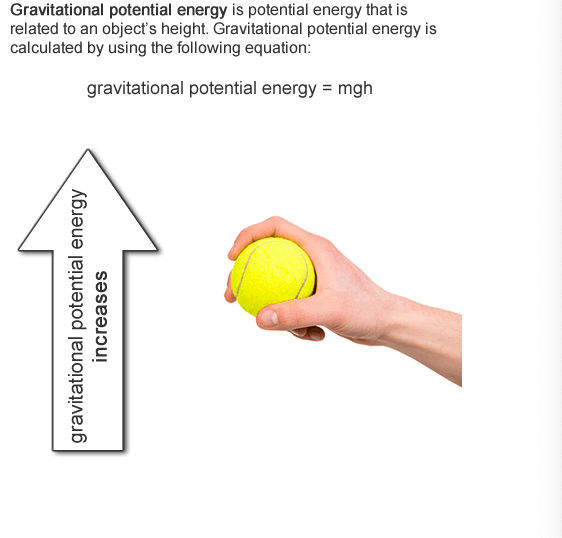
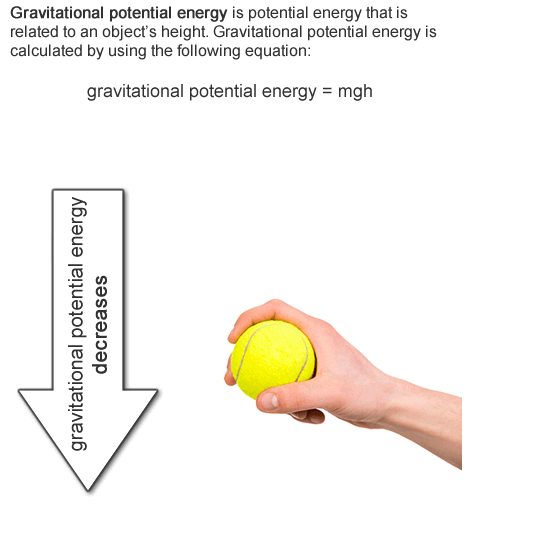
3. Gravitational potential energy is potential energy that is related to an object’s height.

4. gravitational potential energy = mgh

5. Elastic potential energy is a type of potential energy that is stored when materials stretch or compress.
Question 15
15.

Question 16
16.

Question 17
17.

Question 18
18.

1. There are two general types of energy that an object can have: kinetic energy and potential energy.

2. Kinetic energy is energy that is in motion.

3. Kinetic energy is directly affected by speed and mass.
• Kinetic energy increases as speed increases.
• Kinetic energy increases as mass increases.
• Kinetic energy= 1/2 x m x v2

4. Potential energy is the energy an object has due to its position, condition, or chemical composition. It is stored energy.

5. One type of potential energy is gravitational potential energy, which is related to an object’s height.
• gravitational potential energy = mgh

6. Another type of potential energy is elastic potential energy, which is stored when materials are stretched or compressed.
Question 19
19.

Which examples are only potential energy?

1. a water tower
2. a rolling bowling ball
3. water moving in an ocean
4. a baseball held above ground
Question 20
20.

Question 21
21.

Question 22
22.
Aaliyah is a gymnast. To get onto the balance beam, she must jump off of a springboard. The contraction of the springs in the board stores__________
Question 23
23.

Question 24
24.

Question 25
25.

Question 26
26.

Question 27
27.

What is kinetic energy?
the rate at which work is performed
the mass of an object
energy that is due to motion
energy that is stored
A tennis ball weighs 2 kg and is traveling at 10 meters per second. What is the tennis ball’s kinetic energy?
Hint: KE =1/2 × m × v2
100 J
200 J
20 J
10 J
Calculate the kinetic energy of a bike that has a mass of 20 kg and is traveling at 5 meters per second.
(Hint: KE = 1/2 × m × v2)
500 J
25 J
250 J
100 J
An object that is not moving still has energy?
True
False
Which of the following properties of an object could affect its potential energy?
its speed
its condition
its position
its chemical composition
Elle and Ezra have the same mass of 75 kilograms. Elle is skating at the top of a ramp. The ramp she is on is 2 meters high. Ezra is skating on top of another ramp, which is 3 meters high. Which skater has more gravitational potential energy?
Elle has more gravitational potential energy because she is closer to the ground.
Neither of the skaters has gravitational potential energy.
They have the same gravitational potential energy because the acceleration due to gravity is the same.
Ezra has more gravitational potential energy because he is higher off the ground.
What is kinetic energy?
energy due to motion
energy due to height
energy due to position
energy due to chemical composition
What is potential energy?
the energy an object has due to its position, condition, or chemical composition
the energy an object has due to its vibrations
the energy an object has due to its speed
the energy an object has due to its temperature
What is gravitational potential energy?
potential energy that is related to an object’s speed
potential energy that is stored when materials compress
potential energy that is related to an object’s height
potential energy that is stored when materials stretch
What is elastic potential energy?
a type of potential energy that is related to an object's temperature
a type of potential energy that is stored when materials stretch or compress
a type of potential energy that is stored when an object is forced to move
a type of potential energy that is related to an object’s speed
Which of the following correctly describe how the kinetic energy of an object is affected?
As its speed decreases, its kinetic energy increases.
As its mass decreases, its kinetic energy decreases.
As its speed increases, its kinetic energy increases.
As its mass increases, its kinetic energy decreases.
Maya's cat climbed a tree. Maya wants to calculate the gravitational potential energy of her cat. Which one of these equations will help her? (which equation calculates gravitational potential energy?)
mh
mph
mgh
Mark plays basketball. When he dribbles the ball, the ball’s movement is an example of __________. When he holds the ball in his hands, the ball has only __________.
kinetic energy; elastic potential energy
gravitational potential energy; kinetic energy
elastic potential energy; kinetic energy
kinetic energy; potential energy
How do mass and speed affect the kinetic energy of an object?
Check all that are true.
When an object’s speed increases, its kinetic energy decreases.
When an object’s mass increases, its kinetic energy increases.
When an object’s speed decreases, its kinetic energy decreases.
When an object’s mass decreases, its kinetic energy increases.
Calvin rolls a bowling ball that weighs 3 kilograms, travels 5 meters, and moves at a speed of 10 meters per second. How much kinetic energy does the bowling ball have? Hint: kinetic energy = 1⁄2 × m × v2
150 J
28 J
300 J
Which factors are needed to calculate the gravitational potential energy of an object?
Check all that are true.
height
acceleration due to gravity
mass
speed
Which of the following are true?
Check all that are true.
There are different types of potential energy.
An object that is not moving loses its energy the longer it stays stationary.
There is one type of potential energy.
An object that is not moving still has energy.