Twa kɔ nsɛm atitiriw so
Log in
Sign up for FREE
arrow_back
Laabri

Lesson 2.6 Energy Transfer and Heat Capacity Review

star
star
star
star
star
Last updated about 1 year ago
26 Nsɛmmisa
Untitled Section
23
4
Revewing Heat Capacity
1
1
1
1
1
10
4
6
Reviewing Energy Transfer
7
5
2
2
1
1
2
2
Question 1
01:55
Question 2
02:44
Question 3
03:34
Question 4
04:33
Question 5
06:59
Question 6
07:41
Asemmisa {{asɛmmisaAhyɛnsode}}
7.

Match the vocabulary word with its definition

Draggable itemarrow_right_altCorresponding Item

Law of Conservation of Energy

arrow_right_alt

the energy of moving particles

Exothermic process

arrow_right_alt

Energy used to move particles in the presence of a force

Specific Heat Capacity

arrow_right_alt

pulls particles together

Work

arrow_right_alt

pulls particles apart

Attractive force

arrow_right_alt

Energy associated with attractive forces

Calorie

arrow_right_alt

Energy that enters or leaves a system

Repulsive force

arrow_right_alt

Energy transfer by particles colliding with each other

Kelvin

arrow_right_alt

Energy transfer by light energy being absorbed or released

Kinetic Energy

arrow_right_alt

energy associated with attractive forces between atoms or molecules

Potential Energy

arrow_right_alt

energy is entering the system

Endothermic process

arrow_right_alt

energy is leaving the system

Heat

arrow_right_alt

energy can be neither created or destroyed

calorie

arrow_right_alt

Measures the average kinetic energy of the particles in the system

Temperature

arrow_right_alt

the amount of energy needed to increase the temperature of one gram of a substance by one degree Celcius

C

arrow_right_alt

the temperature at which no particles are moving in a system

Chemical Potential Energy

arrow_right_alt

temperature scale that starts at absolute zero

joule

arrow_right_alt

symbol for change in

Δ

arrow_right_alt

heat the flowed into or out of the system

Absolute Zero

arrow_right_alt

change in temperature of the system

ΔQ

arrow_right_alt

specific heat capacity of a substance

Radiation

arrow_right_alt

S.I (metric) unit of energy

ΔT

arrow_right_alt

imperial system unit of energy

Conduction

arrow_right_alt

Food calories- is equal to 1000 calories

Asemmisa {{asɛmmisaAhyɛnsode}}
8.

Sort the

  • Potential Energy

  • Heat

  • Work

  • Kinetic Energy

  • Determines the total energy of the system

  • Changes the energy of the system

Asemmisa {{asɛmmisaAhyɛnsode}}
9.

Which substance has the most energy, the brick or the water?

Asemmisa {{asɛmmisaAhyɛnsode}}
10.

How can one substance have more energy than another if they are both the same temperature?

Asemmisa {{asɛmmisaAhyɛnsode}}
11.

Use the slider to turn on the heat. Which substance heats up the quickest.

Asemmisa {{asɛmmisaAhyɛnsode}}
12.

Which substance requires the most energy to change its temperature 1 degree?

Asemmisa {{asɛmmisaAhyɛnsode}}
13.

Assume that the brick and the water have the same mass. Which substance has the highest heat capacity?

Asemmisa {{asɛmmisaAhyɛnsode}}
14.

Design an experiment using the simulation to determine whether the iron or the brick has the highest heat capacity. Be sure to describe your procedure. The evidence that you obtained and then explain how that evidence supports your conclusion. For full points, you must use the definition of heat capacity in your explanation.

Question 15
01:35
keyboard_arrow_down
1
Asemmisa {{asɛmmisaAhyɛnsode}}
15.

The coldest temperature in Antartica is

Question 16
02:02
keyboard_arrow_down
1
Asemmisa {{asɛmmisaAhyɛnsode}}
17.

All solids, liquids and gasses have a specific heat capacity. In the heating curve below, we are starting with a sample of ice from that very cold ridge in Antartica. Label each part of the curve with the correct name for the energy being absorbed between the two points.
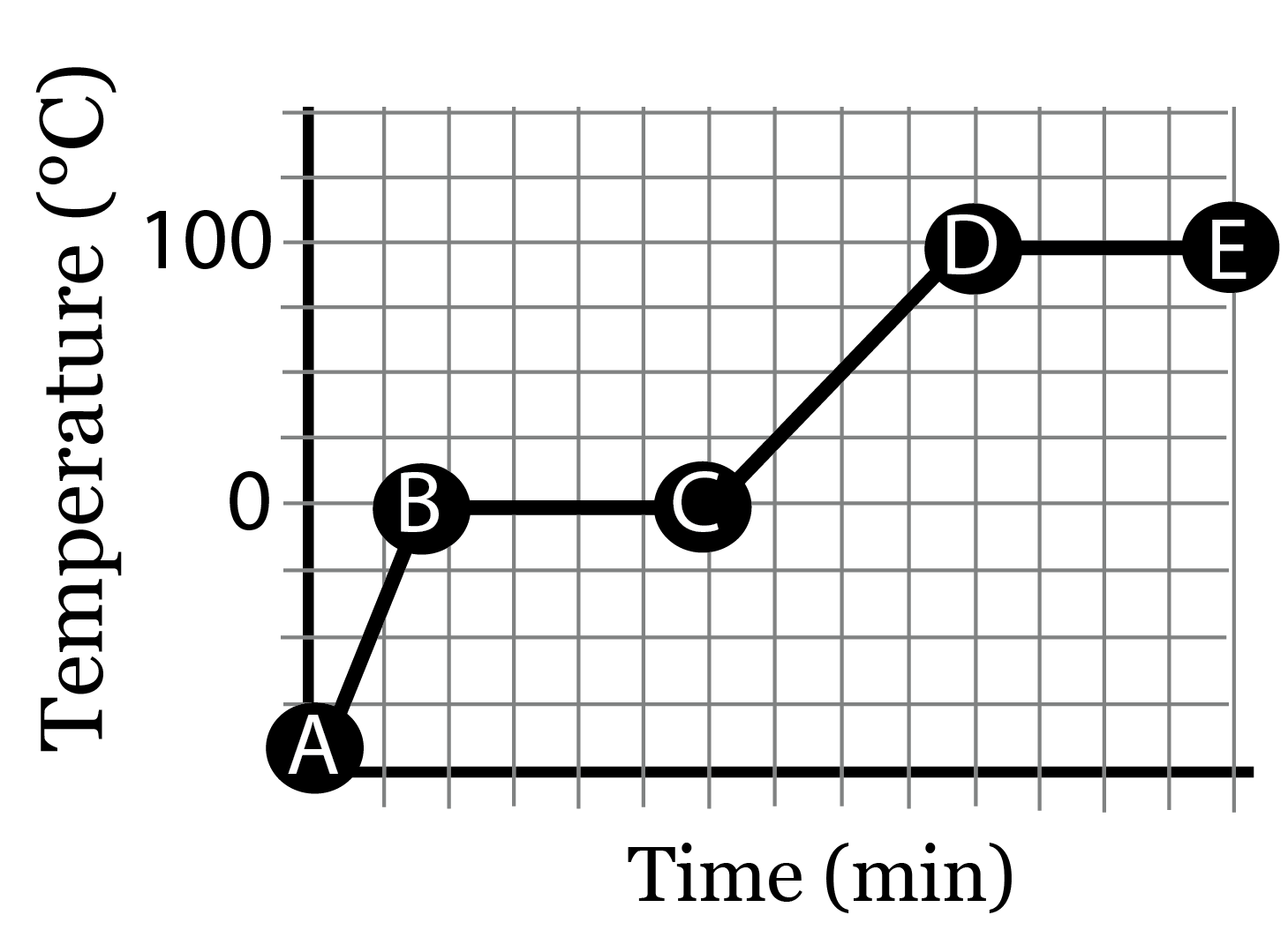
Mmuae Afoforo a Wobɛpaw:
Heat Capacity
Heat Capacity
Heat of Fusion
Heat of Vaporization
Asemmisa {{asɛmmisaAhyɛnsode}}
18.

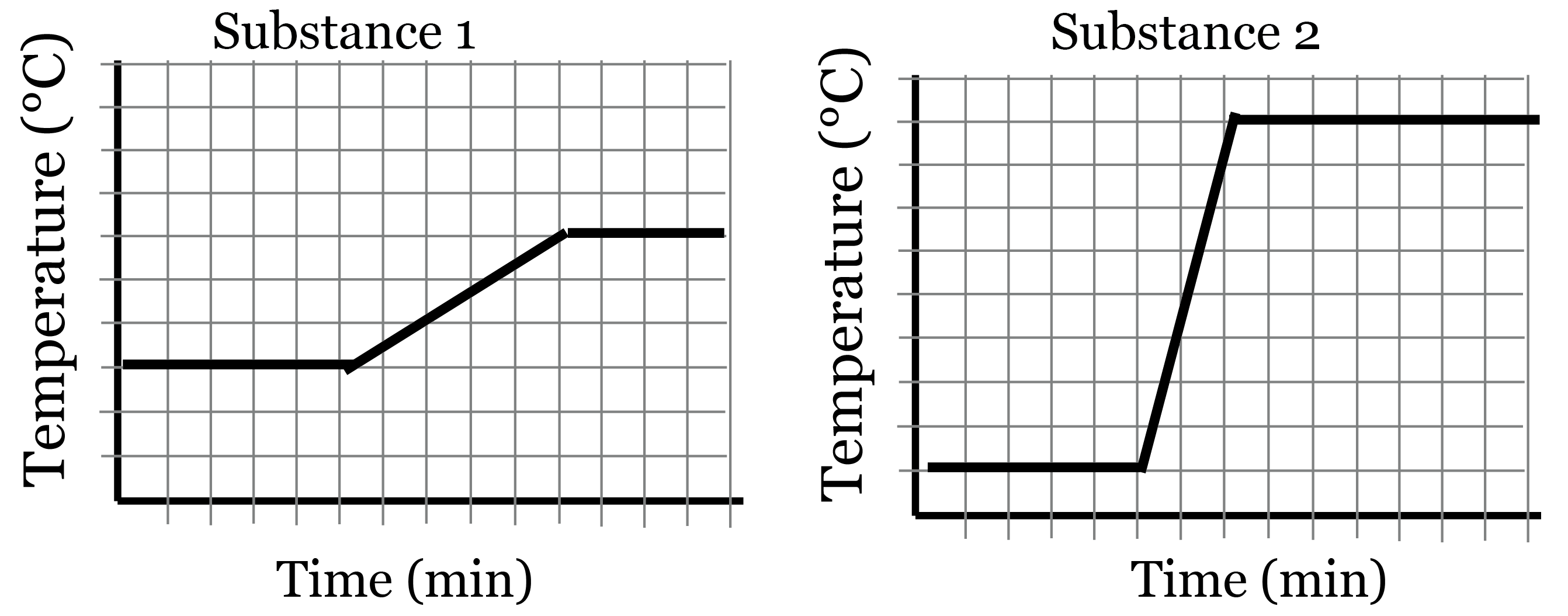
Compare the heating curves of these two substances and then chose the substance for which each of the following is true.

Substance 1

Substance 2

Lowest Melting Point

Lowest Boiling Point

Lowest Heat Capacity

Most temperature change for 1 unit of heat

Requires most heat to melt

Requires most heat to change temperature of liquid

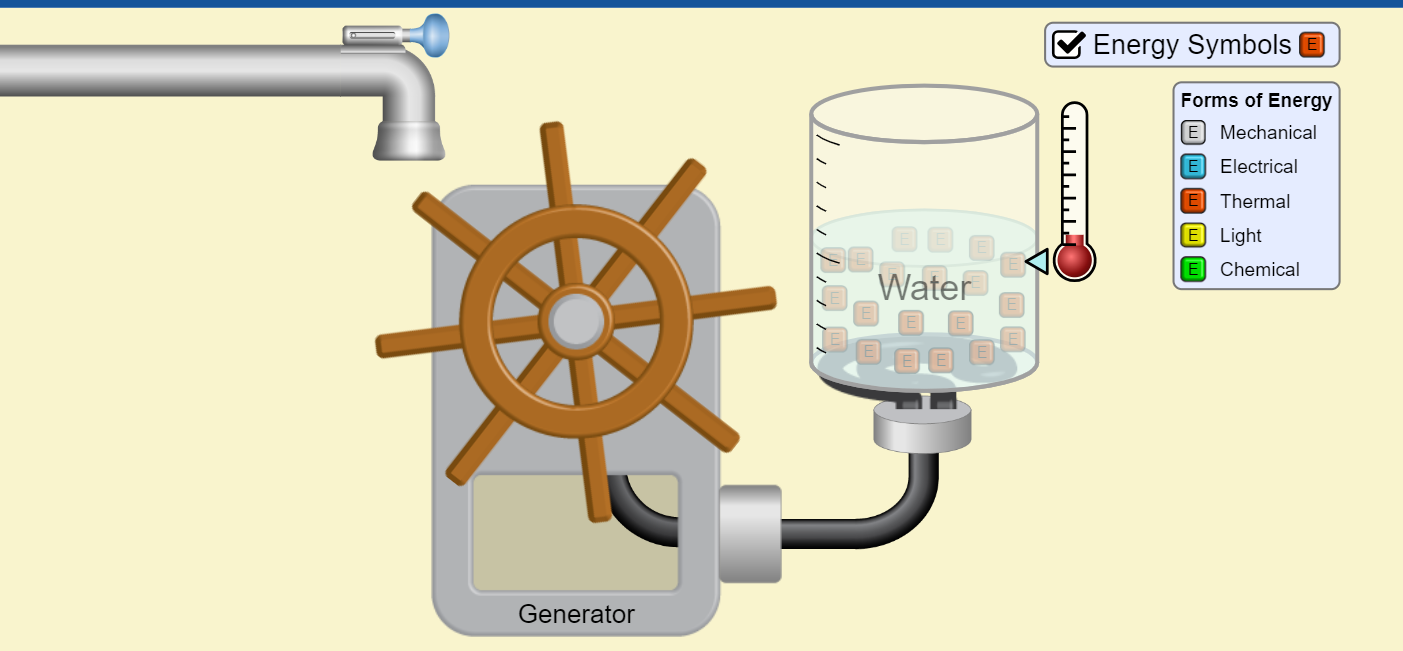
1. Click on the Systems Box.

2. Select the Pipe and the generator and the water.

3. Click on the box for the energy symbols.

If you have it set up correctly, it should look like this.

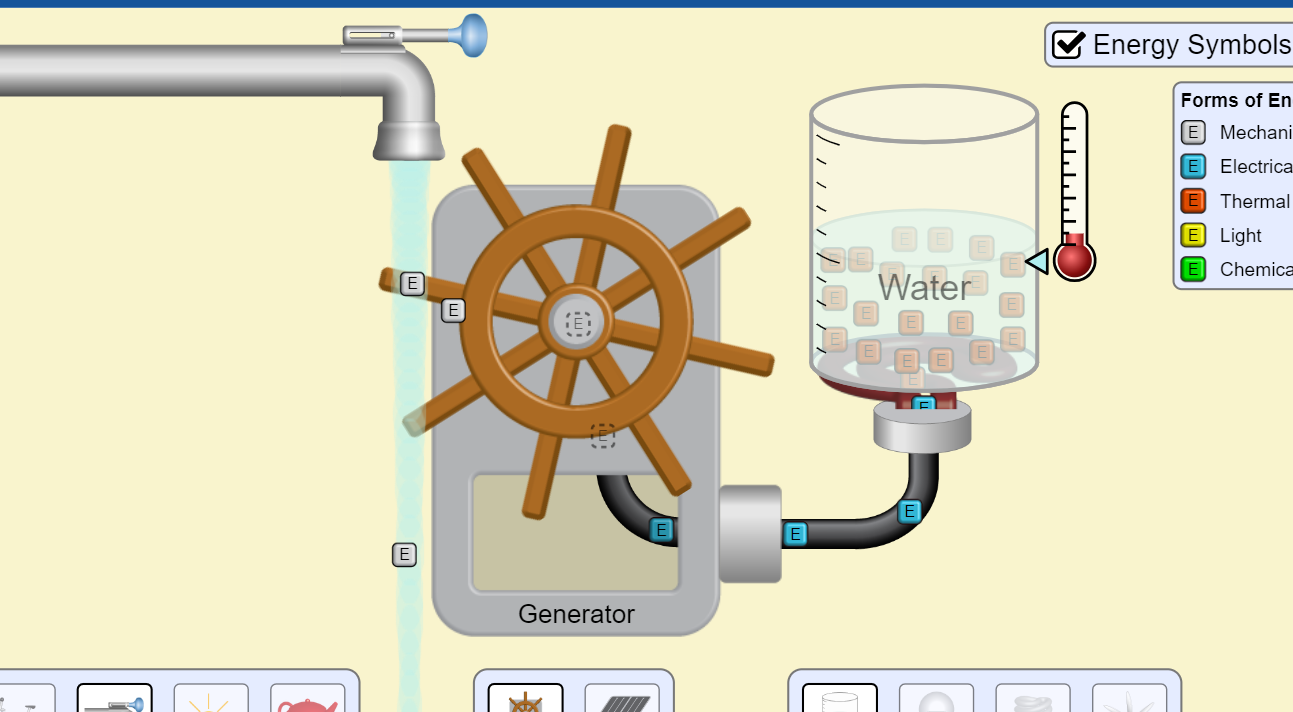
Open the pipe and watch the energy flow, it should look like this

Watch the simulation and then use your observation to fill in the statements below.

Asemmisa {{asɛmmisaAhyɛnsode}}
19.
Mmuae Afoforo a Wobɛpaw:
potential energy
low
work
kinetic energy
high
Asemmisa {{asɛmmisaAhyɛnsode}}
20.
Mmuae Afoforo a Wobɛpaw:
attractive forces
heat
speed
kinetic energy
work
Asemmisa {{asɛmmisaAhyɛnsode}}
21.
Mmuae Afoforo a Wobɛpaw:
generator
air
wheel
water
Asemmisa {{asɛmmisaAhyɛnsode}}
22.
Mmuae Afoforo a Wobɛpaw:
generator
water
wheel
air
Asemmisa {{asɛmmisaAhyɛnsode}}
23.
Mmuae Afoforo a Wobɛpaw:
more than
equal to
less than
Asemmisa {{asɛmmisaAhyɛnsode}}
24.

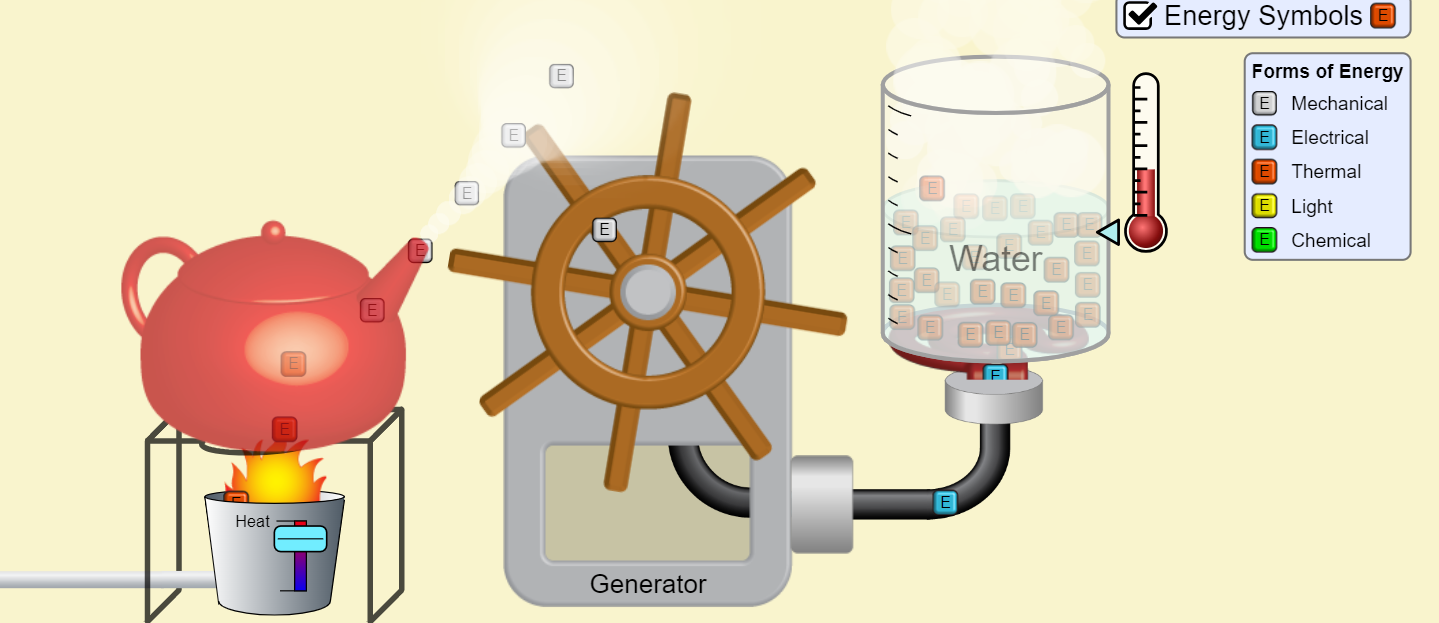
Click on the spot where the thermal energy is being transformed to mechanical energy.

Asemmisa {{asɛmmisaAhyɛnsode}}
25.

Play with the simulation by changing the sources of energy and the mechanisms of transfer.

What is an example of energy being transferred using radiation?

Asemmisa {{asɛmmisaAhyɛnsode}}
26.

Play with the simulation by changing the sources of energy and the mechanisms of transfer.

What is an example of energy being transferred using conduction?

Asemmisa {{asɛmmisaAhyɛnsode}}
16.

If the air above the ice is at -90°C and the ice is not melting how cold is the surface of the ice?