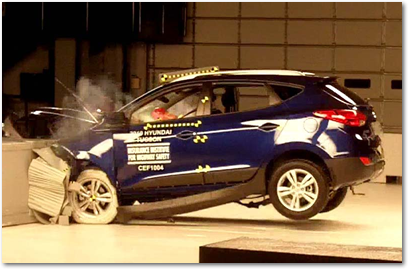
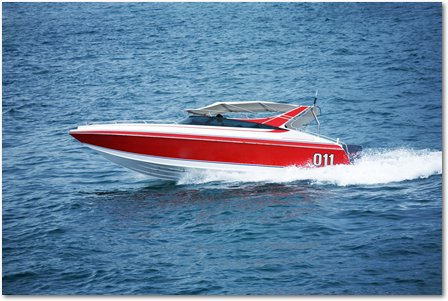
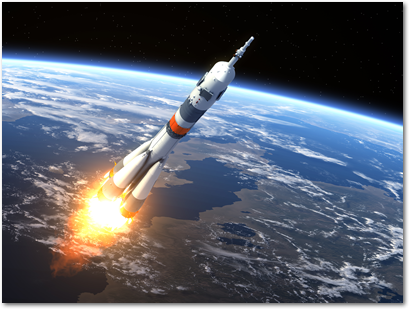
Why does a snowflake fall out of the sky instead of stopping in midair? Why do rocks not roll down mountains on their own? Questions such as these about force and motion fascinated a British scientist named Sir Isaac Newton. In the 1680s, Newton published a book called Mathematical Principles of Natural Philosophy, in which he tried to answer those types of questions. He described three laws of motion that are still used and studied today.
Newton’s first law of motion states that an object at rest will stay at rest unless it is acted upon by a nonzero net force. An object in motion will stay in motion with the same direction and speed unless it is acted upon by a nonzero net force.
Newton’s first law describes something called inertia. Inertia is the tendency of objects to resist a change in motion. In other words, an object that is still will not move unless a force makes it move, and an object that is moving will not stop unless a force makes it stop. For example, inertia explains why a person riding in a car keeps moving forward in his seat if the car brakes suddenly. The person only stops moving forward because the force of the seat belt stops him.
Inertia is affected by mass. Objects with more mass have more inertia, which means more force is required to move them or bring them to a stop. It takes more force to move a bowling ball than it does to move a tennis ball because the bowling ball has more mass, and therefore it has more inertia.
Required
1 point
1
Question 1
1.
The speed of an object determines the amount of inertia it has.
Required
1 point
1
Question 2
2.
Which of the following statements correctly describes Newton’s first law?
Required
1 point
1
Question 3
3.
If a vehicle’s __________increases, its inertia also increases. If all the vehicles on this road are traveling at the same speed, a __________will take the longest amount of time to come to a complete stop.
Check for Understanding:
1. Newton’s first law of motion states that an object at rest will stay at rest unless it is acted upon by a nonzero net force. An object in motion will continue moving with the same direction and speed unless it is acted upon by a nonzero net force.
2. Inertia is the tendency of objects to resist a change in motion.
3. Objects with more mass have more inertia.
Newton’s first law tells scientists that if an unbalanced force acts on an object at rest, that object will accelerate. Newton’s second law describes that acceleration. Newton’s second law states that an object’s acceleration depends on its mass and the net force acting on it. This law can be written in the following way:
Newton’s second law can also be rewritten to show how much force is needed to move an object at a certain acceleration. That relationship is written in the following way:
Acceleration is measured in meters per second per second (m⁄s⁄s), which equals m/s2. Scientists measure mass in kilograms (kg). Newton’s second law says that force = mass × acceleration. That means that force = kg × m/s2. That unit of measurement, kg × m/s2, is called the newton (N), which is how scientists measure force. One newton is the force required to give an object with a mass of 1 kg an acceleration of 1 m/s2.
Sarah wants to throw a 2 kg ball with an acceleration of 15 m/s2. How much force should she use? Click the buttons below to learn how to use Newton’s second law to calculate the amount of force that she needs to throw the ball with.
It turns out that Sarah is much stronger than she thought. She throws the 2 kg ball with a force of 50 N. What is the acceleration of the ball? Click the buttons to see how to use Newton’s second law to calculate the ball’s acceleration.
Required
1 point
1
Question 4
4.
Move the text boxes in order to complete the formula for Newton’s second law.
Other Answer Choices:
Net Force
Acceleration
Volume
Speed
Velocity
Required
1 point
1
Question 5
5.
How could the acceleration of this airplane be increased (choose 2)?
Required
1 point
1
Question 6
6.
Use the formulas above to answer the following questions.
If a 10 N net force acts on a ball with a mass of 2 kg, the ball's acceleration will be
__________m/s2.
A net force of__________N would be needed to accelerate the 2 kg ball at 10 m/s2.
Check for Understanding:
1. Newton’s second law states that an object’s acceleration depends on its mass, and on the net force acting on it.
2. An object’s acceleration can be increased by decreasing its mass, or increasing the net force acting on it.
When a student sits in a chair, what prevents her from falling through the chair? Newton’s third law answered this question by stating that if one object exerts a force on a second object, then the second object exerts a force of equal strength in the opposite direction on the first object. In other words, for every action, there is an equal and opposite reaction. This explains why the student does not fall through the chair. When she sits and exerts a force downward on the chair, the chair exerts an equal force back up toward her.

Newton’s third law shows that forces come in action and reaction pairs. For example, when a swimmer moves her hand through the water, she exerts a force backward on the water. This is the action force. At the same time, the water exerts an equal reaction force back toward her hand.
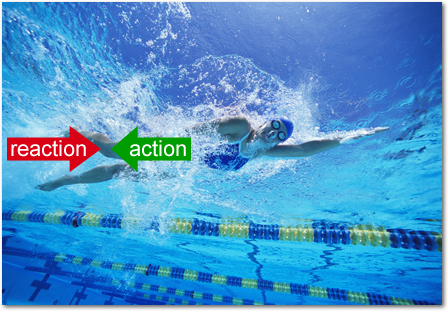
But if the action and reaction forces are equal and act in opposite directions, why do they not cancel each other out in a nonzero net force? The forces do not cancel each other out because they act on different objects. The swimmer’s hand pushes a force on the water, but the water pushes a force on the swimmer’s hand. The water is sent backward, while the swimmer is accelerated forward.
Required
1 point
1
Question 7
7.
Newton’s third law states that if one object exerts a force on a second object, then the second object exerts a force of__________strength in the__________
direction on the first object.
Required
1 point
1
Question 8
8.
When this runner exerts an action force on the ground, the ground exerts a reaction force. Move the arrow that shows the correct reaction force onto the diagram.
Other Answer Choices:
When two people push on a box with equal but opposite force, the equal forces cancel each other out in a nonzero net force. This means that the box does not accelerate in any direction.
When a tennis player hits a tennis ball with his racket, the ball pushes back on his racket with an equal and opposite force, but the ball accelerates away from the racket. The force of the racket and the force of the tennis ball do not cancel each other out because they are acting on different objects. The force of the racket is acting on the ball, and the force of the ball is acting on the racket. However, when the two people push on the box, the forces are acting on the same object: the box. That makes the net force on the box equal to zero.
Even though action and reaction forces have equal strength, their effects on the objects involved can be unequal. For example, when an apple falls from a tree, gravity pulls it toward the Earth. Newton’s third law states that the apple exerts an equal and opposite reaction on the Earth, so the apple also pulls the Earth toward it with the force of gravity. The Earth’s effect on the apple is easy to see, but it does not seem like the apple is pulling the Earth. Why is one effect easy to see, while the other is not?
Newton’s second law answers this question. The force on the apple is the same size as the force on the Earth. However, the mass of Earth is much greater than the mass of the apple, so Earth’s acceleration is much smaller than the apple’s acceleration.
An object can have many force pairs acting on it at once. Click the buttons in order to see how multiple force pairs work when a hockey stick hits a puck.
Required
1 point
1
Question 9
9.
When Nina jumps into the air, the Earth pulls her back down through the force of gravity. What else occurs?
Required
1 point
1
Question 10
10.
Objects can have more than two forces acting on them at a time.
The player’s foot is exerting an action force on the ball. The ball is exerting a reaction force on the player’s foot. Furthermore, the player’s foot is exerting an action force on muscles and bones in the player’s leg. The muscles and bones in the player’s leg are exerting a reaction force on the player’s foot to keep it from moving backward.
Checking for Understanding:
1. Newton’s third law states that for every action, there is an equal and opposite reaction.
2. Action and reaction forces do not cancel each other out with a nonzero net force because they act on different objects.
3. Objects often have multiple forces working on them at once.
Required
1 point
1
Question 11
11.
Inertia is __________.
1. Newton’s first law states that an object at rest will remain at rest, and an object in motion will remain in motion, unless acted upon by a nonzero net force. This is sometimes called the law of inertia.
2. Newton’s second law states that an object’s acceleration depends on its mass and on the net force acting on it.
3. Newton’s third law states that if one object exerts a force on a second object, then the second object exerts a force of equal strength in the opposite direction on the first object.
Required
1 point
1
Question 12
12.
A rocket has been launched into outer space, and it no longer experiences significant gravitational attraction from Earth. According to Newton’s first law, what will happen to this rocket?
Required
1 point
1
Question 13
13.
A 10 kg dog runs forward with a net force of 80 N. The dog's acceleration is__________m/s2.
Remember, acceleration = net force/mass.
Required
1 point
1
Question 14
14.
When a tennis racket strikes a tennis ball with a force of 120 N, what else occurs?
Required
1 point
1
Question 15
15.
An asteroid is flying through space with a velocity of 1,500 m/s. If no forces act on the asteroid, what will happen to it?
Required
1 point
1
Question 16
16.
How does an object’s mass affect its inertia?
Required
1 point
1
Question 17
17.
Abdul wants to increase the acceleration of his bike when he rides it. What can he do to accomplish that goal?
Check all that are true (choose 2)
Required
1 point
1
Question 18
18.
If Abdul pedals his 20 kg bike with a force of 100 N, what will the bike’s acceleration be? The formulas above may be helpful in finding the bike's acceleration.
Required
1 point
1
Question 19
19.
The picture above shows the force that this woman exerts on the wall as she leans against it. Which arrow below shows the force exerted by the wall?