HG U1D10 Unit 1 Test Review Aug15
star
star
star
star
star
Posljednje ažuriranje about 1 year ago
20
1
1
1
1
1
1
1
1
1
1
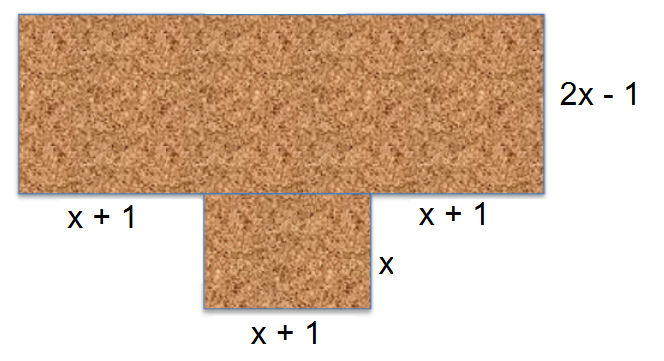
Use the figure below to write a simplified polynomial expression for the perimeter and area.
Perimeter
Write a polynomial expression in standard form to represent the perimeter.
Perimeter =
Lead Coefficient
The lead coefficient of the perimeter is
Degree
The degree of the perimeter is
Area
Write a polynomial expression in standard form to represent the area.
Area =
Degree
The degree of the area is
Constant
The constant of the area is
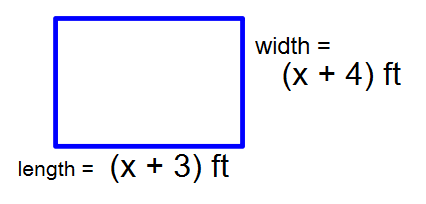
The rectangle below is stretched. The lengths are increased by 2 feet and the widths are decreased by 2 feet.
New Area
Write a polynomial expression in standard form to represent the new area.
New Area =
Did the area increase, decrease or stay the same?
Determine whether each statement is always, sometimes, or never true.
The sum of two trinomials is always a trinomial.
Determine whether each statement is always, sometimes, or never true.
Any 3rd degree polynomial always has four terms.
Determine whether each statement is always, sometimes, or never true.
A polynomial of degree 3 is added to a polynomial of degree 5. The sum would have a degree of 4.
Solve for x.
44x - 7 = 31 + 6
x =
Solve for x.
14x + 18 = 40 - 8x
x =
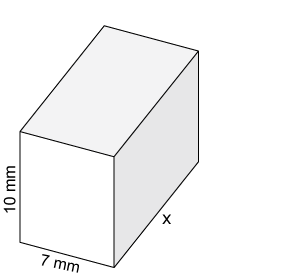
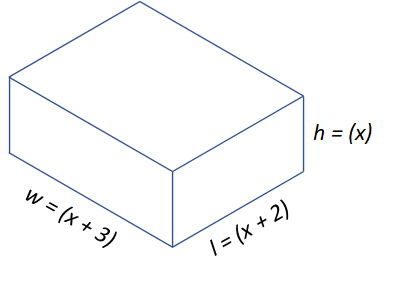
Write a polynomial expression in standard form to represent the volume of the box.
Volume =
The degree of the volume is
The volume has
Write a polynomial expression in standard form to represent the volume of the box.
Volume =
The degree of the volume is
The volume has
Find the sum.
(2x2 + 3x + 2) + (3x2 - 5x -1) =
What's the difference?
(3x2 - 5x - 1) - (2x2 - 3x - 2) =
Products!
a. 3x(4x + 2) =
b. (x + 2)(x -1) =
c. (x + 5)(x2 - 11x + 6) =
d. (x - 3)(x + 4)2 =
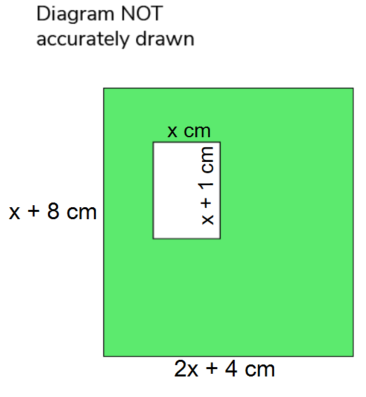
Area of the Shaded Region
Express the area of the shaded region as a polynomial is standard form.
Areashaded region =
If the area of the shaded region is 52 cm2, what is the value of x?
x =
(try graphing it)