DIY Matter Stations
star
star
star
star
star
Last updated 7 months ago
34 questions
Classifying Matter
Physical properties of matter can be observed, tested, or measured. Mass, relative density, solubility, physical state, magnetism, electrical conductivity, and thermal conductivity are physical properties.
Mass
Mass is how much matter is in an object. You can measure mass using a balance. Mass is measured in milligrams, grams, and kilograms.
Objects with more mass are heavier. For example, a boulder has more mass than a pebble. A pencil box that is full of supplies has more mass than an empty pencil box.
Relative Density
Objects with less density float better than objects with more density. Many pool toys are designed to either sink or float. You may want to lounge in the water on a pool float. The pool float is less dense than water. You may want to dive for heavy sticks that are designed to sink in water. The sticks are denser than water.
Solubility
A substance is soluble in water if it can be dissolved completely in water. When a substance dissolves, it gets smaller and smaller until it can no longer be seen. The substance is still there; you just can’t always see it.
For example, you can dissolve sugar in water. Sugar is soluble in water.
Some substances, like sand, are insoluble, meaning they do not dissolve in water.
Physical State
Matter on Earth can be found in three different physical states: solid, liquid, or gas.
Solids have a fixed volume and shape that does not change. Liquids keep their same volume, but their shape changes depending on its container. Gases have no fixed shape or volume.
Magnetism
Some matter, like nickel, iron, cobalt, and steel, is attracted to a magnet. Objects attracted to a magnet are magnetic and objects not attracted to a magnet are non-magnetic.
Electrical Conductivity
Electrical current flows in a circle from a power source to the object it is powering. Objects are either conductors or insulators of electricity.
Conductors allow energy to flow through. Insulators do not allow energy to flow through.
Electrical wires are often made of copper, a good conductor of electricity. Copper allows electricity to flow through easily. Electrical wires are usually coated with an insulator.
Thermal Conductivity
Thermal conductivity refers to how well matter allows heat to pass through. Like with electrical energy, matter can be a thermal conductor or a thermal insulator. Metal is a good thermal conductor. Styrofoam, air, and cotton are good insulators.
1
Which physical property of matter is measured in grams using a balance?
1
According to the text, which four types of matter are magnetic?
Select ALL that are true.
According to the text, which four types of matter are magnetic?
Select ALL that are true.
1
What do you call a material that does NOT dissolve in water?
1
Is metal an electrical conductor, thermal conductor, or both?
1
What do you call a material that floats in water?
1
What is an electrical insulator?
1
What are 3 main physical states of matter?
Select all 3 correct states of matter.
What are 3 main physical states of matter?
Select all 3 correct states of matter.
4
Watch the video above (Study Jams - Properties of Matter), then drag and drop the words in the correct place.
Matter is anything with _________ and volume.
Mass is the measure of ___________ in an object.
Volume measures how much __________ an object takes up.
In the video, the ball that sank in the water was the ______________ .
Other Answer Choices:
golf ball
mass
matter
space
tennis ball
5
Watch the video above (Study Jams - Solids Liquids Gases), then drag and drop the words in the correct place.
The state of matter depends on how fast the ______________ in it move.
Molecules move fastest in a ________ .
Molecules in a liquid move ___________ than a gas.
Solids are hard and don’t change __________ because the molecules move very little.
Adding _________ or taking it away can change matter’s state.
Other Answer Choices:
molecules
shape
gas
faster
slower
heat
solid
9
Reflect on relative density for each object below. Decide weather each item below is more dense than water (sink) or less dense than water (float).
more dense than water (sink) | less dense than water (float) | |
|---|---|---|
penny (coin) | ||
ping pong ball | ||
rock | ||
paperclip | ||
sponge | ||
cork | ||
rubber duck | ||
regular Coca-Cola | ||
diet Coca-Cola |
7
Reflect on magnetic properties for each object below. Decide weather each item below is magnetic or non-magnetic.
magnetic | non-magnetic | |
|---|---|---|
Aluminum can | ||
penny (coin) | ||
cotton ball | ||
rock | ||
iron nail | ||
steel paperclip | ||
wooden craft stick (popsicle stick) |
3
Decide if each item or description on the left is categorized as solid, liquid, or gas.
- Fixed volume and shape
- Fixed volume with a shape that changes to fit its container
- Volume and shape can change
- solid
- liquid
- gas
1
Draw a picture showing attraction to a magnet.
1
Draw a picture showing a material's ability to dissolve.
1
Draw a picture showing a material that allows energy (electrical or thermal) to pass through it.
1
Draw a picture showing a material that stops or slows energy (electrical or thermal) to pass through it.
1
Decide if the items on the left are true for the iron nail, sugar cube, or both.
iron nail | sugar cube | both | |
|---|---|---|---|
Soluble in water | |||
Insoluble in water | |||
Conductor of electricity | |||
Electrical insulator | |||
Solid physical state | |||
Denser than water | |||
Magnetic | |||
Non-magnetic |
Explain It!
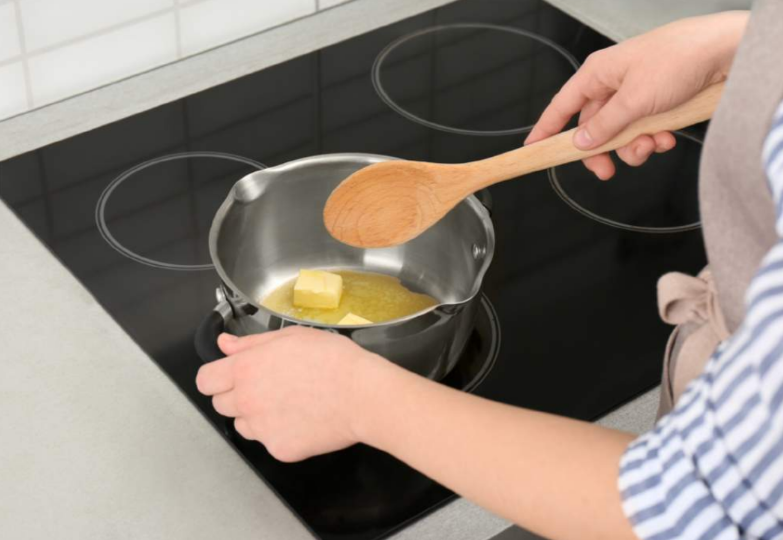
Observe the photo and read the caption.
A cook melts butter in a metal pot on an electric cooktop. She stirs the butter with a wooden spoon.
1
What physical property of metal makes it a good material for a cooking pot?
1
What physical property of wood makes it a good material for a spoon?
1
Explain why cooks use metal pans and wooden spoons.
1
Use the table in the "show your work" to decide which mystery substances are less dense than water.
1
Use the table in the "show your work" to decide which mystery substances are solid conductors.
1
Use the table in the "show your work" to decide which mystery substance could be steel, which is an electrical conductor that is solid and magnetic.
1
Use the table in the "show your work" to decide which mystery substance could be salt.
1
Use the table in the "show your work" to decide which mystery substance could be a plastic ping pong ball.
1
Use the table in the "show your work" to decide which mystery substance could be a copper block.
1
Use the video to answer the question.
What is the state of matter for a solid?
Use the video to answer the question.
What is the state of matter for a solid?
1
Use the video to answer the question.
What changes in matter when it goes from a liquid state to a gaseous state?
Use the video to answer the question.
What changes in matter when it goes from a liquid state to a gaseous state?
1
Use the video to answer the question.
How would you compare the mass of a rock and feather of the same size?
Use the video to answer the question.
How would you compare the mass of a rock and feather of the same size?
1
Use the video to answer the question.
If you freeze water, it turns into what state of matter?
Use the video to answer the question.
If you freeze water, it turns into what state of matter?
1
Use the video to answer the question.
Which properties can be used to classify a substance as a solid?
Use the video to answer the question.
Which properties can be used to classify a substance as a solid?
1
Use the video to answer the question.
Why does a helium balloon float in the air?
Use the video to answer the question.
Why does a helium balloon float in the air?
4
Categorize the items on the left as either a thermal conductor or thermal insulator.
- metal door handle
- aluminum rod
- cast iron griddle
- plastic handle
- steel pan
- cotton ball
- wooden spoon
- styrofoam
- thermal conductor
- thermal insulator
4
Categorize the items on the left as either a electrical conductor or electrical insulator.
- wooden spoon
- plastic handle
- rubber boots
- copper wire
- aluminum rod
- iron nail
- steel pan
- cotton ball
- electrical conductor
- electrical insulator