1
Why do dislocations usually take longer to heal than bone fractures?
Why do dislocations usually take longer to heal than bone fractures?
If you couldn't make it to our live session or just want to review the class content, here is the recording link from 10/1/24.
Here is a link to the google doc I shared in class with Unit 3 resources.
Past recordings:
This is the recording link for our lesson from 10/3/23.
Here is a recording link from our class on 1/9/24.
Here is a link to the recording for our class session last year that reviewed the material in this assignment.
You can use the recordings to help you if you need assistance answering any of the questions from this assignment since we go over all of the material together during class time.
Here are the slides from this unit:
Which bone helps produce and repair blood cells the most?
Imagine an archeologist said they found an "osseous knife" used by ancient humans. What would you expect the knife to be made of?
An embryo's skeletal system begins as:
Red blood cells are produced in your:
You're a forensic scientist who discovers a frozen body with a broken leg. The fracture is narrow, and a callus seems to have formed. What could you safely estimate about the length of time between the leg breaking and the time of death?
Your friend is experiencing pain in their sternum. Where would you look for damage?
Why do dislocations usually take longer to heal than bone fractures?
Scenario
You are a radiologist for ISWA Medical Center and it is a busy day!
Patients are waiting for you to view their x-rays. Analyze each patient x-ray and answer the questions connected to the image. Remember, interpreting x-rays is not simple and you will only get better with practice, so don’t get frustrated!
Use the following steps when analyzing x-rays:
1. Where am I? Start by identifying the part of the skeleton you are viewing and the bones involved.
2. Compare it to the normal or opposite side. If you are unfamiliar with normal skeletal anatomy, use normal x-rays for comparison. A normal x-ray has been provided for each patient as comparison. Remember that every individual is different, so x-rays of the same area from two different people will not look identical.
3. Is everything aligned? Look at the joints. A dislocation will be obvious, but often a fractured bone will cause the joint to be misaligned. Check to see if the joint is uneven, narrowed, or widened.
4. Check the outer cortex. Systematically look over the whiter outer cortex (edges) of each bone. Is there an obvious misalignment of the outer cortex, slightly darker areas, a difference in bone texture, or portions of the bone missing? Even if a fracture is present in the inner medulla, it will normally start at the outer cortex.
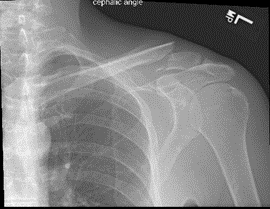
Patient 1: 52 y/o female experiencing severe shoulder pain after being slammed into the sand by a wave, learning how to boogie board while on vacation
What bone appears fractured?
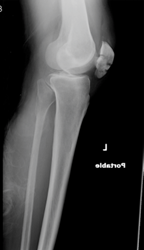
Patient 2: 38 y/o male experiencing knee pain after slipping on ice and hitting his knee on a rock
What four (4) bones are visible in the x-ray radiograph?
What type of injury likely occured in this patient?
Identify a disease or disorder that is associated with the SKELETAL SYSTEM and learn about it online, in a magazine, newspaper, etc. Complete the questions below to share with me what you’ve learned.
You can copy/paste the questions below into your response and then type your answer after the question. This makes it easier for me to grade your work.
A. What is the name of the disorder your researched:
B. What causes this disorder?
C. What are the signs and symptoms of someone experiencing this condition? (How would you know if you have it?)
D. What is the treatment or management for this condition?
E. How many people in the US are affected by this condition?
F. What other interesting facts about this condition did you learn in your research?
How did you like learning about the skeletal system?
Let me know if you need help with any assignments from this unit or would like to be invited to a small group class session.
Is the fractured bone part of the axial or appendicular skeleton?
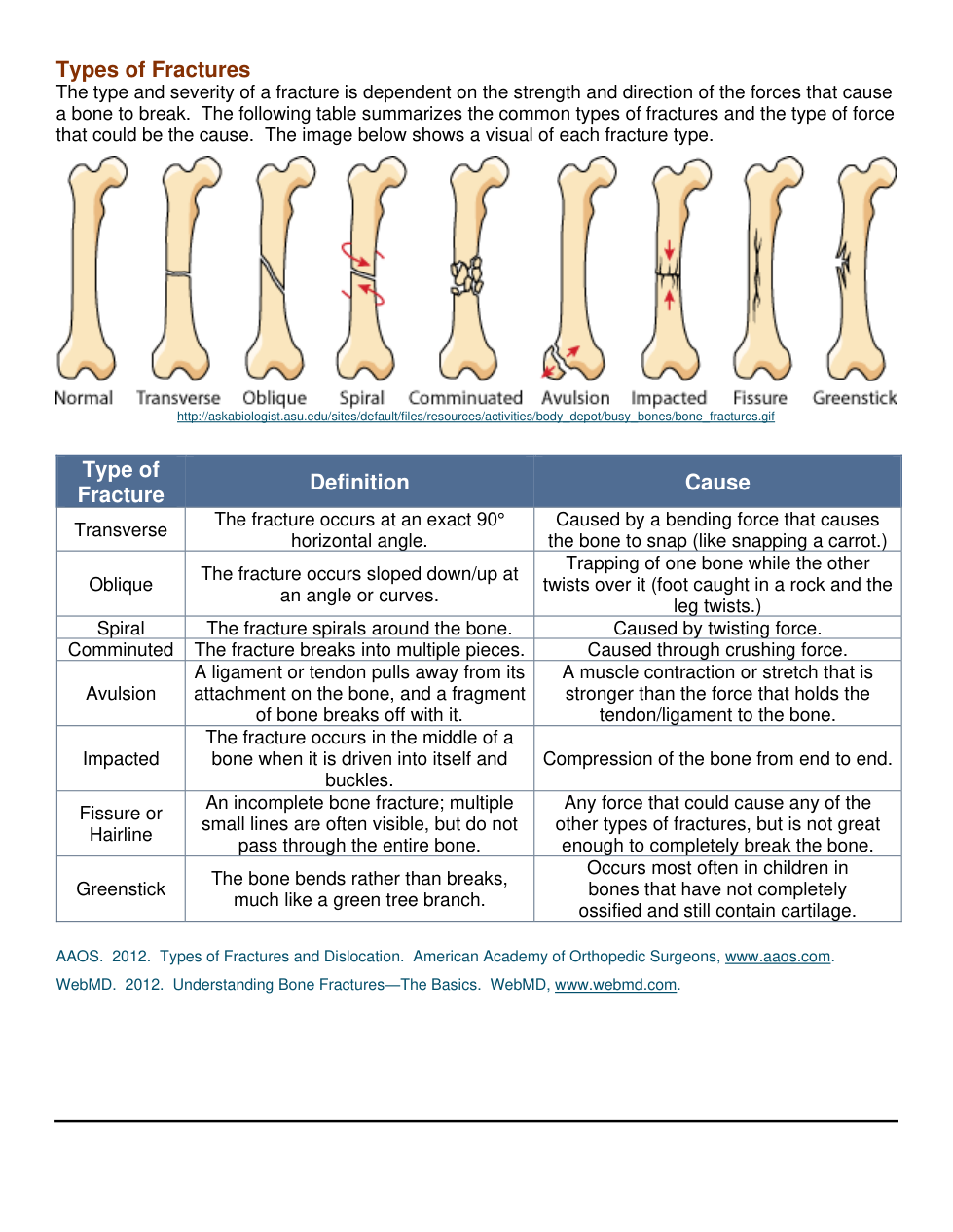
What type of fracture do you see?
Use the table above to help.