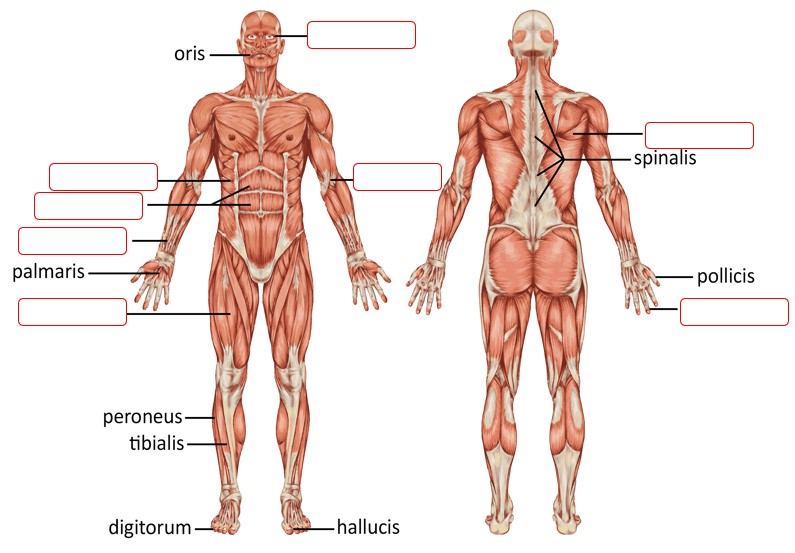
Drag the terms to complete the diagram showing labels of the region names.
Mmuae Afoforo a Wobɛpaw:
Oculi
Costals
Brachii
Femoris
Carpi
Scapularis
Abdominus
Digitorum
Explain the structure and function of muscles and muscle tissue
Describe the sliding filament theory
Interpret the names of various muscles based on Latin terms
Examine the types of movement muscles can achieve
Select all of the functions of the muscular system. (there are 4 correct choices)
There are three characteristics to match with each of the types of muscle.
Some of the characteristics are used more than once but each category will only have 3 correct answers.
Voluntary
Involuntary
Striations
No striations
Makes up the structure of the heart
Found in digestive system, blood vessels, etc.
Found attached to bones
Cardiac muscle
Skeletal muscle
Smooth muscle
What is a motor neuron.
What is the function of the enzyme acetylcholinesterase?
What is a sarcomere?
Match the muscle name terms related to size with their correct description
| Draggable item | arrow_right_alt | Corresponding Item |
|---|---|---|
Maximus | arrow_right_alt | Large |
Longus | arrow_right_alt | Largest |
Major | arrow_right_alt | Mid size |
Vastus | arrow_right_alt | Smallest |
Brevis | arrow_right_alt | Long |
Latissimus | arrow_right_alt | Short |
Minimus | arrow_right_alt | Very wide |
Medius | arrow_right_alt | Huge |
Drag the terms to complete the diagram showing labels of the region names.
The deltoid muscle is shaped like a trapazoid.
Match the name of each muscle below with its location.
Use the information we learned about muscle naming based on shape and region terms.
You can go back to the recording (linked at top of this assignment) or class slides (found in class announcements) to help you with this question.
| Draggable item | arrow_right_alt | Corresponding Item |
|---|---|---|
Intercostals | arrow_right_alt | Thigh, runs parallel along the midline |
Tibialis anterior | arrow_right_alt | In the arm, has two points of origin |
Biceps brachii | arrow_right_alt | Wide muscle located in the back |
Rectus femoris | arrow_right_alt | Front of the leg |
Latissimus dorsi | arrow_right_alt | In between the ribs |
A muscle origin is attached to the fixed bone; the insertion of the muscle is attached to the bone that will move.
Wow, that was a lot of new information!
What do you think about the muscular system so far?
Do you prefer learning about the micro side of things, like how the molecules work together in a sarcomere?
Do you prefer the macro side of things, like the parts we can see without a microscope, such as designing exercises to target specific muscles?