Log in
Sign up for FREE
arrow_back
Library

World War I Test

star
star
star
star
star
Last updated 4 months ago
31 questions
Required
22
Required
2
Required
2
Required
2
Required
2
Required
2
Required
2
Required
2
Required
2
Required
2
Required
2
Required
2
Required
2
Required
2
Required
2
Required
2
Required
2
Required
2
Required
2
Required
2
Required
2
Required
2
Required
2
Required
2
Required
2
Required
2
Required
2
Required
2
Required
2
Required
2
Required
20
Question 1
1.
Draggable itemarrow_right_altCorresponding Item
arrow_right_alt
arrow_right_alt
arrow_right_alt
arrow_right_alt
arrow_right_alt
arrow_right_alt
arrow_right_alt
arrow_right_alt
arrow_right_alt
arrow_right_alt
arrow_right_alt
arrow_right_alt
arrow_right_alt
arrow_right_alt
arrow_right_alt
arrow_right_alt
Question 2
2.

Question 3
3.

Question 4
4.

Question 5
5.

Question 6
6.

Question 7
7.

Question 8
8.

Question 9
9.

Question 10
10.

Question 11
11.

Question 12
12.

Question 13
13.

Question 14
14.

Question 15
15.

Question 16
16.

Question 17
17.

Question 18
18.

Question 19
19.

Question 20
20.

Question 21
21.

Question 22
22.

Question 23
23.

Question 24
24.

Question 25
25.

Question 26
26.

Question 27
27.

Question 28
28.

Question 29
29.

Question 30
30.

Question 31
31.

Choose TWO of the questions below to answer in complete and coherent sentences:
  1. Briefly describe how trench warfare influenced the direction of technological advancement in Europe.
  2. Explain how the role of women changed during the course of World War I.
  3. Explain why many historians view the Treaty of Versailles as a troublesome document that pushed Europe closer to a second major conflict.
  4. Briefly explain one of the four parts of MAIN and how it helped to cause World War I.

Russian Civil War
Term referring to Russia under communist rule
total war
Austrian heir whose assassination set off a chain of events resulting in WWI
Western front
Combat where opposing armies fight from parallel sets of fortified ditches
Archduke Franz Ferdinand
British passenger ship sunk by a German U-boat in 1915, angering the US
Treaty of Versailles
Legal right of a people to form their own country and government
Armenian Genocide
War policy of firing on all ships, military and civilian, without warning
unrestricted submarine warfare
Theater of WWI stretching along the French and German border from the Atlantic to the Alps
Fourteen Points
Systematic deportation and execution of Armenians by the Ottoman government during WWI
Soviet Union
Woodrow Wilson's idealistic plan for peace following WWI
R.M.S. Lusitania
Russian term for a radical socialist
League of Nations
New weapon innovated prior to WWI that could fire hundreds of bullets per minute
machine guns
War policy that targets civilians and the economy like soldiers, involving the entire country in the war effort
trench warfare
Peace that formally ended WWI; heavily punished Germany for its role in the conflict
Bolshevik
Conflict between the communist Reds and anti-communist Whites immediately following the October Revolution
self-determination
New weapons innovated during WWI that used poison gases to kill or injure
chemical weapons
International association created after WWI designed to prevent future global conflicts
Which statement best explains why the Bolsheviks revolted in 1917 and overthrew Russia's provisional democratic government?
The provisional government had dropped out of World War I.
The provisional government continued to fight in World War I.
The provisional government had been set up by the Germans.
The provisional government was on track to reinstate the tsar.
What effect of World War I is shown in this image?
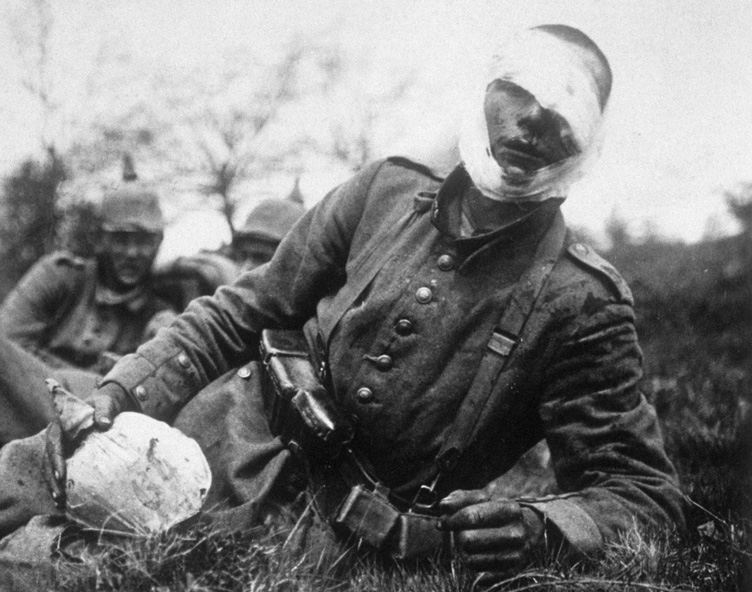
environmental pollution
casualties
financial costs
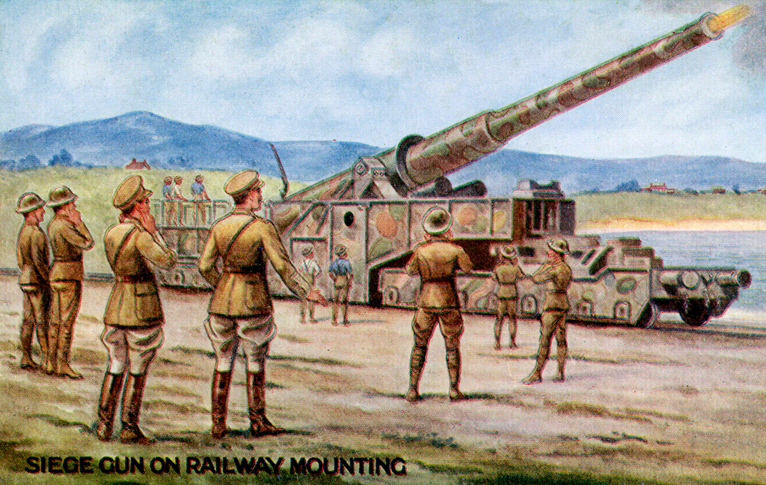
The military technology shown in this illustration was important during World War I because it allowed...

troops to quickly advance and smash through trenches
troops to attack targets up to and beyond 10 miles away
soldiers to target submarines at sea
gunners to mow down waves of advancing soldiers
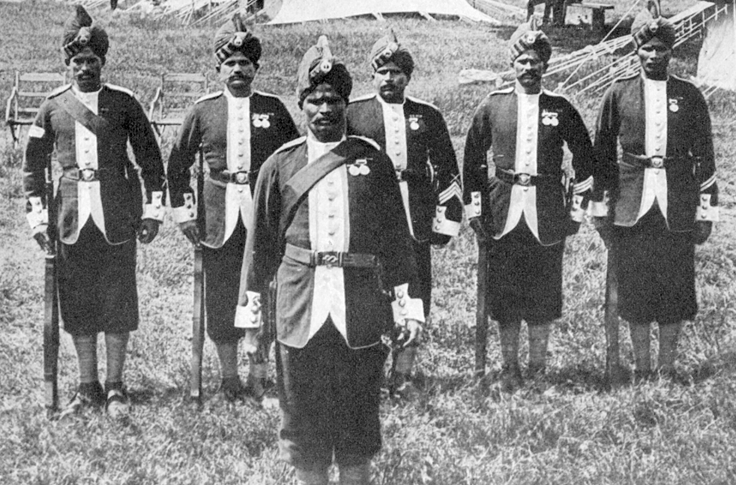
Many foreign soldiers like these shown below chose to fight in World War I in the hopes of achieving...

territory from the Ottoman Empire
autonomy or independence from a colonial power
knowledge about new military technology
voting rights
Which statement describes a feature of “war communism” in Russia?
Peasants were forced to deliver their crops to feed the army and people in the cities.
Some private ownership of banks, mines, factories, and railroads was restored.
The interests of the states were made subservient to the rights of individuals.
Aristocrats and landowners were drafted into the military or forced to work in factories.
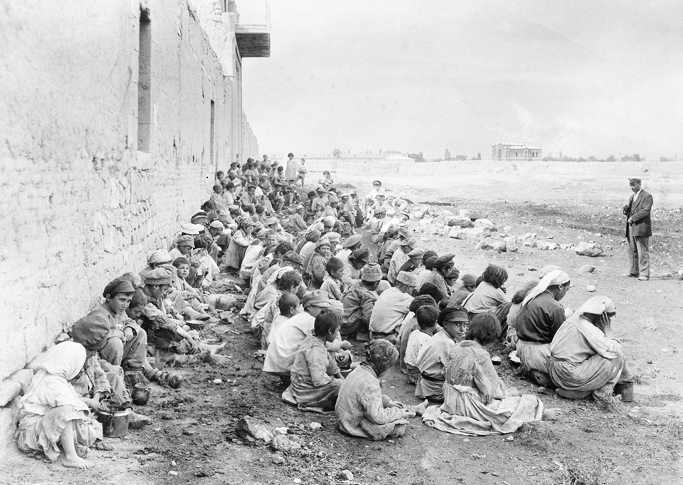
The Armenian refugees shown in the picture here were fleeing from...

Arab revolts in the Ottoman Empire
genocide by the Ottoman government
conscription by Austria-Hungary
advancing Russian troops
Which statement best describes why many historians view the Treaty of Versailles as disasterous?
It focused too much on punishing the Central Powers, fostering deep-seated resentment.
It allowed the Bolsheviks to overthrow the Russian monarchy.
It made Europe too economically reliant on the United States.
It focused too little on punishing the Central Powers, allowing them to restart pre-war militarism.
What happened right after the sinking of the British ship Lusitania by a German U-boat?
Woodrow Wilson threatened to cut diplomatic ties if unrestricted submarine warfare continued.
Britain put in place a naval blockade of German ports.
Russia signed the Treaty of Brest-Litovsk, leaving World War I.
Germany continued unrestricted submarine warfare against the Allies.
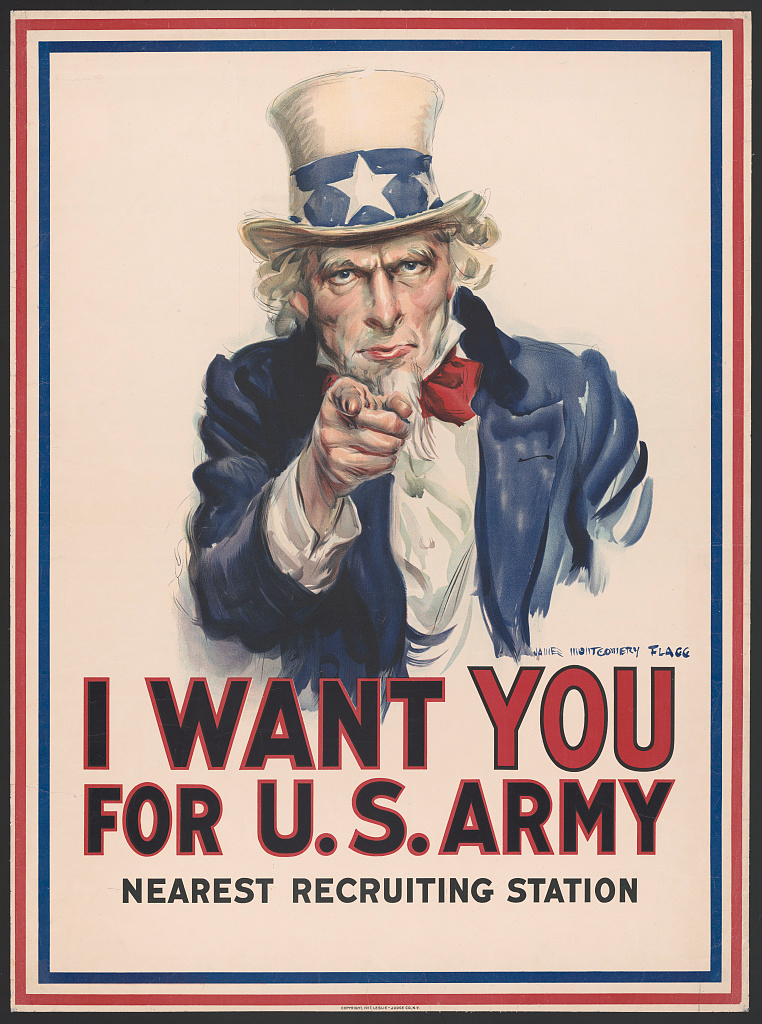
Why were posters like this a core part of the US war effort?

The US never used a military draft during the war.
The US needed more financial support from civilians.
The US had suffered massive casualties in the 1914-1915 offensives.
The US entered the war late and had little time to mobilize an army.
Which statement best describes Lenin’s contribution to the creation of the Soviet Union?
He led the Red Army to victory in the Russian Civil War.
He led the provisional government in the transition towards communism.
He masterminded the overthrow of the tsar.
He provided the new country with political and ideological leadership.
Which statement best expresses why military technologies like tanks, chemical weapons, and aircraft were innovated during World War I?
Casualties rates were very low, so new weapons were needed to achieve victory.
Each were attempts to end the stalemate created by trench warfare.
These technologies allowed for attacking civilians rather than soldiers.
Which of the following reasons best describes why Britain entered World War I?
Britain had pledged to defend Belgian neutrality.
Britain was directly attacked by Germany.
Britain was an outspoken supporter of pan-Slavism.
Britain was bound to honor its alliance with France.
“We shall now occupy ourselves in Russia in building up a proletarian socialist state.”
— Vladimir Lenin

Which measure did Lenin adopt in trying to achieve the promise made in this statement?
He introduced a multi-party democratic system of government.
He supported private ownership of major industries.
He ended private ownership of land and distributed it to peasants.
He withdrew Russia from World War I.
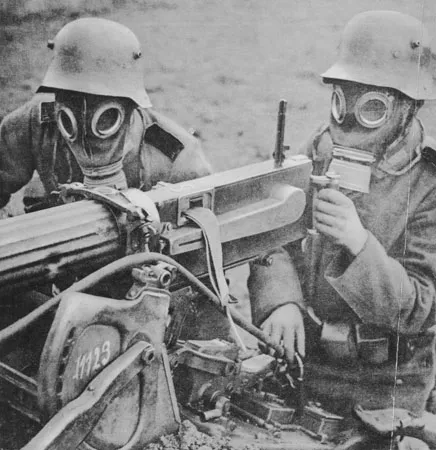
Use of the masks on the soldiers seen below was a direct response to the invention of...

tanks
chemical weapons
machine guns
long-range artillery
The British naval blockade of the North Sea contributed to...
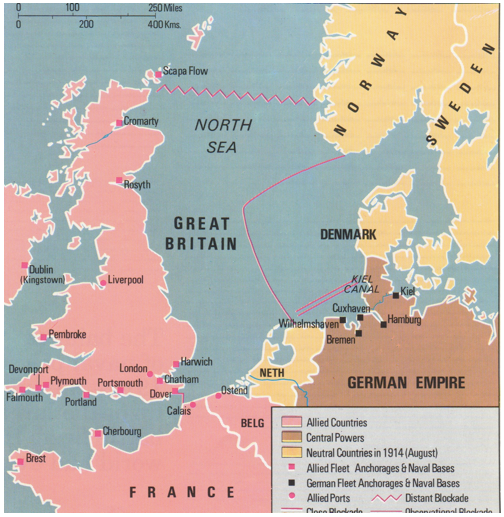
Germany's decision to abandon unrestricted submarine warfare.
the outbreak of the Russian Revolution.
food shortages in Germany.
declining morale among Allied troops on the western front.
Which type of military technology played the largest role in creating the long stalemate on the Western Front?
machine guns
tanks
U-boats
zeppelins
Who won the Russian Civil War?
the Mensheviks
the Whites
the Communists
the Germans
Which of the following was a political impact of World War I?
The war caused millions of people, both soldiers and civilians, to be killed.
The war caused hundreds of billions in damages.
The war caused the collapse of many governments.
The war caused a permanent gender shift in the workplace.
Which of the following is the best example of total war during World War I?
Women having to take the jobs of men who had been sent abroad.
Machine guns that caused an extremely high casualty rate on the western front.
The complex system of pre-war alliances.
U-boats attacking enemy ships in the Atlantic.
Which was a lasting effect of the Treaty of Versailles?
The Austro-Hungarian government was strengthened.
It triggered the Russian Revolution.
The United States joined the League of Nations.
It fostered extreme distrust and resentment within Germany.
The chief goal of the League of Nations was to...
end imperialism.
enforce the Treaty of Versailles.
prevent future wars.
create a unified European state.
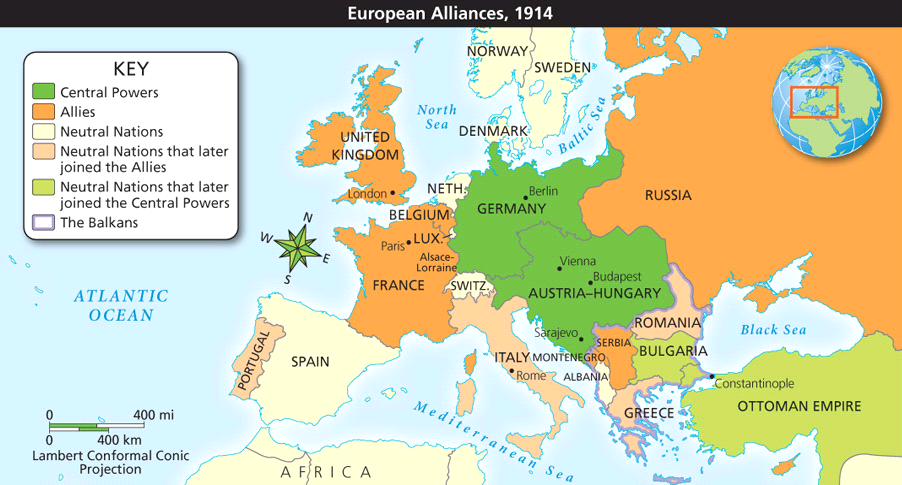
Which situation, highlighted by the map, most heavily influenced Germany's military strategy throughout most of World War I?

The alliance between France and Russia.
The neutrality of the Netherlands and Switzerland.
The alliance between Britain and France.
The absence of a German port on the Mediterranean.
“The peoples of Austria-Hungary, whose place among the nations we wish to see safeguarded and assured, should be accorded the freest opportunity of autonomous development.”
— Woodrow Wilson, The Fourteen Points

The quotation above reflects which goal of Woodrow Wilson?
self-determination
creating the League of Nations
punishing the Central Powers
ending imperialism
“There were vast stretches of mud, of fields once cultivated, but now scarred with pits . . . rusty barbed wires. The roads were rivers of clay. They were lined with dugouts, cellars, and caves.”
— Richard Harding Davis, war correspondent

This passage describes the impact of...
military aircraft
total war
chemical weapons
trench warfare
“We have no selfish ends to serve. We desire no conquest, no dominion. We seek no indemnities for ourselves, no material compensation for the sacrifices we shall freely make. We are but one of the champions of the rights of mankind. We shall be satisfied when those rights have been made as secure as the faith and the freedom of nations can make them.”
— Woodrow Wilson

Which post-war conflict amongst the Allied Powers is highlighted by these words?
Disagreements about severely punishing the Central Powers
Debates over which nations to create out of Austria-Hungary
American unwillingness to join the League of Nations
Arguments over inviting Russia to treaty negotiations
“The second bullet struck the Archduke close to the heart. He uttered only one word, ‘Sofia’— a call to his stricken wife. Then his head fell back and he collapsed. He died almost instantly.”
— Borjove Jevtic, co-conspirator

What was the reason behind the incident described in this passage?
ethnic conflict in the Ottoman Empire
extreme militarism in Germany
economic competition between France and Germany
Serbian nationalism
What is one reason for the staggering casualties that Russia suffered in World War I?
The long stalemate on the western front
The necessity of fighting a two-front war
A poorly equipped army
The ongoing civil war between the Reds and Whites
Which of the following best describes a core weakness of the League of Nations?
The League's military arm was too aggressive in peacekeeping
Germany had too powerful a role in the organization
The Treaty of Versailles disallowed international diplomacy
Major global powers refused to join
How did US entrance into World War I shift the conflict towards Allied victory?
The US deployed millions of troops, overwhelming western German lines.
It significantly boosted Allied morale, allowing troops to fend off a final German offensive.
Russia rejoined the war, again forcing Germany into a two-front conflict.
The US navy blockaded Germany's coast, cutting off supply lines.