Ɛhia
1
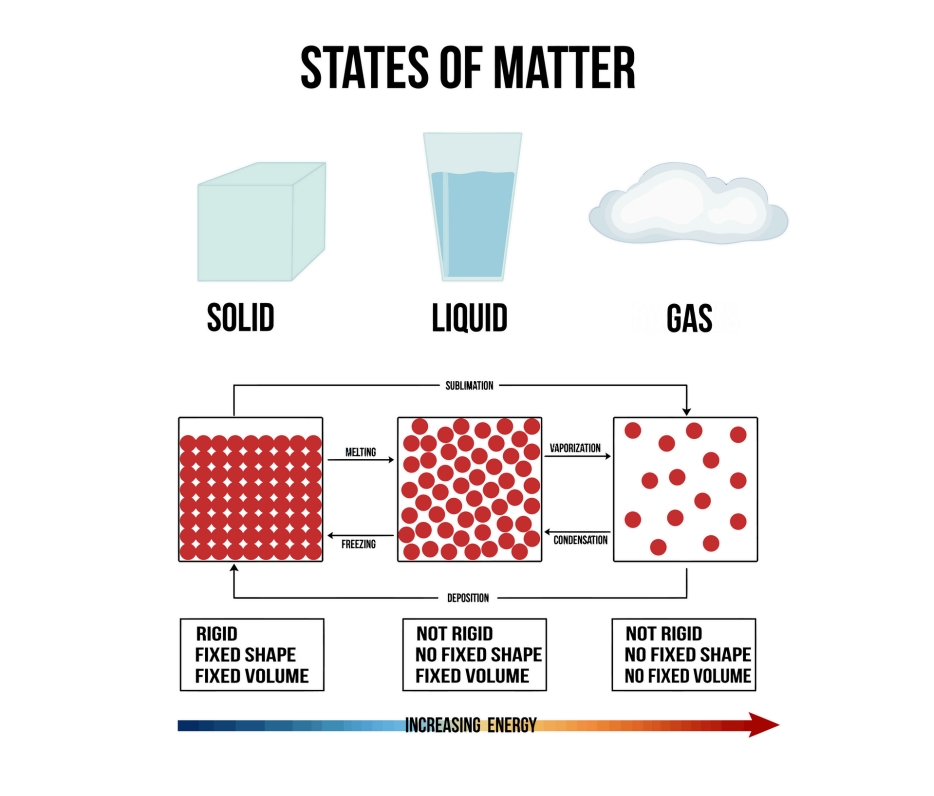
Based off of the model shown, what can you say about liquids compared to solids and gases?
Based off of the model shown, what can you say about liquids compared to solids and gases?
Ɛhia
1
Ɛhia
1
Answer the questions using your notes and the resources that we have used in class. You will only get one chance to do this. There are no "re-do's". The grade you make will not be able to be redone.
Based off of the model shown, what can you say about liquids compared to solids and gases?
What is the smallest unit of an element that maintains the properties of that element?
What is formed when two or more atoms combine?
Which particles are found in the nucleus of an atom?
Match the term to its correct definition.
| Draggable item | arrow_right_alt | Corresponding Item |
|---|---|---|
Atom | arrow_right_alt | Two or more atoms bonded together. |
Hydrogen molecule | arrow_right_alt | The smallest unit of a chemical element. |
Molecule | arrow_right_alt | Two hydrogen atoms bonded together. |
Identify the term by the featured examples.
| Draggable item | arrow_right_alt | Corresponding Item |
|---|---|---|
H2 | arrow_right_alt | Atom |
Oxygen, Hydrogen, Carbon | arrow_right_alt | Molecule |
Water (H2O), Carbon dioxide (CO2) | arrow_right_alt | Hydrogen molecule |
What are the main parts of an atom?
Where is the nucleus located in an atom?
What carries a negative charge in an atom?
Which part of an atom contains neutrons and protons?
Draw a model of an atom and its parts. Label the parts.
Draw a molecule with at least 3 atoms in it.
According to the gas model, the large space between each particle shows a greater amount of kinetic energy and a lesser amount attraction force than in a solid and liquid.
The word "rigid" means that the structure