Log in
Sign up for FREE
arrow_back
Library
States of Matter Task Cards
By NICHOLAS GLAESER
star
star
star
star
star
Share
share
Last updated 9 months ago
20 questions
Add this activity
1
5.5.A
1
5.5.A
1
5.5.A
1
5.5.A
1
5.5.A
1
5.5.A
1
5.5.A
1
5.5.A
1
5.5.A
1
5.5.A
1
5.5.A
1
5.5.A
1
5.5.A
1
5.5.A
1
5.5.A
1
5.5.A
1
5.5.A
1
5.5.A
1
5.5.A
1
5.5.A
Question 1
1.
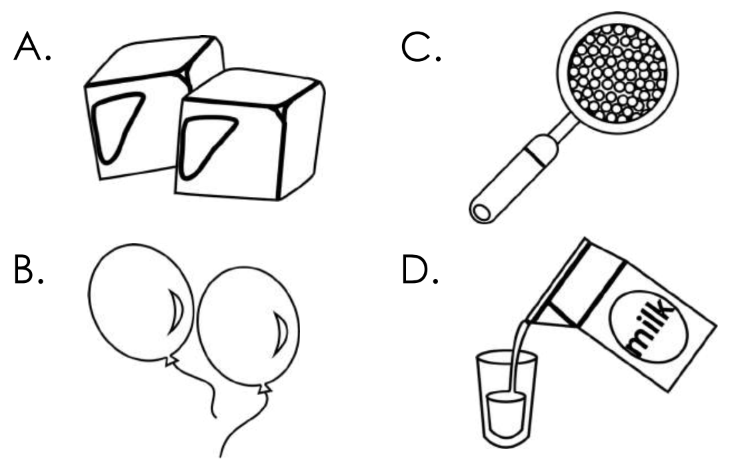
Which of the following best shows gas state of matter?
Question 2
2.
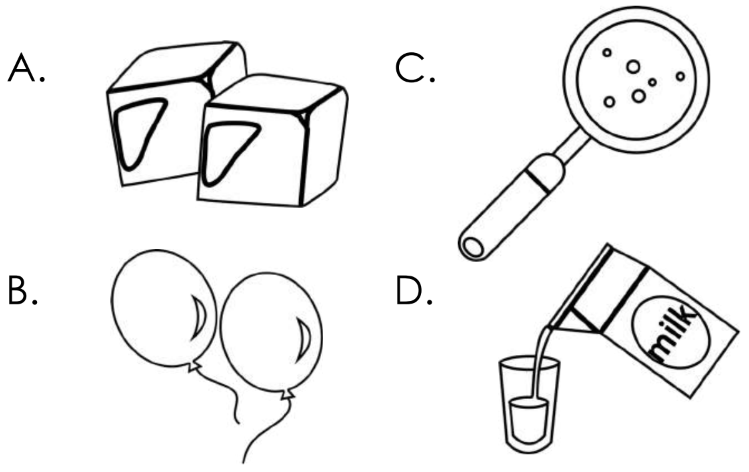
Which of the following best shows liquid state of matter?
Question 3
3.
Which of the following best shows solid state of matter?
Question 4
4.
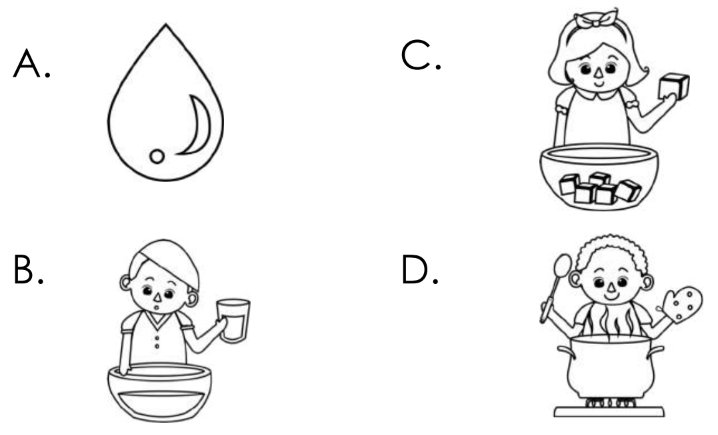
Which of the following best demonstrates evaporation?
Question 5
5.
Which of the following is an example of condensation?
When water in a puddle turns into water vapor
When water vapor turns into a cloud
When water turns into a solid
What water in a pot on a stove begins to boil
Question 6
6.
Which of the following is a description of a solid substance?
Substance A has a definite shape and definite volume.
Substance B takes the shape of its container and has a definite volume.
Substance C takes the shape of its container and does not have definite volume.
Substance D does not exist.
Question 7
7.
Which state of matter has no definite shape or volume?
Solid
Liquid
Gas
All the above
Question 8
8.
What is happening when ice cream is changing from a solid to a liquid?
Evaporation
Condensation
Freezing
Melting
Question 9
9.
What is a particle?
The form in which matter exists.
Anything that takes up space and has mass.
The amount of space matter takes up.
A small portion of matter.
Question 10
10.
What is a physical state?
The form in which matter exists.
Anything that takes up space and has mass.
The amount of space matter takes up.
A small portion of matter.
Question 11
11.
What is volume?
The form in which matter exists.
Anything that takes up space and has mass.
The amount of space matter takes up.
A small portion of matter.
Question 12
12.
What is matter?
The form in which matter exists.
Anything that takes up space and has mass.
The amount of space matter takes up.
A small portion of matter.
Question 13
13.
What do liquids and solids have in common?
They both have a definitive shape.
They both have a definitive volume.
Both their particles move at about the same speed.
They both have definitive density.
Question 14
14.
What do evaporation and melting have in common?
In both, particles start to move slower.
In both, particle motion does not change.
In both, particles start to move faster.
In both, particles stop moving.
Question 15
15.
Which of the following states of matter involves little to no particle motion?
Solid
Liquid
Gas
All the above
Question 16
16.
Which of the following processes is a change from a gas to a liquid?
Freezing
Condensation
Ice
Evaporation
Question 17
17.
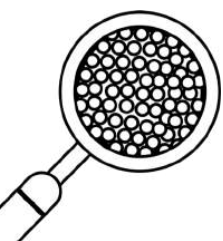
Which state of matter is represented by the particles in this image?
Solid
Liquid
Gas
All the above
Question 18
18.
Which state of matter is represented by the particles in this image?
Solid
Liquid
Gas
All the above
Question 19
19.
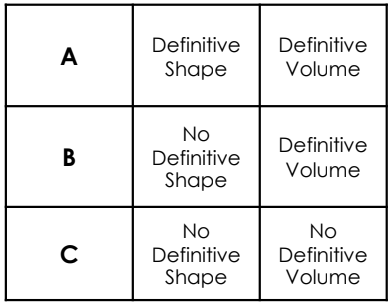
Which of the following terms belongs in box A?
Solid
Liquid
Gas
All the above
visibility
View drawing
Question 20
20.
Which of the following terms belongs in box B?
Solid
Liquid
Gas
All the above
visibility
View drawing