Log in
Sign up for FREE
arrow_back
Library

Lab: Penny Density

star
star
star
star
star
Last updated 22 days ago
11 questions
Required
2
Required
1
Required
1
Required
1
Required
1
Required
1
Required
1
Required
2
Required
1
Required
1
Required
2
Background information:

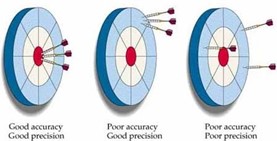
In the laboratory, accuracy refers to how close a measured value is to an accepted value. Precisionrefers to how close a series of measurements are to one another. In the example below, hitting the center target is accurate (accepted goal/value).

In an experiment, the independent variableis the variable that you change. The data collected or value that changes in response to a change in the independent variable is called the dependent variable. It is valuable to have a control, a standard for comparison, in experiments.

Physical properties can be measured without changing a substance’s chemical identity or composition. Extensive properties are physical properties that depend on the amount of matter being measured, example length. Intensive properties are physical properties that are independent of amount, they can be measured without changing a substance’s chemical identity, such as color.
Procedure:

1) Find the combined mass of 5 pennies minted prior to 1982. Record your mass in data table.

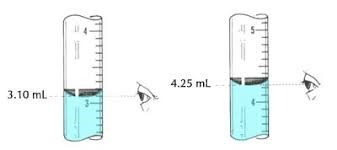
2) Record a volume of water in a plastic 100 mL graduated cylinder. The starting volume is not important, but must be recorded accurately, using significant figures (remember: record all digits the tool shows plus one estimated digit). Make sure to read the bottom of the meniscus at eye level. Record initial volume in data table.

3) Drop the pennies one-by-one into the graduated cylinder. Be careful not to splash water on the interior edges of the graduated cylinder. Record the final volume.

4) Subtract the initial volume from the volume after the pennies were added to find the volume of the pennies.

5) Calculate the density of the pennies minted prior to 1982.

6) Repeat steps 1-5 using 5 pennies minted after 1982.
Question 1
1.

Fill out the (2) Data Tables posted OR upload a picture of your data table. Show Density calculations below the tables and make sure to use correct significant digits.

Question 2
2.

Compare the densities of pennies minted prior to 1982 and pennies minted after 1982.

Question 3
3.

What was your independent variable? Refer to background information.

Question 4
4.

What was your dependent variable? Refer to background information.

Question 5
5.

What was your control? Refer to background information.

Question 6
6.

What were some intensive properties in the lab? Refer to background information.

Question 7
7.

What were some extensive properties in the lab? Refer to background information.

Question 8
8.

According to the US Mint, pennies minted before 1982 are made of copper. Copper has a density of 8.96 g/mL. Compare the density you calculated for pennies minted before 1982 to the accepted value. What was the percent error? The equation to calculate percent error is below. Show your work below and make sure to use correct significant digits.

Question 9
9.

Discuss how you could verify that your data is accurate? Refer to background information.

Question 10
10.

How could you verify that your data has high precision? Refer to background information.

Question 11
11.

Since 1982, pennies have been made of a different metal and coated with copper plating. Using your data and the reference chart given, what metal do you predict is on the interior of pennies minted after 1982? Explain your choice.